


In the summer of 2024, the waters surrounding Okinawa Island in southern Japan absorbed a thermal punch unlike anything in the observational record. Cumulative heat stress reached approximately 18 degree-heating weeks, a metric that quantifies how long sea surface temperatures remain above the threshold at which corals begin to expel the symbiotic algae that power their metabolism. That figure, coinciding with the Fourth Global Coral Bleaching Event, produced the most severe mass bleaching episode ever documented for this subtropical island chain. Now, a team of researchers from the University of the Ryukyus has published the first integrated before-during-after assessment of what that heat did to both the seafloor communities and the fish assemblages that depend on them, and the results paint a picture of a reef system undergoing rapid, uneven transformation.
The study, led by Lucas Yutaka Kimura and Rickdane Gomez with senior author Takashi Nakamura, was designed around a rare and demanding sampling strategy. Rather than surveying the damage only after the fact, the team documented benthic and fish communities at seven sites around Okinawa Island across three time windows: before the thermal stress peaked, from March to April 2024; during the height of bleaching, in August 2024; and after the event, from January to March 2025. They stratified their surveys by depth, sampling shallow zones between 1 and 6 meters and deeper zones between 8 and 15 meters, allowing them to test whether depth acted as a buffer against the heat. This temporal and vertical design is what gives the work its power, because it separates genuine bleaching impacts from the natural seasonal variation that confounds many post-hoc studies.
The headline numbers are stark. Bleaching affected 69.8 percent of coral colonies on average across the surveyed sites, and by the follow-up surveys in early 2025, hard coral cover had declined by an average of 46 percent. In practical terms, nearly half the living coral framework that structured these reefs at the start of 2024 was dead within a year. The loss was not distributed evenly. Mortality was strongly mediated by depth, with shallower communities generally suffering more, and by site-level characteristics, meaning that some locations around the island fared considerably worse than others despite experiencing broadly similar thermal exposure. That spatial heterogeneity matters for conservation planning, because it suggests local factors, possibly including water flow, turbidity, and historical stress exposure, modulate how a given reef translates heat stress into mortality.
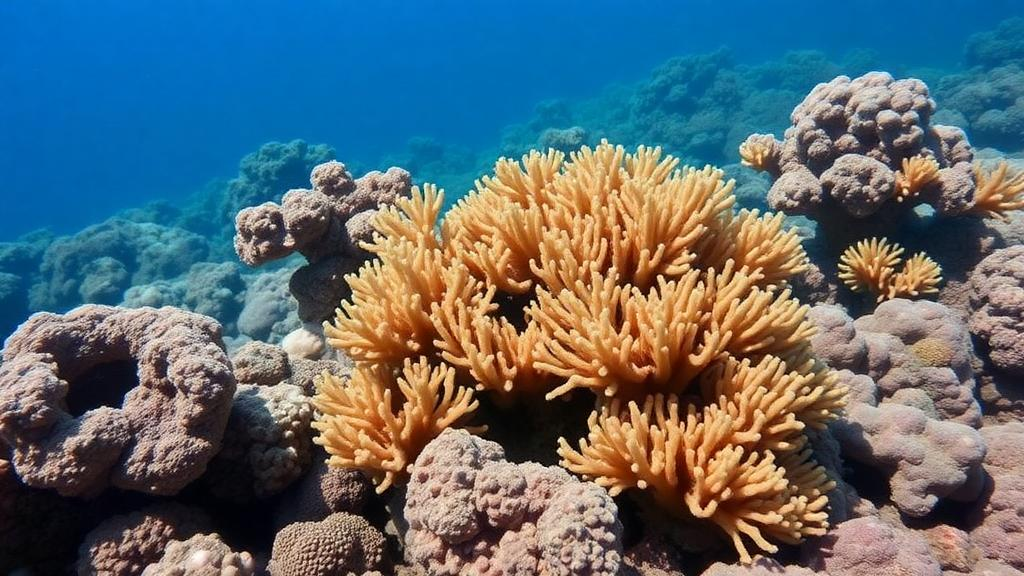
Perhaps the most scientifically intriguing finding concerns which corals died and which survived. The staghorn genus Acropora, long recognized as one of the most thermally sensitive and ecologically important reef builders in the Indo-Pacific, suffered high mortality, and its collapse drove much of the observed benthic shift. Dead Acropora skeletons were rapidly colonized by algae, converting complex three-dimensional coral architecture into flatter, algal-covered substrate. Yet in a twist that complicates the conventional wisdom, genera previously flagged as thermally vulnerable, including Pocillopora and Montipora, showed unexpected resistance to bleaching during this event. The authors suggest this apparent reversal may reflect prior selection: corals that survived repeated bleaching events in recent decades may represent hardier genotypes or host more heat-tolerant symbiont communities. Such survivorship effects have been documented elsewhere, but seeing them play out at this severity in a subtropical system underscores how quickly selective pressure can reshape a reef’s taxonomic composition.
The benthic consequences extend beyond coral cover itself. When branching corals die and algae proliferate on their skeletons, the reef undergoes what ecologists call a phase shift, a persistent reorganization of the community toward an alternative stable state dominated by fleshy or turf algae. The Okinawa surveys documented exactly this dynamic, with algal proliferation on dead coral skeletons identified as a key driver of the observed benthic changes. Phase shifts are notoriously difficult to reverse because algae suppress coral larval settlement and compete for space, and herbivorous fish that graze algae can become overwhelmed when dead coral area expands faster than grazing capacity can respond. Whether Okinawa’s reefs rebound or lock into an algal-dominated state will depend on herbivore abundance, future heat events, and local management of coastal development and water quality.
Against this dramatic benthic upheaval, the fish communities told a strikingly different story, at least in the near term. Fish species richness and Shannon diversity, a standard index combining species count and evenness, remained statistically stable through the bleaching event and its aftermath. This resilience is consistent with a growing body of evidence, including a 2024 meta-analysis, showing that many reef fishes are only weakly coupled to live coral cover and can persist on structurally complex reefs even after coral death, so long as the physical framework has not yet eroded. The dead Acropora skeletons on Okinawa’s reefs still provide shelter, and mobile fish can also move among sites, buffering population-level responses that individual colonies cannot escape.
But stability in aggregate concealed vulnerability in specific functional groups. The only fish category to show a clear decline was obligate corallivores, species such as butterflyfishes that feed almost exclusively on live coral polyps, and their drop was confined to shallow reefs where coral mortality was most severe. For these specialists, the bleaching event was effectively a famine: their food source bleached, lost tissue, or died outright. Previous work has shown that corallivorous butterflyfishes can decline sharply after bleaching even when coral structure remains intact, because their decline tracks coral mortality rather than structural collapse. Meanwhile, herbivorous fishes increased, likely responding to the flush of algae growing on freshly killed coral skeletons. This divergence between functional groups illustrates why reef monitoring must track functional composition, not just total fish counts, to detect the early signatures of ecosystem degradation.
The authors are careful to frame their findings as near-term, and that qualifier carries real weight. Coral reef ecology has repeatedly shown that fish community responses to bleaching lag behind the physical event, sometimes by years. Structural erosion of dead coral frameworks, which eliminates shelter for juvenile fish and recruits, unfolds over years to decades, and the full demographic consequences of a recruitment failure during or after a bleaching year may not appear in adult counts until those missing cohorts would have matured. The stable diversity figures from Okinawa’s 2025 surveys therefore cannot be read as evidence that the fish communities escaped unscathed; they may simply be early in a longer cascade. Sustained monitoring, the researchers emphasize, will be essential to determine whether the patterns they documented persist, deepen, or reverse under continued warming.
The Okinawa study also carries broader implications for how scientists think about depth as a refuge. The idea that deeper reefs might shelter corals from heat stress, sometimes called the deep refuge hypothesis, has been challenged by studies showing that mesophotic communities can bleach too and that vertical connectivity between shallow and deep populations is often limited. The strong depth mediation of bleaching severity and mortality in this event supports the notion that deeper water offered some protection in 2024, but the authors’ site-level variation suggests that depth alone is not destiny. As marine heatwaves intensify and lengthen under climate change, subtropical reefs like Okinawa’s, which sit near the poleward edge of coral distribution and have historically experienced less frequent thermal stress, are being pushed into a regime of recurrent, severe bleaching that their communities have had little evolutionary time to accommodate. What happens next on these Japanese reefs will be a bellwether for the millions of people and industries worldwide that depend on coral reef ecosystems for food, coastline protection, and economic value.
Subject of Research: Near-term ecological impacts of the 2024 mass coral bleaching event on benthic and fish communities in Okinawa Island, Japan
Article Title: Near-term impacts of the 2024 mass coral bleaching event on benthic and fish communities in Okinawa Island, southern Japan
Article References: Kimura, L. Y., Gomez, R., & Nakamura, T. (2026). Near-term impacts of the 2024 mass coral bleaching event on benthic and fish communities in Okinawa Island, southern Japan. Coral Reefs. https://doi.org/10.1007/s00338-026-02966-0
Image Credits: AI Generated
DOI: 10.1007/s00338-026-02966-0
Keywords: coral bleaching, Okinawa, marine heatwave, coral reefs, reef fish, Acropora, benthic communities, thermal stress, corallivores, phase shift, depth refuge, climate change
Cite Scienmag News
Violet Maxwell. (September 30, 2026). Record Heat Wiped Out Nearly Half of Okinawa’s Corals in 2024, Surveys Reveal. Scienmag. https://scienmag.com/record-heat-wiped-out-nearly-half-of-okinawas-corals-in-2024-surveys-reveal/
Violet Maxwell. "Record Heat Wiped Out Nearly Half of Okinawa’s Corals in 2024, Surveys Reveal." Scienmag, 30 September 2026, https://scienmag.com/record-heat-wiped-out-nearly-half-of-okinawas-corals-in-2024-surveys-reveal/. Accessed 4 October 2026.
Violet Maxwell. "Record Heat Wiped Out Nearly Half of Okinawa’s Corals in 2024, Surveys Reveal." Scienmag. September 30, 2026. https://scienmag.com/record-heat-wiped-out-nearly-half-of-okinawas-corals-in-2024-surveys-reveal/


