


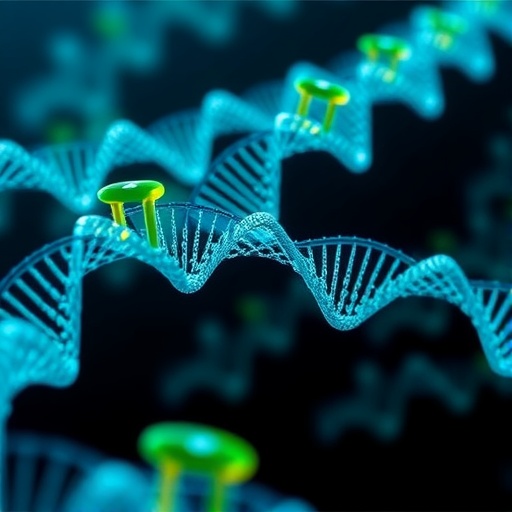
In a groundbreaking advance at the intersection of synthetic biology and nanotechnology, researchers have unveiled a highly sophisticated strategy to engineer synthetic cells capable of dynamically reshaping their membranes and selectively controlling substance transport at the nanoscale. This novel approach hinges on the creation and deployment of reconfigurable DNA nanorafts—ingeniously designed DNA origami structures that serve as programmable platforms for modulating membrane morphology in tandem with the formation of precisely gated membrane channels. The transformative potential of this technology reaches beyond established DNA nanopore systems by enabling an unprecedented, stepwise, and reversible coupling between membrane remodeling and channel gating.
At the core of this innovation lies the meticulous construction of DNA nanorafts that incorporate cholesterol moieties as membrane anchors. These cholesterol-functionalized DNA assemblies can undergo conformational transformations triggered by specific stimuli, thereby altering their spatial organization upon the lipid bilayer. Such coordinated shape shifts induce the self-assembly of nanorafts into locally ordered domains on the membrane surface, imparting mechanical forces that deform giant unilamellar vesicles (GUVs). This controlled membrane reshaping mimics aspects of natural cellular morphogenesis, presenting an elegant synthetic analog that can be manipulated with exquisite precision.
Unlike canonical DNA nanopores, which typically require pre-assembled insertion into membranes, these DNA nanorafts operate through a more integrative and reversible mechanism. Upon binding, conformational changes in the DNA origami scaffold not only dictate membrane deformation but also instigate the emergence of large synthetic channels, capable of transporting sizeable biomolecules up to approximately 70 kilodaltons. The channels’ gating dynamics are tightly coupled to vesicle morphology transitions, opening pathways for programmable permeability control that is simultaneously reversible and temporally coordinated with nanoraft conformation.
The researchers elucidate a comprehensive protocol spanning several critical stages, starting with the synthesis of the DNA nanorafts using advanced DNA origami methodologies. This involves the precise folding of single-stranded DNA into predefined architectures, followed by functionalization with cholesterol anchors to promote stable membrane association. Subsequent steps incorporate membrane-bound conformational control, where environmental or molecular signals induce the nanorafts’ shape shifts, triggering their reorganization into clustered domains that mechanically interact with the GUV membrane.
One of the protocol’s pivotal aspects is the formation and maintenance of GUVs, serving as synthetic cell models for studying the membrane remodeling phenomena. These giant unilamellar vesicles are engineered to interface with the DNA nanorafts, allowing direct visualization and characterization of morphological changes and channel formation. Membrane deformation mediated by the nanorafts is reversible, a quality harnessed to engineer synthetic channels whose opening and closing can be precisely modulated, a feature rarely achievable in existing synthetic membrane systems.
To further augment channel functionality, the nanorafts are coupled with protein nanopores, which synergistically contribute to the recovery of GUV morphology and facilitate the formation of large, gated synthetic channels. This hybrid system enables transport of macromolecular cargoes across the membrane, verified through quantitative fluorescence microscopy assays. These analyses provide rigorous, time-resolved insights into vesicle shape alterations and molecular flux, substantiating the programmable and reversible gating capability of the synthetic channels.
The integration of DNA nanotechnology and membrane biophysics embodied in this protocol offers broad implications for constructing artificial cellular systems with emergent properties previously only observed in living cells. Programmable membrane remodeling, combined with dynamic channel gating, lays a foundation for synthetic life-like compartments that can mimic cellular responses to environmental cues, potentially revolutionizing drug delivery systems, biosensing platforms, and synthetic organelle construction.
Importantly, the system’s modularity allows researchers to tailor nanoraft architecture, cholesterol density, and protein pore associations, creating a versatile toolkit adaptable to a variety of synthetic membrane environments. This flexibility is expected to accelerate innovations across molecular engineering disciplines, facilitating the design of synthetic cellular models that bridge the gap between bottom-up nanofabrication and functional biological mimicry.
The reversible nature of the gating mechanism, achieved through shape-driven domain formation and subsequent recovery, represents a paradigm shift compared to static nanopore constructs. It allows the synthetic membranes to dynamically respond to external stimuli, enhancing user control over molecular trafficking and membrane integrity in real time. This capability is critical for advancing synthetic cells toward practical applications requiring on-demand release or sequestration of biomolecules.
Moreover, the application of routine fluorescence microscopy techniques renders this protocol accessible and reproducible in laboratories equipped with standard nanobiological research tools. The approximately four-day workflow encompasses DNA origami synthesis, vesicle preparation, membrane binding assays, morphological modulation, and channel function evaluation, providing a robust framework to propel experimental studies in programmable synthetic membrane systems.
Beyond immediate synthetic biology contexts, the principles underpinning the DNA nanoraft strategy could inspire new designs in smart materials and responsive nanodevices. The fine-tuned interplay between molecular conformation and mesoscale membrane architecture suggests avenues for creating mechanically adaptive surfaces and nanopatterned interfaces with user-defined permeability and shape-changing attributes.
This innovative approach powerfully exemplifies how structurally programmable DNA nanostructures, when integrated with lipid membranes, can emulate complex biological functions and afford new mechanisms of membrane controlled transport. The reversible coupling of morphology to channel activity introduces a layer of dynamic regulation enhancing the functional complexity attainable within synthetic cells.
As synthetic biology strives toward the construction of artificial life systems with ever more sophisticated behaviors, programmable DNA nanorafts and their membrane-modulated channel function present a critical advancement. By bringing responsive and reversible membrane engineering into nanoscale synthetic compartments, this technology paves the path for next-generation bioinspired devices capable of intricate biological-like processes.
Future directions for this research include exploring stimulus-responsive triggers beyond conformational cues, expanding cargo specificity and throughput, and integrating these synthetic channels into multicompartmental or tissue-scale assemblies. Such developments could ultimately lead to synthetic cells that operate as autonomous biosensors, therapeutic delivery agents, or smart biomaterials with finely orchestrated molecular exchange profiles.
In summary, the reported protocol and its underlying concepts represent a remarkable convergence of DNA nanotechnology, membrane engineering, and synthetic cellular construction. Its potential to produce highly regulated, reversible membrane channels embedded within shape-shifting vesicles promises to transform both fundamental studies and practical applications of artificial cells.
The work, spearheaded by Ding, Fan, and Liu, sets a compelling benchmark for future efforts that seek to engineer life-like features into abiotic systems through programmable structure-function relationships at the molecular and nano scales. The marriage of programmable DNA architectures with membrane remodeling heralds a new era in synthetic cell design poised to impact multiple scientific and technological fields.
Cite Scienmag News
Ophelia Keating. (April 23, 2026). Reconfigurable DNA Nanorafts Enable Synthetic Cell Channels. Scienmag. https://scienmag.com/reconfigurable-dna-nanorafts-enable-synthetic-cell-channels/
Ophelia Keating. "Reconfigurable DNA Nanorafts Enable Synthetic Cell Channels." Scienmag, 23 April 2026, https://scienmag.com/reconfigurable-dna-nanorafts-enable-synthetic-cell-channels/. Accessed 3 September 2026.
Ophelia Keating. "Reconfigurable DNA Nanorafts Enable Synthetic Cell Channels." Scienmag. April 23, 2026. https://scienmag.com/reconfigurable-dna-nanorafts-enable-synthetic-cell-channels/


