

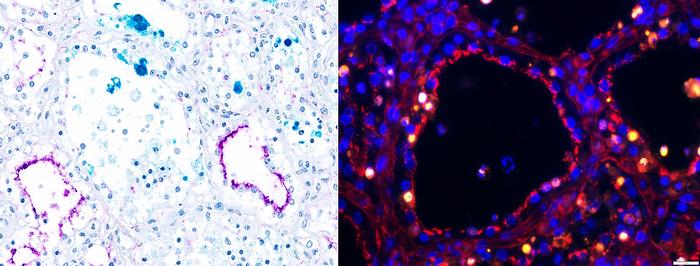
AMES, Iowa – As highly pathogenic avian influenza has spread in dairy herds across the U.S., the virus is being detected in raw milk. A new study by a broad team of researchers at Iowa State University’s College of Veterinary Medicine helps explain why.

Credit: Christopher Siepker and Tyler Harm/Iowa State University
AMES, Iowa – As highly pathogenic avian influenza has spread in dairy herds across the U.S., the virus is being detected in raw milk. A new study by a broad team of researchers at Iowa State University’s College of Veterinary Medicine helps explain why.
Sialic acid, a sugar molecule found on the surface of some animal cells, acts as a receptor for influenza. Without sialic acid providing an entry point to attach, invade and infect, a flu virus is unlikely to find a potential host hospitable.
Before the recent HPAI outbreak in dairy herds, there was scant research into sialic acid levels in the mammary glands of cattle. Scientists had no reason to suspect the milk-producing organs would be a good target for influenza.
“In livestock, we hadn’t usually looked in milk for viruses. Bacteria, sure. But not so much viruses,” said Eric Burrough, professor of veterinary diagnostic and production animal medicine.
A team of Iowa State researchers who examined mammary gland samples from two infected cows found a rich supply of sialic acid, which could shed light on how the virus attaches to hosts and help develop measures to slow the illness’ spread.
“We need to stop transmission, and one way to potentially do that is through milking machines. We’re not sure that’s involved with how this is spreading, but it’s one hypothesis,” said Todd Bell, professor of veterinary pathology.
All milk sold commercially in stores is pasteurized, and research consistently shows pasteurization neutralizes viruses such as influenza. But knowing cows are a biologically suitable home for the flu virus, particularly in their mammary glands, reiterates the dangers of consuming raw milk and raises questions about how milk from infected cows is discarded, Burrough said.
“The idea that the mammary glands are being passively infected is put to rest by this paper,” he said. “They’re pumping out tons of virus, and that’s a risk.”
While HPAI isn’t usually deadly for cows, it’s often fatal for birds. Since the start of the outbreak in the U.S., more than 97 million birds have been affected, according to the U.S. Department of Agriculture. Commercial poultry flocks where the virus is detected are typically euthanized.
The infected dairy cattle samples ISU researchers examined – both mammary glands and respiratory tissues – had receptors for flu strains that originate from birds as well as humans and pigs. The presence of both types of receptors poses added risks, as a single cell infected by avian and mammalian viruses could lead to potentially dangerous mutations, Bell said.
The study was published in the July edition of Emerging Infectious Diseases, the Centers for Disease Control and Prevention’s peer-reviewed journal. Thirteen of its 14 co-authors are from Iowa State, including researchers and faculty from across the College of Veterinary Medicine. Another article in the same edition of Emerging Infectious Diseases – with a list of co-authors that includes 10 ISU researchers – describes the initial diagnosis of HPAI in dairy, a finding made at the ISU Veterinary Diagnostic Laboratory this spring.
Speedy teamwork in the face of new public health threats is essential, said Rahul Nelli, research assistant professor of veterinary diagnostic and production animal medicine.
“Having different departments coming together to collaborate was key for this study and will be key for future investigations,” Nelli said.
Further research could involve influenza receptors in other species and organs, including a closer look at dairy cattle, Bell said. The just-published study is based on a handful of samples. Scientists’ understanding of how influenza affects cattle will improve as more data is collected and herds are regularly screened.
“Surveillance will be really important moving forward, not only through this event but in the years to come,” Burrough said.
Journal
Emerging Infectious Diseases
Method of Research
Observational study
Subject of Research
Animal tissue samples
Article Title
Sialic Acid Receptor Specificity in Mammary Gland of Dairy Cattle Infected with Highly Pathogenic Avian Influenza A(H5N1) Virus
Article Publication Date
1-Jul-2024

