


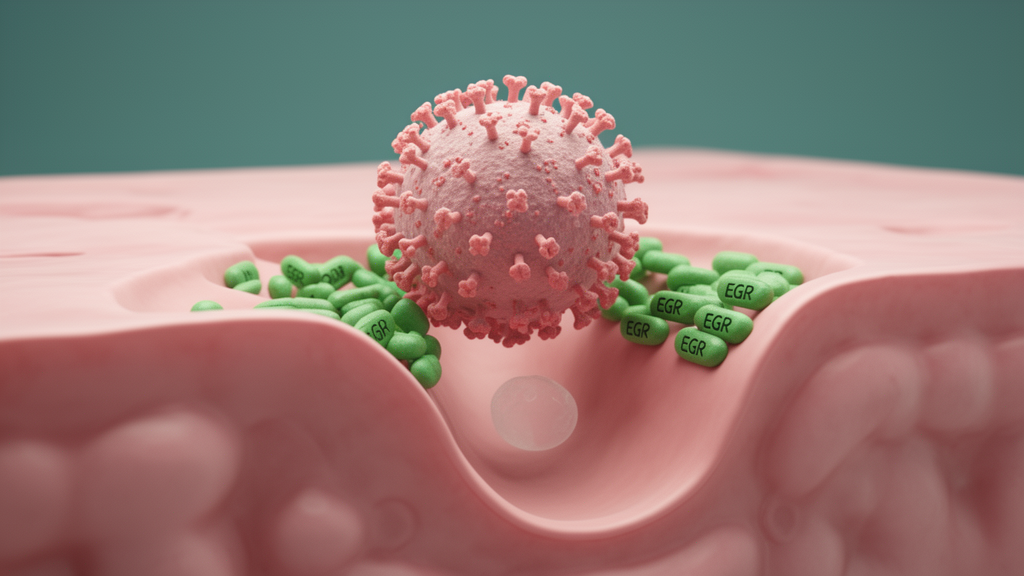
Porcine epidemic diarrhea virus (PEDV), a coronavirus that causes severe acute diarrhea, vomiting, dehydration and high mortality in suckling piglets, appears to rely on a molecular accomplice during the earliest moments of infection. In a study conducted at Henan Agricultural University and the Henan Academy of Agricultural Sciences in Zhengzhou, China, researchers identified the epidermal growth factor receptor (EGFR) as a host co-factor that promotes PEDV entry into cells. The work, published in Frontiers in Veterinary Science, addresses a specific and previously unresolved question: what role EGFR plays while the virus is physically making its way into a cell.
EGFR was not an entirely unfamiliar presence in PEDV research. Earlier studies had reported that the receptor can promote PEDV infection by modulating the JAK-STAT type I interferon axis, a key antiviral signaling pathway. What remained unclear, according to the authors, was EGFR's precise contribution during the early viral entry phase, before such immune signaling comes into play.
The new study was designed to examine that entry phase directly, separating the steps of attachment, internalization and intracellular trafficking to see where the receptor matters most. The experimental system was the Vero cell line, a standard laboratory model widely used to propagate and study coronaviruses. The team combined genetic knockout of EGFR with imaging-based colocalization analysis, allowing them to compare viral behavior in cells with and without the receptor and to track where virus particles and EGFR travel together inside the cell.
This pairing of a loss-of-function approach with spatial mapping is what made it possible to assign EGFR a role at particular steps rather than in infection as a whole. The first key finding concerns physical association. The PEDV spike protein, the surface glycoprotein coronaviruses use to dock onto and enter host cells, was found to associate with EGFR.
This link between a viral entry protein and a growth factor receptor raised the possibility that EGFR participates actively in the entry process rather than serving as a bystander, and the functional experiments that followed tested that possibility directly. Those experiments produced a clear dissociation between two stages of entry. When the researchers knocked out EGFR, viral internalization was partially impaired, meaning fewer virus particles successfully completed the transition from the cell surface into the cell interior.
Viral attachment, by contrast, remained unaffected: in EGFR-deficient cells, PEDV could still bind to the cell surface just as it did in normal cells. The defect therefore lies specifically in the internalization step, the moment when attached virions are taken up across the membrane, and the partial nature of the impairment indicates that other routes or factors can still carry some virus inside. The second strand of evidence came from following the virus after it gets in.
Colocalization analysis showed that PEDV particles colocalized with EGFR in early endosomes, late endosomes and lysosomes, the sequence of membrane-bound compartments through which incoming enveloped viruses are typically ferried from the surface toward sites further inside the cell. When EGFR was knocked out, PEDV's colocalization with late endosomes was impaired, indicating that the receptor is needed not only for uptake but also for the post-internalization trafficking that follows. Taken together, the authors conclude that EGFR supports PEDV infection by promoting viral internalization and facilitating endo-/lysosomal trafficking, a dual role at consecutive stages of the entry process.
In their view, these data extend current understanding of coronavirus entry pathways by identifying a host co-factor that acts both at the membrane and along the intracellular route, rather than at attachment alone. Several caveats frame the significance of these results. The knockout produced a partial, not complete, impairment of internalization, and the study examined entry specifically, leaving open how this entry role interacts with the receptor's previously reported effects on interferon signaling during infection.
Subject of Research: EGFR promotes PEDV internalization via spike protein association and endo−/lysosomal trafficking
Article Title: EGFR promotes PEDV internalization via spike protein association and endo−/lysosomal trafficking
Article References: Yang, S., Liu, X., Li, Y., Yu, L., Wang, Z., Wang, X., Zhao, J., Chen, L., Yang, X., Jiao, W., Xing, G., Duan, H., & Li, D. (2026). EGFR promotes PEDV internalization via spike protein association and endo−/lysosomal trafficking. Frontiers in Veterinary Science, 13, Article 1980444. https://doi.org/10.3389/fvets.2026.1980444
Image Credits: AI Generated
DOI: 10.3389/fvets.2026.1980444
Keywords: EGFR, promotes, PEDV, internalization, spike, protein, association, endo, lysosomal, trafficking, scientific research
Cite Scienmag News
Kristina Jarvis. (October 26, 2026). Receptor EGFR helps swine diarrhea virus enter cells, study finds. Scienmag. https://scienmag.com/receptor-egfr-helps-swine-diarrhea-virus-enter-cells-study-finds/
Kristina Jarvis. "Receptor EGFR helps swine diarrhea virus enter cells, study finds." Scienmag, 26 October 2026, https://scienmag.com/receptor-egfr-helps-swine-diarrhea-virus-enter-cells-study-finds/. Accessed 26 October 2026.
Kristina Jarvis. "Receptor EGFR helps swine diarrhea virus enter cells, study finds." Scienmag. October 26, 2026. https://scienmag.com/receptor-egfr-helps-swine-diarrhea-virus-enter-cells-study-finds/


