


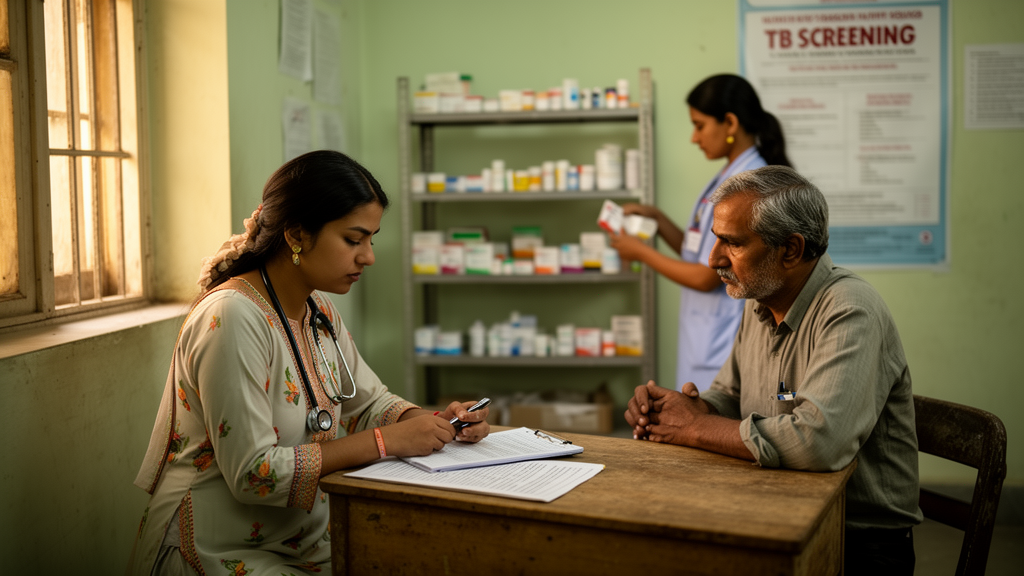
Tuberculosis remains one of Pakistan’s most stubborn public health challenges, and the country now ranks fifth among the world’s high-burden nations, with an estimated 510,000 people developing the disease each year, including a substantial proportion who develop drug-resistant forms. Yet the burden of tuberculosis in Pakistan cannot be understood through case numbers alone. Almost a quarter of people with tuberculosis in the country are diagnosed with diabetes, and another quarter are pre-diabetic. Studies in tuberculosis facilities across Peshawar have documented depression in roughly 35 percent of patients, a comorbidity linked to poor treatment outcomes, extended hospital stays, and high medical costs. Tobacco use, present in approximately 20 percent of people with tuberculosis, nearly triples the risk of both acquiring infection and progressing from latent infection to active disease, a collision of epidemics that compounds the clinical challenge.
Researchers writing in Frontiers in Tuberculosis argue that the integration of tuberculosis care with management of these comorbid conditions—diabetes, depression, and tobacco use—represents a critical pathway for improving service delivery, efficiency, and health outcomes in Pakistan. But they caution that successful integration cannot rest on clinical evidence of effectiveness alone. It requires a systematic knowledge of health facility readiness and implementation capacity, something that has been largely absent from past efforts. The authors contend that readiness assessment should be institutionalized—formally embedded within service delivery structures, routine policy, planning, and decision-making processes—as a strategic prerequisite rather than treated as a one-time, donor-funded exercise.
The evidence for this argument comes partly from Pakistan’s own programmatic history. The Programmatic Management of Drug-Resistant Tuberculosis program, a nationally coordinated initiative under the National TB Programme, initially demonstrated strong performance but plateaued, partly because it focused predominantly on easily measurable inputs such as infrastructure and service outputs while giving comparatively limited attention to care delivery processes, provider competencies, and broader dimensions of health system readiness. The absence of integrated and coordinated tuberculosis care has contributed to the emergence of multidrug-resistant tuberculosis through diagnostic delays, delayed health-seeking behaviour, inadequate treatment regimens, weak follow-up mechanisms, and limited social support. Healthcare system fragmentation has further exacerbated these challenges, with multiple vertical disease-specific programs—for tuberculosis, HIV, immunization, and non-communicable diseases—operating in parallel through separate structures with limited coordination.
Implementation science frameworks act as a bridge between evidence and practice by systematically assessing the contextual factors that influence intervention success. Readiness assessment is an evaluative process that examines current capabilities, resource availability, and potential barriers within healthcare facilities. In the context of integrated tuberculosis-comorbidity care, it identifies measurable material inputs such as staffing levels, infrastructure, and drug supply, as well as less quantifiable factors like provider competencies and people-centred practices. The authors describe this as assessing both the hardware—infrastructure and equipment—and the software of the healthcare system: provider skills, service user engagement, and cultural adaptation. This holistic evaluation informs decision-makers on whether interventions are likely to be implemented as intended and sustained over time.
Three evidence-based frameworks anchor the approach. The Consolidated Framework for Implementation Research examines contextual determinants across multiple levels, including outer setting factors such as external policy and resource allocation, inner setting elements like organisational culture and leadership engagement, intervention characteristics including complexity and adaptability, and individual attributes such as competence and motivation. The RE-AIM framework focuses on Reach, Effectiveness, Adoption, Implementation, and Maintenance, operationalising success at scale by tracking whether interventions reach all eligible individuals equitably, produce meaningful clinical improvements, are adopted by frontline providers, are delivered with fidelity, and endure beyond the pilot period without continued external support. The Exploration, Preparation, Implementation, and Sustainment framework supports planning across implementation phases, anchoring the process chronologically from surfacing unmet need and stakeholder readiness through translating evidence into context-sensitive plans and embedding services within routine care structures.
Pakistan’s own integration experiences demonstrate the value of systematic readiness assessment. A depression care integration study in Peshawar assessed three tuberculosis facilities using comprehensive checklists evaluating infrastructure, human resources, organisational policies, and linkage mechanisms. The assessment identified facility-specific gaps: the district-level facility required training of DOTS facilitators in mental health modules, the secondary care facility needed formal referral protocols with mental health services, and the tertiary care facility required patient flow adaptations to accommodate depression screening. Targeted interventions addressed these gaps before implementation, and the study achieved significant success, screening 191 of 301 people with tuberculosis for depression, with approximately 35 percent screening positive across varying severity levels, without disrupting routine tuberculosis care delivery.
Similarly, the World Diabetes Foundation’s projects in Khyber Pakhtunkhwa demonstrated large-scale integrated care through systematic facility strengthening. Twenty-five clinics underwent comprehensive readiness assessments and capacity-building, evaluating infrastructure, human resources, and organisational factors. The implementation screened 12,496 people with tuberculosis for diabetes, diagnosing 779 with the condition, while 67,213 people with diabetes were screened for tuberculosis. Forty-nine healthcare providers were trained in integrated management, and 30 awareness campaigns were conducted. Critically, the intervention influenced policy development, and bidirectional tuberculosis-diabetes screening was included in the National End TB Strategic Plan for national scale-up.
The TB and Tobacco Consortium’s multi-country implementation study across Bangladesh, Nepal, and Pakistan offers a more nuanced picture. Pakistan had the largest footprint with 59 learning sites across Khyber Pakhtunkhwa and achieved the study’s most complete institutionalization: training was rolled out to all 121 provincial facilities by 2020, the national tuberculosis patient registration form was revised to include tobacco status, and cessation was formally incorporated into the NTP strategic plan. However, Pakistan showed the study’s most significant under-identification of smokers, identifying only 43 percent of expected prevalence, driven by reluctance among patients to disclose tobacco use, gender-concordance barriers between providers and service users, and intervention materials often adapted or partially implemented in busy clinics.
The authors argue that successful tuberculosis-comorbidity integration operates across three interdependent dimensions: clinical integration, demanding adequate diagnostic capacity, trained providers, and established referral mechanisms; organisational integration, requiring supportive culture, leadership commitment, and available resources; and systems integration, depending on policy convergence, sustainable funding, and cross-programme coordination. Readiness assessment is the mechanism through which gaps across all three dimensions are identified before implementation begins. Its absence leads to poor results, resource waste, and sustainability failures, while its presence enables evidence-based intervention adaptation, targeted resource allocation, and enhanced stakeholder engagement.
Translating this evidence into actionable policy requires a realistic appraisal of Pakistan’s implementation environment. Key strengths include the existing DOTS infrastructure, documented integration achievements in pilot settings, and political goodwill towards tuberculosis elimination and Universal Health Coverage. These are counterbalanced by fragmented vertical programmes, limited staff trained in integrated care delivery, and the absence of a standardised national readiness assessment tool. The authors recommend that the National TB Control Program mandate readiness assessment as a prerequisite condition for all tuberculosis-comorbidity integration efforts, with standardized tools developed nationally and adapted to provincial contexts. They further recommend linking resource allocation directly to readiness assessment reports, embedding readiness indicators into the District Health Information Software for real-time monitoring at scale, and establishing district-level readiness working groups to carry out assessments with capacity-building support at regular intervals. By institutionalizing readiness assessment, Pakistan can avoid repeating the costly mistakes of inadequately planned interventions, protect scarce resources, and ensure that integration efforts move beyond launch toward sustained, high-fidelity delivery that improves health outcomes and advances the End TB and Universal Health Coverage goals.
Subject of Research: Health
Article Title: Readiness assessment as a strategy, not an afterthought: leveraging implementation science to integrate tuberculosis comorbidity care in Pakistan's health system
Article References: Aleem, S., Khan, Z., Khan, B. A., Zala, & Afaq, S. (2026). Readiness assessment as a strategy, not an afterthought: leveraging implementation science to integrate tuberculosis comorbidity care in Pakistan's health system. Frontiers in Tuberculosis, 4, Article 1809118. https://doi.org/10.3389/ftubr.2026.1809118
Image Credits: AI Generated
DOI: 10.3389/ftubr.2026.1809118
Keywords: tuberculosis, Pakistan, implementation science, integrated care, health systems, Readiness, assessment, strategy, afterthought, leveraging, implementation, science
Cite Scienmag News
Glenn Wilkins. (October 17, 2026). Readiness Assessment as Strategy: Implementation Science to Integrate TB Comorbidity Care in Pakistan. Scienmag. https://scienmag.com/readiness-assessment-as-strategy-implementation-science-to-integrate-tb-comorbidity-care-in-pakistan/
Glenn Wilkins. "Readiness Assessment as Strategy: Implementation Science to Integrate TB Comorbidity Care in Pakistan." Scienmag, 17 October 2026, https://scienmag.com/readiness-assessment-as-strategy-implementation-science-to-integrate-tb-comorbidity-care-in-pakistan/. Accessed 17 October 2026.
Glenn Wilkins. "Readiness Assessment as Strategy: Implementation Science to Integrate TB Comorbidity Care in Pakistan." Scienmag. October 17, 2026. https://scienmag.com/readiness-assessment-as-strategy-implementation-science-to-integrate-tb-comorbidity-care-in-pakistan/


