


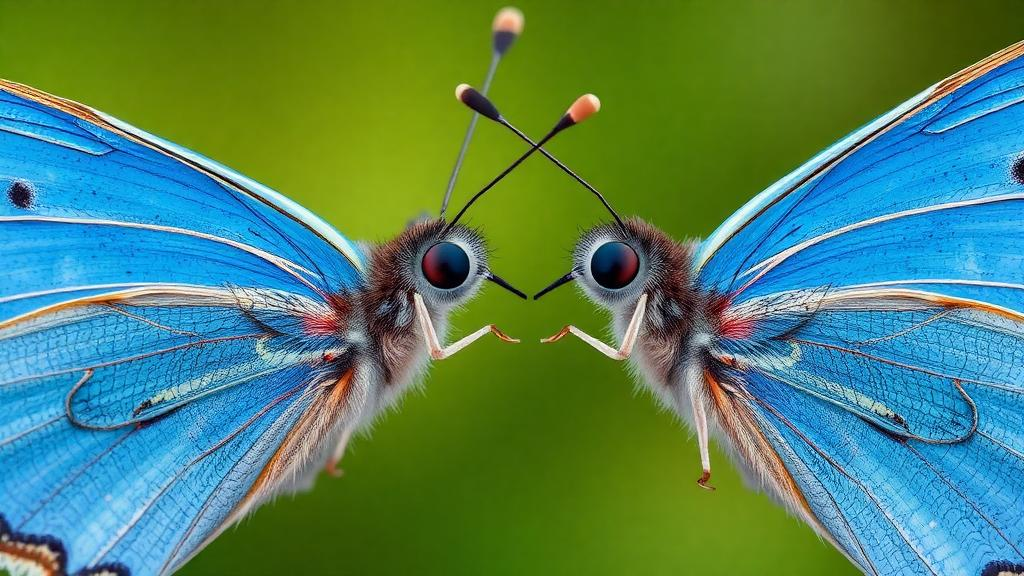
In the meadows of northern Bohemia, on a summer afternoon in July 2016, two butterflies belonging to different species were photographed locked together on a flower head of great burnet, Sanguisorba officinalis. The image, reviewed only after a field survey had ended, documents what researchers believe is the first recorded attempt at interspecies mating between Phengaris nausithous and Phengaris teleius, two closely related large blue butterflies protected under the European Union Habitats Directive. The observation, published in the journal Nota Lepidopterologica, offers a rare glimpse of a reproductive barrier failing in the wild between species that scientists have studied intensively for decades because of their extraordinary dependence on ants.
The encounter took place on 19 July 2016 at approximately 13:25 CEST near the village of Hynčice in the Protected Landscape Area of Broumovsko, in the Czech Republic, at an elevation of roughly 400 metres beside the river Stěnava. One of the authors of the study took random photographs of butterflies throughout the survey as part of routine documentation. Only during later analysis of the photo archive did the team notice that what had initially appeared to be an interesting shot of two species sharing a single inflorescence was in fact something far more unusual: the abdomen tips of a female P. nausithous and a male P. teleius were visibly connected, indicating an attempt to copulate. The researchers do not know how long the pair remained in copula, because the connection was discovered only in the photographs.
Both species belong to the genus Phengaris, a group whose members are famous for a parasitic relationship with Myrmica ants. The caterpillars of these large blues are carried into ant nests, where they are fed or feed on ant brood, a life history so complex that it has made the genus a model system for evolutionary ecology. Despite this intensive research attention, and despite the fact that P. teleius and P. nausithous frequently occur side by side at the same sites and share the same food plant across Europe, no previous record of interspecific mating or hybridization between members of this genus has ever been documented. The new observation therefore fills a surprising gap in the knowledge of one of the best-studied butterfly lineages in Europe.
The sighting was made during a systematic survey conducted from 4 July to 5 August 2016 across 13 habitat patches near the villages of Hynčice, Ruprechtice and Vižňov, all of them containing flowering great burnet, the exclusive larval food plant of both species in Europe. The survey was carried out as part of conservation monitoring obligations, since both butterflies are listed for protection under the EU Habitats Directive. The researchers used the Mark-Release-Recapture method, analysed with the program MARK 8.1 and modified according to established procedures for Phengaris, to estimate the density of the butterflies. The colonies in the area form a single metapopulation, with individuals dispersing between patches.
The population estimates reveal that the mating attempt occurred in a community where both species were well represented. Using the Cormack-Jolly-Seber method, the team calculated that the metapopulation contained approximately 802 individuals of P. teleius and 1487 individuals of P. nausithous. These figures matter for interpreting the event: the researchers considered whether unusually high densities might have caused confusion between the species, but concluded that the density at the observation site was neither higher than average nor so low that finding a conspecific partner would have been difficult. The abundance of both species at the site was, in other words, entirely ordinary, which makes the unusual behaviour harder to explain.
Interspecific mating is a rare phenomenon in butterflies generally, and it is far more commonly documented in some families than in others. Records from the wild are relatively rich for swallowtails in the genera Ornithoptera, Papilio and Troides, for whites of the genus Colias, and for nymphalids including Danaus, Erebia, Heliconius and Limenitis. The family Lycaenidae, to which Phengaris belongs, has produced only a handful of such observations. Previous lycaenid examples include matings between species of Callophrys and between species of Lycaena, as well as reports from India of copulation between Castalius rosimon and Talicada nyseus and between Chilades parrhasius and Zizina otis. For the genus Phengaris itself, the authors of the new study found no comparable record anywhere in the literature.
The vast majority of documented interspecific copulations in butterflies occur between species of the same genus, as in Limenitis, Colias, Danaus, Heliconius and the classic examples in Papilio. Rarer still are matings between different genera, and exceptional are cases spanning entire families, such as an observed union between the burnet moth Zygaena filipendulae and the tiger moth relative Amata phegea, or even between a nymphalid butterfly, Melitaea athalia, and that same moth species. Interspecific mating is a prerequisite for hybridization, yet natural hybridization in Lepidoptera remains rare. One celebrated natural hybrid is Erebia serotina, produced by males of E. pronoe and females of E. epiphron. Most known hybrids, by contrast, have been created in captivity, particularly among Papilio species, where hybrids can remain fertile for several generations.
Why would two species that normally maintain separate identities attempt to mate at all? Reproductive barriers in butterflies typically operate on several levels, combining olfactory recognition with species-specific behaviour, pheromones and other signals. However, mating pheromones often share similar chemical compositions across related species, and their content varies not only between species but also within single species. The lock-and-key mechanism of butterfly genitalia, long assumed to prevent mechanical mating between different species, does not always function reliably. Molecular studies have repeatedly shown that reproductive barriers in Lepidoptera usually hold firm, but when they fail, the willingness to mate is often strongly asymmetric between the species involved, as demonstrated by observations of male Papilio canadensis showing strong preferences for females of Papilio glaucus.
The authors of the new report propose possible explanations for the Bohemian encounter. Because species of Phengaris differ in the number of androconia, the scent-producing scales on their wings, one possibility is that individuals became confused when pheromones of both species mixed in the air, particularly if many butterflies were concentrated at the spot. Alternatively, a suitable partner of the same species might have been harder to detect if the pheromones of the two species are chemically similar. Yet the researchers note that neither explanation seems particularly convincing, given that population densities at the site were unremarkable. The true cause of the behaviour therefore remains unresolved.
The consequences of such events can range from negligible to profound. Hybridization can threaten vulnerable species when a related species colonizes or is introduced into a landscape, but it can also trigger the emergence of new species, as documented in Heliconius butterflies. In the case of the Bohemian observation, the photographic evidence confirms that the butterflies achieved a physical connection, but it remains far from certain whether the copulation was successful or whether deeper isolation mechanisms prevented any possibility of hybrid offspring. What the images do establish is that even in a genus whose ecology has been scrutinized more intensively than almost any other butterfly group, the boundaries between species can still, on rare summer afternoons, briefly dissolve.
Subject of Research: First photographic record of an attempted interspecies mating between the butterflies Phengaris nausithous and Phengaris teleius in the Czech Republic
Article Title: An attempt of interspecies mating between Phengaris nausithous and P. teleius ( Lepidoptera , Lycaenidae )
Article References: Pilařová, A., Zachardová, S., Fric, Z. F., & Vrabec, V. (2024). An attempt of interspecies mating between Phengaris nausithous and P. teleius (Lepidoptera, Lycaenidae). Nota Lepidopterologica, 47, 105-111. https://doi.org/10.3897/nl.47.118947
Image Credits: AI Generated
DOI: 10.3897/nl.47.118947
Keywords: Phengaris, Phengaris nausithous, Phengaris teleius, Lycaenidae, interspecies mating, butterflies, hybridization, reproductive barriers, Czech Republic, Sanguisorba officinalis, lepidoptera, conservation
Cite Scienmag News
Margaret Porter. (October 17, 2026). Rare interspecies mating attempt photographed between two endangered large blue butterflies. Scienmag. https://scienmag.com/rare-interspecies-mating-attempt-photographed-between-two-endangered-large-blue-butterflies/
Margaret Porter. "Rare interspecies mating attempt photographed between two endangered large blue butterflies." Scienmag, 17 October 2026, https://scienmag.com/rare-interspecies-mating-attempt-photographed-between-two-endangered-large-blue-butterflies/. Accessed 17 October 2026.
Margaret Porter. "Rare interspecies mating attempt photographed between two endangered large blue butterflies." Scienmag. October 17, 2026. https://scienmag.com/rare-interspecies-mating-attempt-photographed-between-two-endangered-large-blue-butterflies/


