


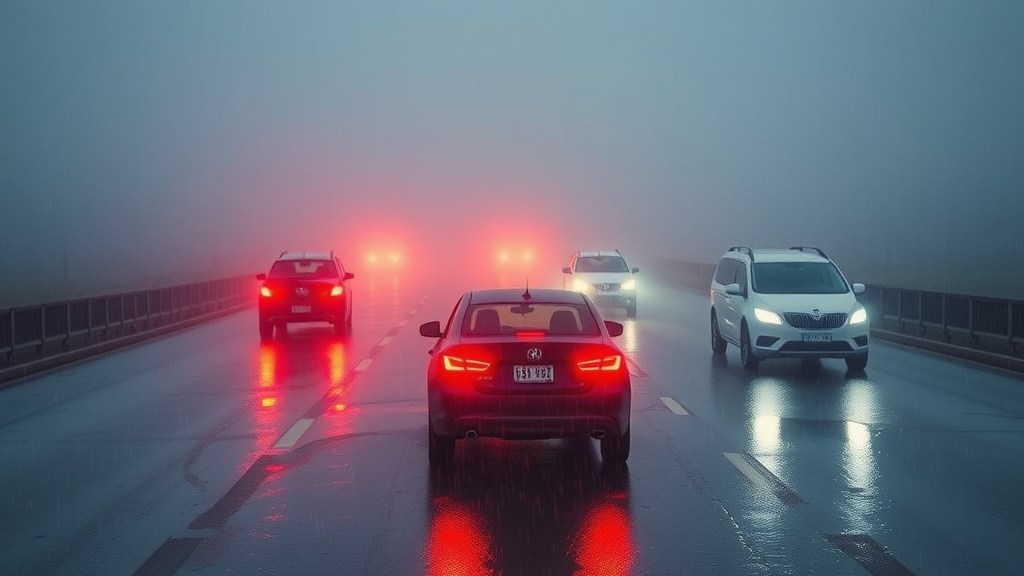
Intelligent transportation systems promise cities that can see: cameras and drones that watch traffic flow, count vehicles, and flag congestion or accidents in real time. But there is a stubborn gap between that promise and the hardware that must deliver it. The deep learning models that dominate modern computer vision are heavy, and the unmanned aerial vehicles that offer the best vantage point over highways are, by their nature, light. A new study tackles this tension head-on with a hybrid architecture that pairs randomized convolutional feature extraction with extremely fast classifiers, and it reports results strong enough to matter for anyone building the next generation of traffic monitoring systems.
The research, published in the International Journal of Machine Learning and Cybernetics by Shamama Anwar and Mayank Kumar of the Birla Institute of Technology, Mesra, addresses a problem that has quietly constrained drone-based traffic analytics for years. Conventional convolutional neural networks can classify vehicles with high accuracy, but training them requires iterative optimization of millions of weights through many passes over the data. That process is computationally intensive, energy hungry, and poorly matched to the embedded processors aboard small UAVs. The authors’ answer is to stop training the feature extractor altogether and let randomness do part of the work.
The core of the proposed framework is a Randomized Convolutional Neural Network, or RCNN. Instead of learning filters through backpropagation, the RCNN uses predefined random filters to transform raw images into rich feature representations. This idea draws on a broader body of research showing that randomness in neural networks, when properly harnessed, can serve as a powerful form of regularization and dramatically reduce training cost. Because the filters are fixed rather than learned, the expensive gradient-descent stage of feature learning disappears. What remains is a classification problem on top of those features, and this is where the architecture splits into two variants: one feeding the randomized features into an Extreme Learning Machine, the other into a Dense Neural Network.
The Extreme Learning Machine component is the more radical of the two. Introduced formally by Huang and colleagues in 2006, the ELM assigns random weights to its hidden layer and then solves for the output weights in a single linear step, reducing what is normally an iterative training process to an analytical calculation. The result is a classifier that trains orders of magnitude faster than a conventional neural network. Combined with the randomized convolutional front end, the full RCNN-ELM pipeline eliminates nearly all of the slow, iterative training that makes standard deep learning pipelines unsuitable for resource-limited platforms, while still producing discriminative features that separate cars, buses, trucks, and other vehicle categories.
Testing was deliberately harsh. The researchers evaluated the framework on two datasets designed to stress real-world deployment. The first, DAWN, is a benchmark specifically curated for vehicle detection in adverse weather, containing images shot through fog, rain, snow, and other visibility-degrading conditions that routinely defeat vision systems trained on sunny-day data. The second consists of UAV-based traffic images, capturing vehicles from the steep, oblique angles and variable altitudes that drones experience in flight. Both settings are representative of the conditions under which intelligent transportation systems must actually operate, and both are notoriously unforgiving to models tuned on idealized imagery.
The headline results favor the ELM variant. On the adverse-weather DAWN dataset, RCNN-ELM achieved a validation accuracy of 85.42 percent, outperforming the RCNN-DNN configuration, which reached 81.16 percent, while requiring substantially less training time. That combination of higher accuracy and lower cost is unusual; typically researchers trade one for the other. The authors backed the findings with statistical analysis across multiple runs, confirming that the performance differences were reliable rather than artifacts of a lucky random seed. Cross-dataset evaluation, in which a model trained on one data source was tested on the other, showed that the framework generalizes well across very different imaging conditions, a property critical for systems that cannot be retrained every time the weather or camera geometry changes.
Beyond the headline numbers, the study includes ablation studies that peel apart the contribution of each component, along with interpretability analyses that probe what the randomized features are actually detecting. These experiments serve a practical purpose. In safety-relevant applications such as traffic monitoring, understanding why a model classifies a blurred, rain-streaked blob as a truck rather than a car matters as much as the raw accuracy figure. The interpretability results, together with the ablations, support the central claim that randomized deep features capture genuinely useful structure in vehicle imagery even without task-specific training of the convolutional stage.
The work builds on a long line of vehicle classification research, from early SIFT- and HOG-based detectors paired with support vector machines, through dynamic Bayesian networks for aerial surveillance, to the modern YOLO family of real-time object detectors that now spans versions from YOLOv5 through YOLOv8 and beyond. Each generation has improved detection performance, but the computational appetite has generally grown in step. Recent surveys of drone-based road traffic monitoring highlight exactly this bottleneck: the platforms that would benefit most from autonomous vision are the ones least able to run state-of-the-art models at full strength. The randomized-hybrid approach offers an escape route that does not demand waiting for more powerful onboard hardware.
There is also a data-quality story embedded in the study. The framework’s robustness on DAWN speaks to a broader challenge in the field, where models trained on curated benchmarks frequently collapse when confronted with weather-induced image degradation. Researchers have attacked this problem with data augmentation, synthetic data generation, and weather-specific architectures, yet adverse conditions remain a leading cause of failure in deployed vision systems. Demonstrating strong accuracy directly on an adverse-weather benchmark, rather than on clean data with hoped-for transfer, gives the RCNN-ELM approach a credibility that many efficiency-focused papers lack.
The implications extend past traffic cameras. Randomized neural networks and extreme learning machines have found applications from large-scale scene recognition to lane detection, and the pattern they share, replacing slow iterative optimization with fast randomized feature generation plus analytical or lightweight learning, is attractive anywhere compute is scarce: satellites, medical devices at the edge, industrial sensors, and battery-powered robots. For urban planners and transportation agencies, the near-term significance is more concrete. The study suggests that drones patrolling highways in fog and rain could classify vehicles in real time on modest hardware, feeding accurate traffic data into intelligent transportation systems without the latency of offloading video to distant servers. The research was funded by the Department of Science and Technology of India under its Promotion of University Research and Scientific Excellence scheme, and the authors note that the RCNN-ELM framework offers an efficient and robust solution for real-time UAV-based traffic monitoring. If the efficiency gains hold up in field deployments, the humble combination of random filters and a fast linear classifier could become a quiet workhorse of the smart-city sensor layer.
Subject of Research: Lightweight hybrid deep learning for real-time vehicle classification in adverse weather and UAV-based traffic monitoring
Article Title: Hybrid randomized deep feature learning and extreme learning machines for vehicle classification under challenging visual conditions
Article References: Anwar, S., & Kumar, M. (2026). Hybrid randomized deep feature learning and extreme learning machines for vehicle classification under challenging visual conditions. International Journal of Machine Learning and Cybernetics, 17(9), Article 457. https://doi.org/10.1007/s13042-026-03296-x
Image Credits: AI Generated
DOI: 10.1007/s13042-026-03296-x
Keywords: vehicle classification, randomized neural networks, extreme learning machine, RCNN-ELM, adverse weather, UAV traffic monitoring, intelligent transportation systems, computer vision, deep learning, DAWN dataset, lightweight architecture, real-time detection
Cite Scienmag News
Blake Davidson. (September 12, 2026). Randomized Deep Features Meet Extreme Learning Machines to Classify Vehicles in Fog, Rain and Drone Views. Scienmag. https://scienmag.com/randomized-deep-features-meet-extreme-learning-machines-to-classify-vehicles-in-fog-rain-and-drone-views/
Blake Davidson. "Randomized Deep Features Meet Extreme Learning Machines to Classify Vehicles in Fog, Rain and Drone Views." Scienmag, 12 September 2026, https://scienmag.com/randomized-deep-features-meet-extreme-learning-machines-to-classify-vehicles-in-fog-rain-and-drone-views/. Accessed 5 October 2026.
Blake Davidson. "Randomized Deep Features Meet Extreme Learning Machines to Classify Vehicles in Fog, Rain and Drone Views." Scienmag. September 12, 2026. https://scienmag.com/randomized-deep-features-meet-extreme-learning-machines-to-classify-vehicles-in-fog-rain-and-drone-views/


