


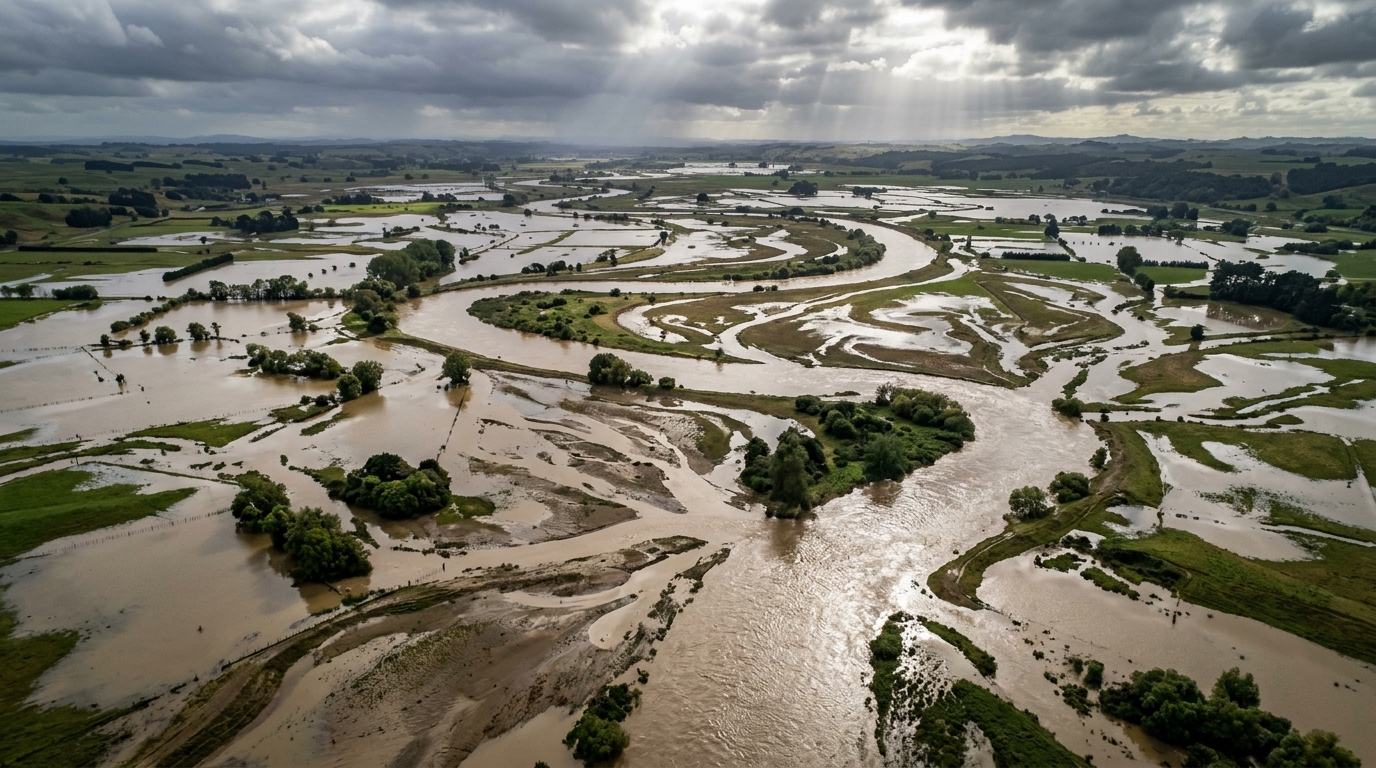
A fine-tuned random forest model achieved an area under the receiver operating characteristic curve of 0.953 and an accuracy of 0.768 in classifying global disaster events into severity categories, according to research published in the International Journal of Data Science and Analytics. Researchers Xiaomei Fan and Pengfei Yu developed the framework, titled the spatiotemporal disaster impact severity classification framework using a fine-tuned random forest, or STD–FTRF. The methodology is designed to categorize reported disaster events into high-impact and low-impact classes. As documented in the study, the growing availability of global disaster databases has made it possible to conduct data-driven assessments of disaster impacts across both spatial and temporal scales.
The proposed framework relies exclusively on spatial, temporal, and contextual attributes that are already available at the time of initial event reporting. For spatial positioning, the classification model incorporates geographic coordinates and identifiers, specifically latitude, longitude, and region. In terms of temporal information, the model utilizes the specific year and month of the disaster event. Alongside these spatiotemporal parameters, contextual attributes documented when the event is reported are fed into the fine-tuned random forest algorithm to assign each event to either the high-impact or low-impact severity class.
Before and alongside the classification modeling, the researchers conducted exploratory analyses on the disaster data. These exploratory analyses examined the specific associations existing among disaster magnitude, human casualties, and economic losses across the recorded events. By assessing these relationships, the study investigated how the physical magnitude of an event connects with its documented impacts on human populations through casualties as well as financial impacts through economic losses, providing context for classifying disaster severity on a global scale.
To evaluate classification efficacy, the researchers tested the STD–FTRF model against four baseline classifiers across five distinct evaluation metrics. Across these measurements, the fine-tuned random forest produced balanced results: an accuracy of 0.768, a precision of 0.787, a recall of 0.765, an F1-score of 0.773, and an area under the curve (AUC) of 0.953. In their assessment of these scores, the authors reported that the STD–FTRF model demonstrated competitive and balanced classification performance relative to the baseline algorithms across every tested criterion.
The comparative evaluation indicated that the proposed model provides consistent performance across all five evaluation metrics, showing stability in precision, recall, accuracy, F1-score, and AUC. Based on these comparative outcomes, the authors concluded that the STD–FTRF framework is suitable for reproducible, large-scale post-event disaster impact characterization. Furthermore, because the classification operates using information available at the time of reporting, the researchers noted that the framework supports spatial decision support in post-event disaster assessment across regional and global scales.
Subject of Research: Machine learning classification of global disaster event severity
Article Title: Spatiotemporal impact classification and risk assessment of global disaster events using a fine-tuned random forest
Article References: Fan, X., & Yu, P. (2026). Spatiotemporal impact classification and risk assessment of global disaster events using a fine-tuned random forest. International Journal of Data Science and Analytics, 22(1), Article 367. https://doi.org/10.1007/s41060-026-01347-8
Image Credits: AI Generated
DOI: 10.1007/s41060-026-01347-8
Keywords: random forest, disaster impact classification, spatiotemporal analysis, machine learning, risk assessment, disaster severity, post-event analysis, spatial decision support, Spatiotemporal, impact, classification, risk
Cite Scienmag News
Denise Maddox. (November 8, 2026). Random Forest Classifies Global Disaster Impact Severity From Spatiotemporal Event Data. Scienmag. https://scienmag.com/random-forest-classifies-global-disaster-impact-severity-from-spatiotemporal-event-data/
Denise Maddox. "Random Forest Classifies Global Disaster Impact Severity From Spatiotemporal Event Data." Scienmag, 8 November 2026, https://scienmag.com/random-forest-classifies-global-disaster-impact-severity-from-spatiotemporal-event-data/. Accessed 10 November 2026.
Denise Maddox. "Random Forest Classifies Global Disaster Impact Severity From Spatiotemporal Event Data." Scienmag. November 8, 2026. https://scienmag.com/random-forest-classifies-global-disaster-impact-severity-from-spatiotemporal-event-data/




