


In a groundbreaking advancement at the intersection of immunology and imaging technology, researchers have developed a novel radiolabeled dendrimer capable of non-invasively identifying and tracking innate immune cell activation within the central nervous system. This innovative approach was meticulously tested in a mouse model of experimental autoimmune encephalomyelitis (EAE), a widely accepted analogue for human multiple sclerosis (MS). The ability to visualize immune cell dynamics in real time presents a revolutionary step toward understanding autoimmune pathology and advancing diagnostics and therapeutics in neuroinflammatory diseases.
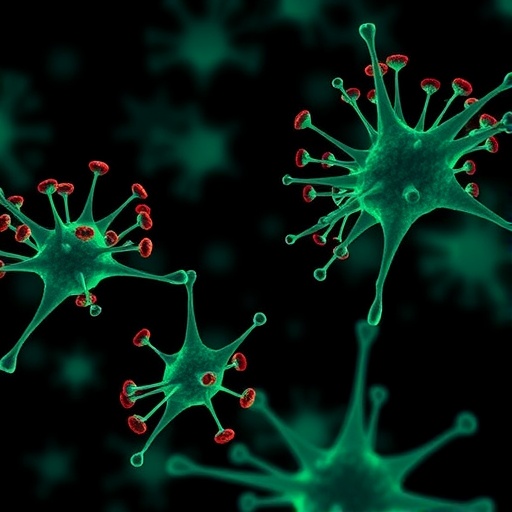
Central to this discovery is the synthesis of a multifunctional dendrimer—a highly branched, nanoscale polymer—engineered to selectively interact with activated innate immune cells. Radiolabeled for positron emission tomography (PET) imaging, this dendrimer acts as a beacon, illuminating inflammation sites within the brain and spinal cord without the need for invasive procedures. The precise targeting capability is achieved through a combination of surface chemistry modifications that favor uptake by microglia and macrophages, the primary innate immune players orchestrating inflammation in autoimmune encephalitis.
Experimental autoimmune encephalomyelitis mimics key pathological features of MS, including demyelination, axonal injury, and immune cell infiltration. Current diagnostic modalities primarily rely on MRI to detect structural damage but lack the capacity to dynamically map cellular immune responses during disease progression. The radiolabeled dendrimer addresses this limitation by binding to receptors or molecules upregulated upon immune cell activation, providing a direct functional readout rather than just anatomical alterations.
Advanced in vivo imaging utilized the dendrimer to monitor spatiotemporal patterns of innate immune activation longitudinally. The non-invasive nature of this method enables repeated scanning across disease stages, offering insight into the timing and intensity of inflammatory episodes. Researchers observed discernible PET signal increases correlating with neuroinflammation severity, demonstrating the dendrimer’s sensitivity and specificity for activated immune cell populations.
The underlying chemistry involved conjugating a radionuclide—carefully selected for optimal PET resolution and biocompatibility—to the dendrimer scaffold. This required overcoming challenges related to maintaining dendrimer stability, preventing off-target radioactive decay, and ensuring the pharmacokinetic profile allowed for sufficient circulation time to reach central nervous system targets. Meticulous in vitro assays validated binding affinity and cell uptake before transitioning to animal models.
Beyond the diagnostic potential, this technology opens avenues for therapeutic monitoring and drug delivery. By elucidating discrete phases of immune cell activation, clinicians could tailor immunomodulatory treatments with improved timing and efficacy. Furthermore, the dendrimer platform could be adapted to ferry therapeutic agents across the blood-brain barrier, leveraging its cell-targeted capabilities to deliver payloads directly to pathogenic immune cells.
The study’s findings also underscore the critical role of innate immunity in neurodegenerative contexts. While adaptive immunity has been traditionally emphasized in MS pathology, the capacity to visualize innate immune activation in live animals spotlights its early and sustained contributions to disease perpetuation. This insight challenges existing paradigms and may guide future investigations into the interplay between immune cell subsets within inflamed neural tissue.
Safety and toxicity evaluations demonstrated that the radiolabeled dendrimer was well tolerated in murine subjects, with no significant adverse effects detected over multiple imaging sessions. Biodistribution analyses confirmed preferential accumulation within inflammatory lesions with minimal off-target deposition, affirming the approach’s precision and translational potential. These aspects are crucial for eventual clinical application in humans.
This technology also exemplifies the power of nanomedicine combined with advanced molecular imaging to probe complex biological phenomena. By tailoring dendrimer size, surface charge, and functional groups, researchers achieved a delicate balance between bioavailability and target specificity. The convergence of synthetic chemistry, immunology, and imaging science in this project marks a notable milestone in biomedical innovation.
Continued development will focus on refining dendrimer design to enhance signal-to-noise ratio, extending the range of detectable immune activation markers and adapting the platform for other models of neuroinflammatory and neurodegenerative diseases. Parallel efforts could explore integrating other imaging modalities such as MRI or fluorescence to enable multimodal visualization, potentially offering synergistic diagnostic insights.
The implications of this research extend beyond MS and EAE. Chronic neuroinflammation is a hallmark of diverse neurological disorders including Alzheimer’s, Parkinson’s, and traumatic brain injury. A robust, non-invasive tracer for immune cell activation could profoundly impact the study and treatment of these conditions by enabling real-time monitoring of inflammatory cascades and therapeutic responses at the cellular level.
Public excitement around this discovery is driven not only by its scientific novelty but also by its potential to transform patient care. The ability to “see” immune processes in action in living organisms bridges a critical gap between molecular pathology and clinical application. As this technology advances from preclinical validation toward human trials, it promises to offer clinicians an unprecedented window into the inflammatory underpinnings of autoimmune and neurodegenerative diseases.
Moreover, the interdisciplinary collaboration evident in this project highlights the future pathway for tackling complex biomedical challenges. Chemists, immunologists, neuroscientists, and imaging specialists combined expertise to engineer, test, and validate this dendrimer system, showcasing the value of integrating diverse scientific perspectives to create impactful innovations.
As with any emerging technology, challenges remain including ensuring scalability of dendrimer synthesis, regulatory approvals, and adaptation to human physiology where immune cell markers may differ from murine models. Nonetheless, the foundational work sets a compelling precedent and provides an invaluable framework for future targeting and imaging strategies of immune dysfunction.
In summation, the introduction of a radiolabeled dendrimer as a selective and non-invasive probe for innate immune cell activation represents a quantum leap in imaging neuroinflammation. This strategy promises to enrich our understanding of autoimmune pathologies, facilitate earlier and more precise diagnosis, and inform tailored therapeutic interventions. By illuminating the cellular drivers of disease in vivo, this technology paves the way toward revolutionizing autoimmune and neuroinflammatory disease management worldwide.
Cite Scienmag News
Ophelia Keating. (January 30, 2026). Radiolabeled Dendrimer Tracks Immune Activation in Mice. Scienmag. https://scienmag.com/radiolabeled-dendrimer-tracks-immune-activation-in-mice/
Ophelia Keating. "Radiolabeled Dendrimer Tracks Immune Activation in Mice." Scienmag, 30 January 2026, https://scienmag.com/radiolabeled-dendrimer-tracks-immune-activation-in-mice/. Accessed 3 September 2026.
Ophelia Keating. "Radiolabeled Dendrimer Tracks Immune Activation in Mice." Scienmag. January 30, 2026. https://scienmag.com/radiolabeled-dendrimer-tracks-immune-activation-in-mice/


