


For children whose bladders misbehave because their nervous systems do, the stakes of a routine diagnostic exam are quietly enormous. Neurogenic bladder dysfunction — a loss of bladder control caused by conditions such as spina bifida, spinal cord injuries, cerebral palsy, and rare genetic syndromes — is one of the leading routes to progressive kidney damage in childhood. When the bladder becomes stiff, overactive, or unable to empty, pressure builds inside it, and that pressure can push urine backward up the ureters toward the kidneys, a phenomenon known as vesicoureteral reflux. Left undetected, this silent backflow can scar the kidneys and, over years, erode their function to the point of failure. A team of pediatric surgeons at Dresden University of Technology in Germany now reports that a radiation-free ultrasound technique, bolted onto the standard bladder-pressure test, can catch this hidden reflux in nearly a third of children who appeared clinically stable — and change their treatment almost immediately.
The study, published in Frontiers in Urology, is a pilot feasibility investigation of a combined procedure the researchers call contrast-enhanced voiding urosonography urodynamics, or ceVUS-UD. The idea is elegant in its simplicity. Conventional urodynamics measures how the bladder fills and empties by tracking pressure through a thin catheter, but it is blind to anatomy: if urine is sneaking backward up the ureters, the pressure readings can look deceptively normal, a problem the authors note can lead to an overestimation of bladder compliance and a dangerous delay in therapy. The gold-standard solution, video urodynamics, adds real-time X-ray fluoroscopy to visualize the reflux — but at the cost of ionizing radiation in children who may need dozens of such exams over a lifetime, and in a fluoroscopy suite that many families find intimidating. CeVUS-UD swaps the X-ray source for ultrasound and a tiny dose of microbubble contrast agent, approved by the US Food and Drug Administration in 2016 under the name SonoVue, which makes urine visible on sonography without a single photon of radiation.
Between January and November 2025, the Dresden team enrolled 19 consecutive children with neurogenic bladder dysfunction, with an average age of 11.4 years and a near-even split of nine boys and ten girls. The underlying diagnoses spanned the full spectrum of pediatric neuro-urology: six children with spina bifida, including five with the severe myelomeningocele form, six with caudal regression syndrome, three with infantile cerebral palsy, and single cases of epispadias and myotonic dystrophy type 1, alongside children with detrusor overactivity following spinal cord injury. Two-thirds of the children managed their bladders with self-intermittent catheterization, inserting a catheter several times a day to empty it, and roughly six in ten took anticholinergic or antispasmodic medications to calm bladder muscle overactivity. Crucially, the cohort was clinically quiet: only three children had had a urinary tract infection in the previous year, and none had experienced a kidney infection — meaning the reflux the team was hunting for had no obvious clinical red flags announcing it.
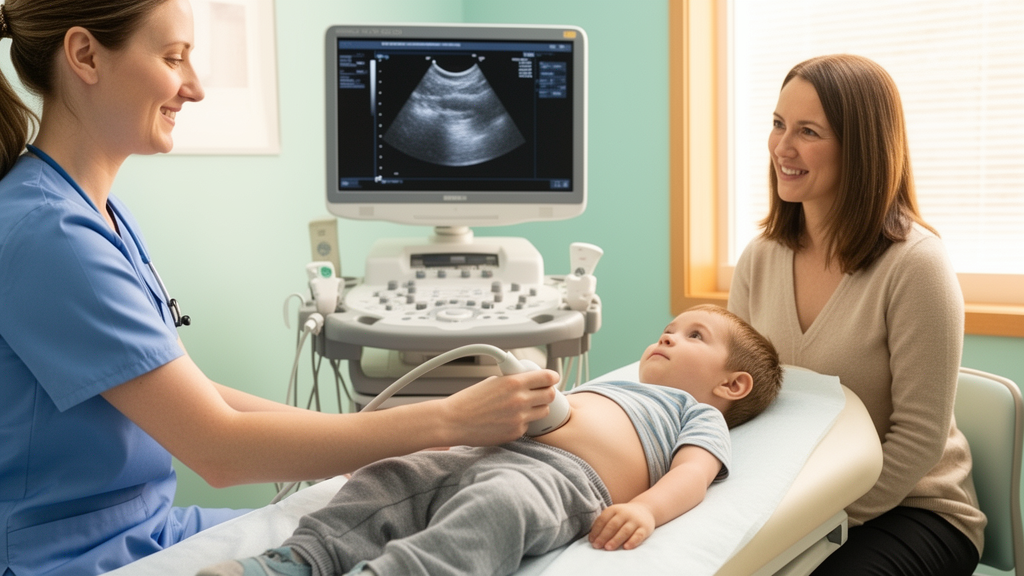
The procedure itself is a careful choreography of two examinations in one. With the child lying supine close to their parents, an experienced nurse prepares the urodynamic setup, and a 6 French catheter is placed into the bladder under aseptic conditions. After the bladder is fully emptied, one milliliter of the SonoVue contrast agent — a suspension of microscopic phospholipid-shelled bubbles that reflect ultrasound waves intensely — is instilled directly into the bladder. Sterile saline then flows in at a controlled rate of 10 milliliters per minute until the bladder reaches an age-appropriate capacity, calculated by the formula (age + 1) × 30 milliliters, capped at 400. If bladder pressure climbs above 20 centimeters of water, urine begins to leak, or the child reports discomfort, the filling rate is halved to protect safety. Throughout filling and voiding, the sonographer captures transverse and longitudinal views of the bladder, ureters, and kidneys, watching in real time for contrast bubbles to appear where they should not — inside the ureters or the kidney collecting systems — which is the sonographic signature of reflux.
The technical question at the heart of the pilot was whether the ultrasound exam would corrupt the delicate pressure measurements it accompanied. The answer, the team reports, is essentially no. Gentle scanning of the bladder produced only a transient pressure bump of 1 to 2 centimeters of water, which vanished within seconds of lifting the probe. Even firm pressure applied to the abdomen to improve visualization of the kidneys did not raise intravesical pressure at all. The contrast agent remained visible for the entire examination period, and despite the scoliosis, contractures, and surgical anatomy present in much of the cohort, sonographic assessment of the bladder, ureters, and kidneys proved feasible in every single patient. Even children who void while seated — a position that can complicate imaging — could be adequately assessed, with reflux detectable down to at least grade II severity. Notably, one child in the study was found to have grade I reflux, demonstrating that even the mildest form of backflow, which ceVUS is sometimes criticized for missing compared with X-ray imaging, could be visualized even while urodynamics was running.
The headline result is striking: previously unknown secondary vesicoureteral reflux was detected in six of the 19 children — a detection rate of 31.6 percent — in a cohort with no urinary tract infections since their last workup to hint at trouble. Every instance of reflux occurred at maximal bladder filling, at the moment urinary leakage was observed, meaning the pressure at which reflux appeared corresponded to the leak point pressure, a key urodynamic safety metric. In one case, the team documented something physiologically remarkable: as left-sided grade III reflux occurred, the pressure inside the bladder fell dramatically from 37 to 20 centimeters of water within just 13 seconds, as if the refluxing ureter were acting as a pressure-release valve. That observation carries a hidden danger the authors emphasize. Reflux can redistribute bladder pressure, making the urodynamic tracing look reassuringly normal during voiding while the kidneys silently absorb the pressure stress — a distortion that could lead clinicians to underestimate renal risk and defer therapy that protects kidney function.
The findings were not merely academic. For five of the six children with newly discovered reflux, the diagnosis triggered an immediate change in management. The adjustments ranged from intensified self-catheterization schedules and the addition of intravesical or oral anticholinergic medications such as propiverine and oxybutynin, to antibiotic prophylaxis, to planned renal scintigraphy — a nuclear medicine scan to check whether the kidneys had already sustained damage and whether surgical options such as ureteral reimplantation or bladder augmentation should be considered. The team also analyzed what might have protected the other children, and found, tellingly, that nothing did: adequate bladder capacity, low leak point pressures, anticholinergic therapy, and well-controlled bowel function all failed to prevent reflux in at least one patient each. Silent reflux, in other words, can lurk behind an apparently well-managed bladder.
The broader significance of the technique lies in what it could replace. A single fluoroscopic voiding cystourethrogram delivers a radiation dose of up to 10 milligrays — comparable to a CT scan — and German guidelines currently call for video urodynamics at 3, 6, and 12 months of age in children with spinal cord malformations, followed by annual to biennial exams. In practice, the authors note, limited availability and radiation concerns mean that schedule is rarely fully honored. Because ceVUS-UD eliminates radiation entirely and takes place in a more comfortable setting — with parents at the child’s side throughout, and children generally reporting that the ultrasound probe felt far less intimidating than a fluoroscopy suite — it could in principle be deployed far more frequently, enabling tighter surveillance of a population whose kidneys depend on it. Prior studies have shown ceVUS matches or exceeds the sensitivity of conventional X-ray cystography for detecting reflux, including reflux into the kidney tissue itself, and a recent comparison study found similar reflux detection rates between ceVUS-UD and video urodynamics.
The technique also reframes a long-standing debate about how reflux damages kidneys in children with neuropathic bladders. The classic explanation centers on recurrent infections driving inflammation and scarring, but the Dresden observations — reflux occurring without any infection, and pressure dropping as urine diverted upward — support a mechanical, pressure-mediated mechanism of injury. Children with neurogenic bladders appear especially vulnerable, often harboring asymptomatic bacteriuria with multidrug-resistant organisms that compounds the risk. The authors also weigh the clinical dilemma their findings create: catching more silent reflux means deciding what to do about it. Endoscopic injection therapy resolves reflux in only about 57 to 62 percent of cases in this population, while open ureteral reimplantation succeeds in up to 99 percent according to American Urological Association guidelines — but surgery and anesthesia carry their own risks in these complex children, and intensified surveillance with catheterization and medication may suffice in selected cases. That trade-off, the team stresses, can only be resolved with long-term prospective data.
The pilot’s limitations are candidly acknowledged: it was a single-center study of 19 children with no control group and no direct head-to-head comparison against video urodynamics, and whether routine ultrasound surveillance of reflux actually translates into better long-term kidney outcomes remains an open hypothesis rather than a proven benefit. The authors recommend that conventional X-ray imaging still be used for the initial diagnostic workup to visualize the urethra and bladder neck, with ceVUS-UD deployed for follow-up — at least until experience accumulates. But as a proof of concept, the study makes a compelling case that the radiation-free exam can run safely alongside urodynamics without disturbing its measurements, uncover clinically invisible reflux at a rate that would otherwise demand routine fluoroscopy to find, and do so in an environment children and parents find markedly less stressful. For a population of children whose kidney futures hinge on catching pressure problems early, a tool that makes frequent, gentle, radiation-free monitoring practical could reshape the surveillance playbook — provided larger, multicenter trials confirm what this small Dresden cohort has begun to show.
Subject of Research: Contrast-enhanced voiding urosonography – urodynamics in patients with neurogenic bladder dysfunction: a pilot study within pediatric urological practice
Article Title: Contrast-enhanced voiding urosonography – urodynamics in patients with neurogenic bladder dysfunction: a pilot study within pediatric urological practice
Article References: Wilke, A., Hörz, T., Pleul, M., Hörz, C., Schuchardt, K., Fitze, G., & Kruppa, C. (2026). Contrast-enhanced voiding urosonography – urodynamics in patients with neurogenic bladder dysfunction: a pilot study within pediatric urological practice. Frontiers in Urology, 6, Article 1891758. https://doi.org/10.3389/fruro.2026.1891758
Image Credits: AI Generated
DOI: 10.3389/fruro.2026.1891758
Keywords: Contrast-enhanced, voiding, urosonography, urodynamics, patients, neurogenic, bladder, dysfunction, pilot, within, pediatric, urological
Cite Scienmag News
Ophelia Keating. (October 15, 2026). Radiation-Free Ultrasound Urodynamics Detect Hidden Reflux in Children’s Neurogenic Bladders. Scienmag. https://scienmag.com/radiation-free-ultrasound-urodynamics-detect-hidden-reflux-in-childrens-neurogenic-bladders/
Ophelia Keating. "Radiation-Free Ultrasound Urodynamics Detect Hidden Reflux in Children’s Neurogenic Bladders." Scienmag, 15 October 2026, https://scienmag.com/radiation-free-ultrasound-urodynamics-detect-hidden-reflux-in-childrens-neurogenic-bladders/. Accessed 15 October 2026.
Ophelia Keating. "Radiation-Free Ultrasound Urodynamics Detect Hidden Reflux in Children’s Neurogenic Bladders." Scienmag. October 15, 2026. https://scienmag.com/radiation-free-ultrasound-urodynamics-detect-hidden-reflux-in-childrens-neurogenic-bladders/


