


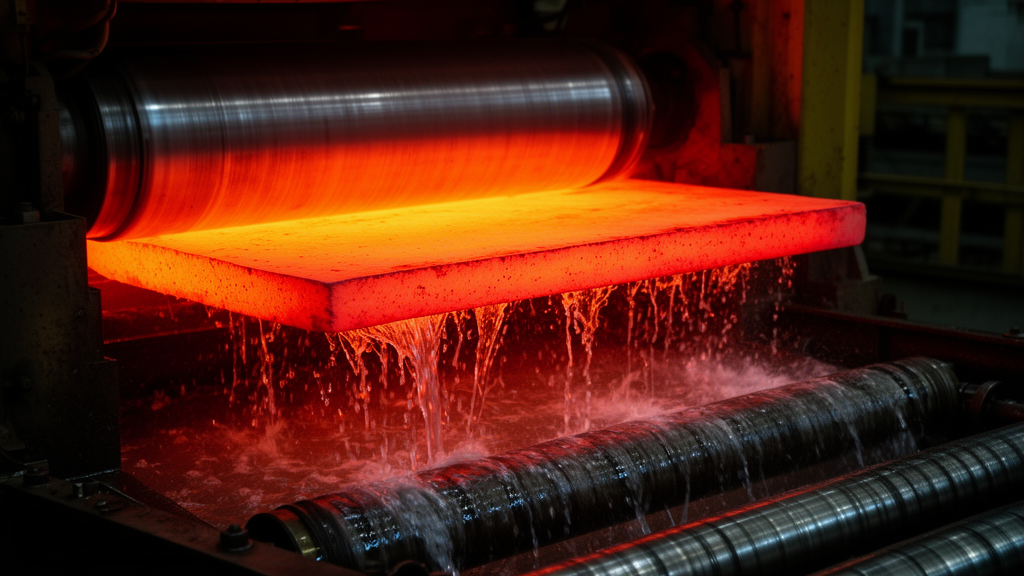
Iron-cobalt alloys sit at the top of the soft magnetic materials table, offering the highest saturation magnetization of any known engineering alloy. That makes them irresistible to designers of motors, transformers, and power transmission equipment, where every extra tesla of magnetization translates into smaller, lighter, and more efficient machines. Yet the same atomic arrangement that gives the equiatomic Fe50Co50 alloy its magnetic superpowers also makes it notoriously brittle at room temperature, and the material has long frustrated manufacturers who need to roll, forge, or draw it into useful shapes without cracking it apart.
A new study published in the Journal of Materials Science by Xintong Zhang, Wei Sun, and colleagues at the University of Science and Technology Beijing, working with Ling Cheng of the China Electric Power Research Institute, has now traced exactly how the way a Fe50Co50 alloy is quenched before hot rolling determines whether the finished sheet emerges strong and ductile or weak and fracture-prone. The work combines microstructural characterization, first-principles calculations, uniaxial tensile testing, and actual rolling deformation into a single multiscale picture, connecting what happens at the level of individual atomic planes to the macroscopic behavior of a rolled plate.
The team prepared specimens using two different quenching routes, labeled HOQ and HWQ, and then examined the room temperature lattice and microstructural states of each before any hot rolling took place. The differences were subtle but consequential. Compared with the HOQ condition, the HWQ specimens showed an apparent relative lattice contraction of approximately 0.46 percent, a tiny squeeze of the crystal lattice that turned out to ripple through every subsequent stage of processing. Beyond the lattice itself, the two conditions also differed in grain structure, crystallographic orientation, the density of geometrically necessary dislocations, and the character of their grain boundaries.
To understand why such a small lattice change could matter, the researchers turned to density functional theory calculations, a quantum mechanical method that models the behavior of electrons in a crystal from first principles. They focused on the generalized stacking fault energy, or GSFE, a quantity that describes the energetic cost of sliding one block of atoms past another along a specific crystallographic plane. Stacking fault energies govern how easily dislocations, the line defects that carry plastic deformation, can move through a metal, and they therefore sit at the heart of any theory of ductility.
The calculations revealed a clear trend. In the undistorted model of the B2 FeCo lattice, the maximum GSFE along the selected slip pathway was 0.898 joules per square meter. When the experimentally measured 0.46 percent lattice contraction was applied to the computational cell, the maximum GSFE rose to 0.926 joules per square meter. Pushing the contraction to an exaggerated 10 percent drove the value up to 1.067 joules per square meter. In other words, squeezing the lattice makes it energetically harder for slip to proceed, which is precisely the kind of change that would be expected to embrittle the material. The authors are careful to note, however, that these DFT results illuminate slip energetics at the atomic scale and are not intended to directly represent dislocation behavior during the high temperature, high strain environment of hot rolling.
With the starting microstructures characterized and the atomic scale energetics mapped, the team subjected both quenched conditions to hot rolling and compared what came out the other side. The differences were striking. The HOQ-HR condition, meaning the HOQ-quenched alloy after hot rolling, exhibited a weaker deformation texture, meaning its grains were less strongly aligned into preferred orientations by the rolling process. It also retained a higher fraction of high angle grain boundaries, showed less pronounced local dislocation entanglement, and, critically, demonstrated better resistance to the cracking that rolling deformation tends to induce. The HWQ-HR condition told the opposite story, with a stronger deformation texture and far more extensive dislocation entanglement woven through its microstructure.
Deformation texture and dislocation entanglement are not merely cosmetic features. A strong texture means that most grains share a common crystallographic alignment, which can concentrate deformation along specific planes and directions and create paths for crack propagation. Dense dislocation entanglement, meanwhile, locks up the mobile dislocations that a metal needs in order to flow plastically, raising the local stress required for further deformation and encouraging cracks to nucleate instead. The microstructural evidence therefore painted a consistent picture: the HOQ route left the alloy in a state that could accommodate rolling deformation gracefully, while the HWQ route left it primed to accumulate damage.
Room temperature tensile tests confirmed the story quantitatively. The HWQ-HR specimens achieved an average ultimate tensile strength of 500.1 megapascals, with a standard deviation of 24.41 megapascals, but managed an elongation after fracture of only 4.6 percent, plus or minus 1.1 percent. The HOQ-HR specimens were in a different league altogether, reaching an average ultimate tensile strength of 725.4 megapascals with a remarkably tight standard deviation of 5.62 megapascals, while still stretching 19.3 percent, plus or minus 1.21 percent, before breaking. That combination of roughly 45 percent higher strength and more than four times the ductility represents a decisively more favorable strength-ductility balance for the HOQ-HR condition.
For a material class whose brittleness has historically limited its adoption, these numbers carry real industrial weight. Equiatomic FeCo and related Fe-Co-V alloys are prized for soft magnetic applications ranging from high performance electric motors to aerospace power systems, and prior research has explored routes as varied as heat treatment optimization and additive manufacturing to coax ductility out of them. The new work adds a deceptively simple lever to that toolkit: the quenching route chosen before hot deformation, which sets the lattice parameter, the dislocation density, and the grain boundary character that the alloy carries into the rolling mill.
What makes the study conceptually interesting beyond metallurgy is its multiscale architecture. Rather than treating the alloy as a black box, the researchers linked an experimentally measured lattice distortion to a computationally predicted change in slip energetics, and then connected both to observable microstructural evolution during rolling and finally to macroscopic tensile performance. Each link in that chain is independently verifiable, and together they demonstrate that a sub-percent lattice contraction, invisible to the naked eye, can cascade into a fourfold difference in ductility. As electrification drives demand for better soft magnetic alloys, understanding how processing history echoes from the atomic scale to the finished component may prove to be the difference between a material that cracks on the production line and one that rolls cleanly into the next generation of electric machines.
Subject of Research: Microstructural and atomic-scale effects of quenching conditions on the hot deformation behavior of equiatomic FeCo alloy
Article Title: Multiscale microstructural characteristics of quenched Fe50Co50 alloy and their effects on hot deformation behavior
Article References: Zhang, X., Sun, W., Xiao, X., Zhang, H., Zu, C., Li, X., Zhang, Z., Cheng, L., & Wang, Z. (2026). Multiscale microstructural characteristics of quenched Fe50Co50 alloy and their effects on hot deformation behavior. Journal of Materials Science. https://doi.org/10.1007/s10853-026-13832-3
Image Credits: AI Generated
DOI: 10.1007/s10853-026-13832-3
Keywords: FeCo alloy, quenching, hot rolling, lattice contraction, stacking fault energy, density functional theory, dislocation density, deformation texture, ductility, soft magnetic materials, grain boundaries, tensile strength
Cite Scienmag News
Neil Sanderson. (October 8, 2026). Quenching Route Decides Whether Iron-Cobalt Alloy Bends or Breaks During Hot Rolling. Scienmag. https://scienmag.com/quenching-route-decides-whether-iron-cobalt-alloy-bends-or-breaks-during-hot-rolling/
Neil Sanderson. "Quenching Route Decides Whether Iron-Cobalt Alloy Bends or Breaks During Hot Rolling." Scienmag, 8 October 2026, https://scienmag.com/quenching-route-decides-whether-iron-cobalt-alloy-bends-or-breaks-during-hot-rolling/. Accessed 8 October 2026.
Neil Sanderson. "Quenching Route Decides Whether Iron-Cobalt Alloy Bends or Breaks During Hot Rolling." Scienmag. October 8, 2026. https://scienmag.com/quenching-route-decides-whether-iron-cobalt-alloy-bends-or-breaks-during-hot-rolling/


