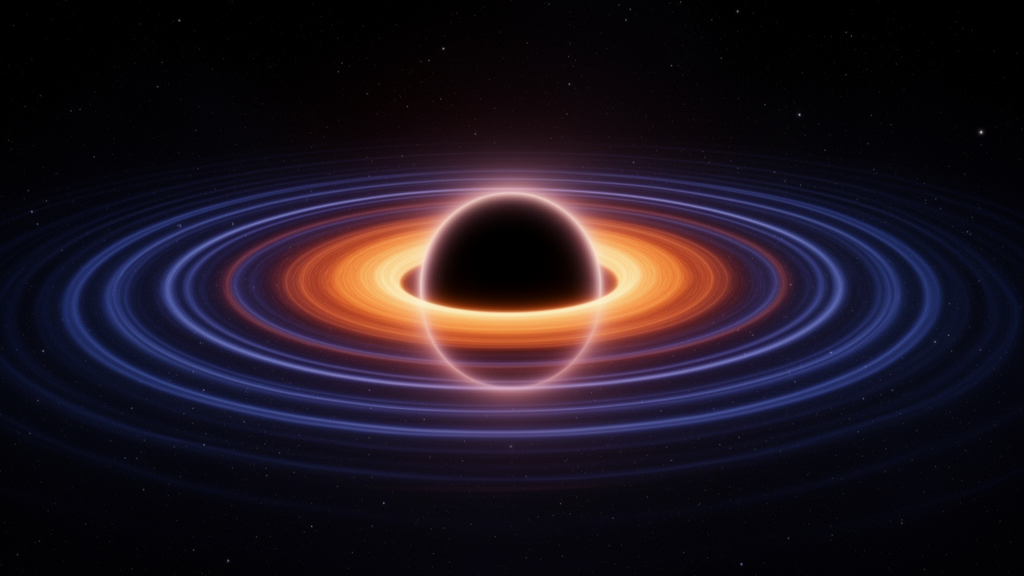
Black holes should ring like struck bells. When a perturbation hits one, it emits gravitational waves at characteristic quasinormal frequencies, a fingerprint of the spacetime geometry that physicists hope could one day reveal whether quantum gravity has reshaped the horizon. A new theoretical study now maps that fingerprint for two quantum-corrected, electrically charged black hole solutions embedded in a universe with a cosmological constant, and the results are stranger than either charge or quantum corrections alone would suggest.
The work, published in The European Physical Journal C by Zhongzhinan Dong and Jinsong Yang, examines two covariant effective black hole spacetimes derived from a loop-quantum-gravity-inspired framework extended to the electrovacuum case with a cosmological constant. Each solution is characterized by a mass, a charge, a cosmological constant, and a quantum parameter called zeta that encodes quantum-gravity corrections. When zeta is set to zero, both solutions reduce to the classical Reissner–Nordström–de Sitter black hole of general relativity. The authors computed the quasinormal frequencies of massless scalar perturbations on these backgrounds using a pseudo-spectral method, which discretizes the wave equation on Chebyshev grids and turns the problem into a matrix eigenvalue calculation.
The choice of numerical method matters. The widely used WKB approximation, accurate for low-lying modes, cannot capture purely imaginary modes whose oscillation frequency vanishes, and such modes are central to this problem. In asymptotically de Sitter spacetimes, purely imaginary modes govern the late-time decay of perturbations, replacing the power-law tails of asymptotically flat spacetimes with exponential decay. The pseudo-spectral method handles both complex and purely imaginary modes robustly, which allowed the authors to analyze the complete spectrum rather than isolated branches. As a validation check, the team showed that their frequencies smoothly recover the well-known Schwarzschild values when charge, quantum parameter, and cosmological constant are scaled to zero, with relative differences below 0.1 percent against previously published results.
The headline finding concerns overtone outbursts. In ordinary black hole ringdown, the fundamental mode dominates and higher overtones fade quickly. But previous work has shown that even small modifications near the horizon can trigger dramatic, oscillatory excursions in the overtone spectrum, a phenomenon vividly dubbed the sound of the event horizon. The new calculations demonstrate that while the quantum parameter significantly modifies the quasinormal frequency spectrum, the non-monotonic behavior and overtone outbursts persist in both charged solutions. More strikingly, the impact of quantum gravity on these outbursts is not simply an enhancement or suppression; it introduces additional spectral features that neither effect produces alone.
The two solutions behave differently in instructive ways. In the first solution, where the quantum parameter enters the metric function that multiplies the classical part, increasing zeta to 3 eliminates the non-monotonic dependence of the fundamental mode frequencies on charge for the lowest angular quantum number. In the second solution, where the quantum parameter appears only in the function governing the radial part of the metric, that non-monotonic behavior survives even at zeta equal to 3. The authors trace this difference to the structure of the effective potential: in the second solution, quantum effects are confined to the gravitational potential term and are more strongly suppressed by the angular quantum number, making the contrast between the lowest two angular modes especially pronounced.
Perhaps the most visually arresting result involves transitions between complex and purely imaginary modes. For certain overtones, the real part of the frequency decreases rapidly with increasing charge, approaches the imaginary axis, touches it, and then moves away again. The modes continuously evolve from oscillating to purely decaying behavior and back. Because the authors could track these frequencies without numerical discontinuities near the imaginary axis, they interpret the behavior as a genuine feature of the spectrum rather than a computational artifact. At a fixed quantum parameter of 1, the first solution undergoes this complex-to-imaginary transition twice, while the second solution undergoes it only once, meaning overtone spectra can distinguish the two quantum-corrected models even when their fundamental modes look nearly identical.
Deeper interactions emerge when the full spectrum is examined. The authors introduce a labeling scheme that orders all modes by their damping rate, regardless of branch, and find that the fundamental complex mode and a nearby purely imaginary mode can exhibit opposite trends with charge, causing their damping rates to approach each other and even cross. Such damping-rate crossings are not unique to quantum corrections; they already exist subtly in the overtone structure of the classical charged de Sitter black hole. The quantum parameter does not change the underlying mechanism but amplifies the dominance of purely imaginary modes, allowing crossings that were previously confined to overtones to appear among the fundamental modes, making them more physically observable.
An even more intricate behavior appears near the extremal regime, where charge is large and the event and cosmological horizons approach one another. There, a complex overtone branch can split, shedding a new purely imaginary mode branch as it enters a transition region around a charge of roughly 0.917, and then merge with a pre-existing purely imaginary branch upon leaving, recovering a nonzero oscillation frequency. These splitting-merging events, which accompany overtone outbursts and become more frequent as the quantum parameter increases, locally rearrange the branch structure of the spectrum and blur the conventional overtone-based classification of modes.
The purely imaginary modes also connect to deep questions about cosmic censorship. In de Sitter spacetimes, the rapid exponential decay they induce suppresses the blueshift instability at the inner Cauchy horizon, which bears on whether the deterministic evolution of general relativity can break down. The authors confirm that in the regime of large cosmological horizon radius, the damping rates of the lowest-lying modes follow the universal inverse scaling with that radius predicted by earlier general analyses, and that the quantum parameter modifies the damping rates only quantitatively without altering this behavior.
Throughout the parameter range explored, all computed frequencies had negative imaginary parts, meaning the perturbations decay and the black holes remain stable. The authors also note that increasing the cosmological constant tends to suppress the sensitivity of the frequencies to both charge and the quantum parameter, so they fixed it at a small value of 0.01 to keep the intrinsic dependencies visible, with additional calculations confirming the qualitative picture holds for larger values. The study is limited to massless neutral scalar perturbations; charged scalar fields could trigger superradiant instabilities that quantum corrections might modify, and electromagnetic or gravitational perturbations may behave differently. Still, the message is clear: analyzing only the fundamental mode misses much of the story. The full quasinormal spectrum, with its crossings, splits, and mergers, carries the richer signature of quantum gravity, and overtones may prove the sharpest available probe of whatever quantum structure replaces the classical event horizon.
Subject of Research: Quasinormal modes of charged covariant effective quantum black holes with a cosmological constant under scalar perturbations
Article Title: Quasinormal modes of charged covariant effective black holes with a cosmological constant
Article References: Dong, Z., & Yang, J. (2026). Quasinormal modes of charged covariant effective black holes with a cosmological constant. The European Physical Journal C, 86(10), Article 1244. https://doi.org/10.1140/epjc/s10052-026-16409-1
Image Credits: AI Generated
DOI: 10.1140/epjc/s10052-026-16409-1
Keywords: black holes, quasinormal modes, loop quantum gravity, de Sitter spacetime, overtone outbursts, purely imaginary modes, quantum gravity, ringdown gravitational waves, Reissner–Nordström–de Sitter, pseudo-spectral method, cosmological constant, effective spacetimes
Cite Scienmag News
Katie Riggs. (October 29, 2026). Quantum-Corrected Charged Black Holes Reveal Hidden Ringdown Spectral Structures. Scienmag. https://scienmag.com/quantum-corrected-charged-black-holes-reveal-hidden-ringdown-spectral-structures/
Katie Riggs. "Quantum-Corrected Charged Black Holes Reveal Hidden Ringdown Spectral Structures." Scienmag, 29 October 2026, https://scienmag.com/quantum-corrected-charged-black-holes-reveal-hidden-ringdown-spectral-structures/. Accessed 1 November 2026.
Katie Riggs. "Quantum-Corrected Charged Black Holes Reveal Hidden Ringdown Spectral Structures." Scienmag. October 29, 2026. https://scienmag.com/quantum-corrected-charged-black-holes-reveal-hidden-ringdown-spectral-structures/