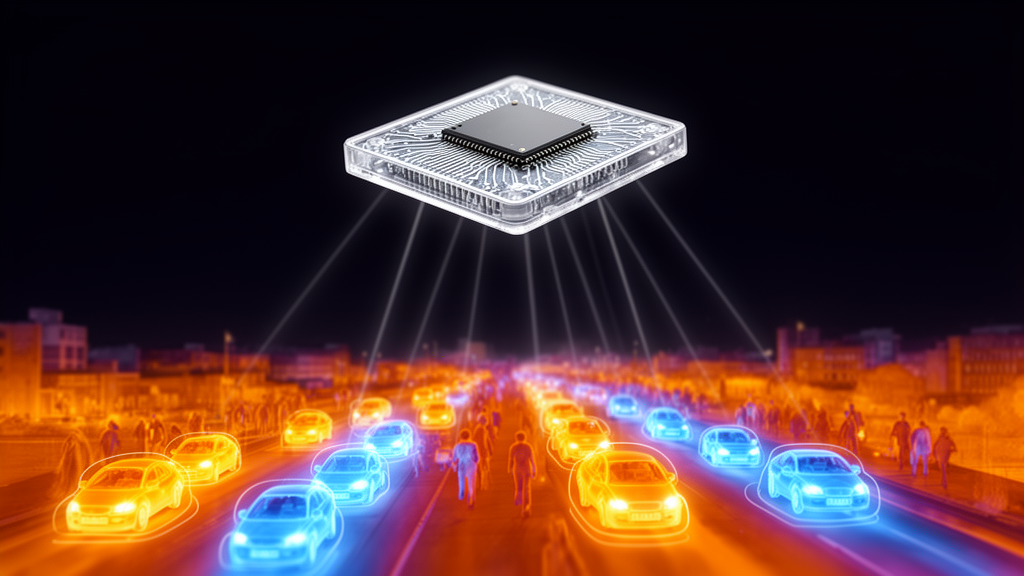
Researchers have developed TCLNet, a Thermal Contrast-Aware Lightweight Network designed to improve infrared object detection, where low signal-to-noise ratios, weak target-background contrast and limited texture often degrade performance, especially for small targets in cluttered scenes.
The network introduces two components: a Thermal Contrast Encoder (TCE) that enhances local contrast-sensitive target representations, and a Thermal-Guided Cross-Feature Attention (TGCA) mechanism that promotes interactions between contrast-enhanced and semantic features, improving target discrimination while suppressing background interference.
In experiments conducted independently on three datasets—M3FD, FLIR ADAS v2 (denoted FLIR_2) and NUDT-SIRST1—TCLNet achieved mAP50 values of 60.5%, 45.4% and 91.4%, respectively. These represent improvements of 12.8, 11.3 and 7.5 percentage points over the YOLO12n baseline.
Despite these gains, the model remains compact at approximately 2 million parameters, a size the authors say reflects a favorable balance between detection accuracy and model complexity—a persistent challenge in infrared detection, where accuracy-heavy models can be too costly for deployment.
According to the study, the results demonstrate that TCLNet improves infrared target detection particularly in low-SNR and small-target conditions. Infrared imaging plays an important role in low-light and complex-environment perception, and the authors position the network as addressing the difficulty of balancing detection accuracy with model complexity in such scenarios.
The work, authored by Xiyuan Zhu, Hongtao Dang and Xiaoyuan Jin, was published in PLOS One.
Subject of Research: A lightweight neural network for infrared object detection that enhances thermal contrast features
Article Title: TCLNet: A Thermal Contrast-Aware Lightweight Network for infrared object detection
Article References: Zhu, X., Dang, H., & Jin, X. (2026). TCLNet: A Thermal Contrast-Aware Lightweight Network for infrared object detection. PLOS One, 21(10), e0361114. https://doi.org/10.1371/journal.pone.0361114
Image Credits: AI Generated
DOI: 10.1371/journal.pone.0361114
Keywords: infrared object detection, TCLNet, thermal imaging, deep learning, computer vision, lightweight networks, mAP50, YOLO12n, FLIR ADAS v2, M3FD, NUDT-SIRST1, attention mechanism
Cite Scienmag News
Blake Davidson. (October 29, 2026). Lightweight TCLNet boosts infrared object detection accuracy on three benchmarks. Scienmag. https://scienmag.com/lightweight-tclnet-boosts-infrared-object-detection-accuracy-on-three-benchmarks/
Blake Davidson. "Lightweight TCLNet boosts infrared object detection accuracy on three benchmarks." Scienmag, 29 October 2026, https://scienmag.com/lightweight-tclnet-boosts-infrared-object-detection-accuracy-on-three-benchmarks/. Accessed 31 October 2026.
Blake Davidson. "Lightweight TCLNet boosts infrared object detection accuracy on three benchmarks." Scienmag. October 29, 2026. https://scienmag.com/lightweight-tclnet-boosts-infrared-object-detection-accuracy-on-three-benchmarks/