


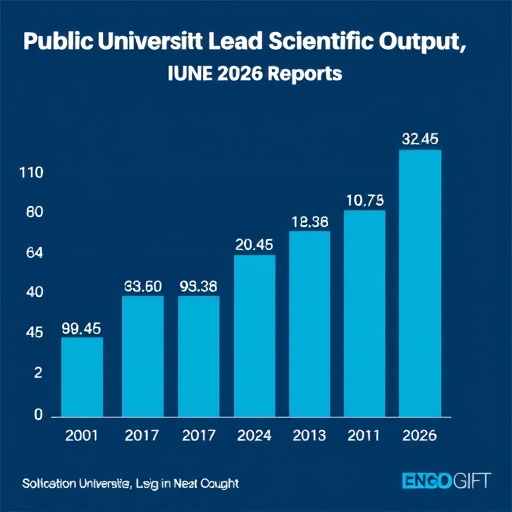
A recent comprehensive report from the IUNE Observatory, jointly prepared by the Interuniversity Institute for Advanced Research on the Evaluation of Science and the University (INAECU) of Carlos III University of Madrid and the Autonomous University of Madrid, reveals an overwhelming dominance of public universities in Spain’s scientific output. Covering the period from 2015 to 2024, the Spanish University System (SUE) published a remarkable total of 668,593 academic works, of which a staggering 95% originated from public institutions.
Public universities not only lead in volume but also demonstrate superior faculty productivity, averaging 1.33 publications per faculty member by 2024, significantly outpacing private universities where productivity stabilized at 0.28. This disparity extends to the recognition of scholarly contributions, measured through the “sexenios”—six-year research periods awarded to faculty. Notably, 91.82% of all sexenios were granted to public university personnel, reflecting a robust research culture within the public sector despite facing a 3.99% decline in faculty numbers over the past decade. Private universities, in contrast, massively expanded their faculty by over 200% but with a substantially lower research output.
Regional analysis highlights that the scientific production is heavily concentrated in Catalonia, Madrid, Andalusia, and the Valencian Community, collectively responsible for over two-thirds of the nation’s output. Interestingly, regions such as Navarre and La Rioja exhibit notable private university contributions when adjusted for their smaller size. Discipline-wise, Experimental Sciences, Medicine, Pharmacology, Engineering, and Computing dominate research outputs, while Arts and Humanities and Social Sciences present comparatively modest figures.
Spanish academic collaboration on the international stage grew appreciably, with joint publications with foreign institutions increasing from 48.2% in 2015 to 55.3% by 2024. This global engagement is mirrored in the significant citation impact of SUE research, averaging 23 citations per publication and accumulating more than 15 billion citations overall during the analyzed period. High-impact publications in top-tier journals are especially prominent in Medicine, Engineering, and Biology.
The report also draws attention to the rapid expansion of open-access publishing within Spanish universities. Between 2015 and 2021, open-access articles more than doubled, driven by institutional open science policies that achieved growth rates as high as 22% in 2020. By 2024, nearly 70% of publications were freely accessible, ensuring broad societal access to cutting-edge scientific discoveries.
The preparation of the report required extensive data collection and harmonization efforts to maintain the accuracy and reliability of the presented indicators, underscoring the technical complexity behind large-scale scientometric analyses. Supported by multiple governmental and academic agencies, the IUNE Observatory’s annual assessment provides a critical empirical foundation for evaluating and enhancing Spain’s scientific enterprise.
This in-depth evaluation highlights the persistent leadership of Spain’s public universities in advancing scientific knowledge, their sustained commitment to quality research despite resource constraints, and the expanding footprint of Spanish science on the global stage, fueled by innovation and open access principles.
Cite Scienmag News
Courtney Benton. (July 9, 2026). Public Universities Lead in Scientific Output, IUNE 2026 Reports. Scienmag. https://scienmag.com/public-universities-lead-in-scientific-output-iune-2026-reports/
Courtney Benton. "Public Universities Lead in Scientific Output, IUNE 2026 Reports." Scienmag, 9 July 2026, https://scienmag.com/public-universities-lead-in-scientific-output-iune-2026-reports/. Accessed 4 September 2026.
Courtney Benton. "Public Universities Lead in Scientific Output, IUNE 2026 Reports." Scienmag. July 9, 2026. https://scienmag.com/public-universities-lead-in-scientific-output-iune-2026-reports/


