


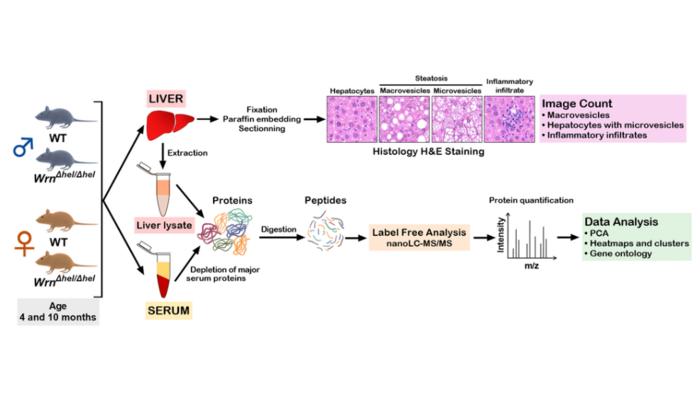
“Proteomics analysis at different ages allows us to follow the progressive biological alterations (including histological fat accumulation) in the liver according to age and/or the Wrn genotype.”

Credit: 2024 Aumailley et al.
“Proteomics analysis at different ages allows us to follow the progressive biological alterations (including histological fat accumulation) in the liver according to age and/or the Wrn genotype.”
BUFFALO, NY- June 3, 2024 – A new research paper was published on the cover of Aging (listed by MEDLINE/PubMed as “Aging (Albany NY)” and “Aging-US” by Web of Science) Volume 16, Issue 10, entitled, “Integrated liver and serum proteomics uncover sexual dimorphism and alteration of several immune response proteins in an aging Werner syndrome mouse model.”
Werner syndrome (WS) is a progeroid disorder caused by mutations in a protein containing both a DNA exonuclease and DNA helicase domains. Previous studies indicated that males lacking the helicase domain of the Wrn protein orthologue exhibited hepatic transcriptomic and metabolic alterations.
In this new study, researchers Lucie Aumailley, Marie Julie Dubois, André Marette, and Michel Lebel from Université Laval used a label-free liquid chromatography-tandem mass spectrometry approach to uncover proteins abundance associated with specific biological processes that differed depending on the age (four or ten months) and/or the genotype (wild type or Wrn mutant) in the serum and liver of mice. Principal component analysis of the proteomic data from both serum and hepatic tissue revealed a sexual dimorphism regardless of the age and the genotype of the mice.
“Moreover, although all Wrn mutant mice exhibited fatty liver by the age of ten months, a significant age and genotype dependent enrichment of proteins involved in lipid and fatty acid metabolic processes were uncovered only in males.”
Also, a genotype dependent increase in serum oxidant detoxification processes was observed in the serum of Wrn mutant males. Despite these sexual differences, several aspects of the immune system were affected in both females and males. Finally, an increase of specific immunoglobulin molecules was common in the liver and serum of both older Wrn mutant females and males.
“Such results suggest that specific immunoglobulin variants maybe associated with fatty liver progression in WS.”
Read the full study: DOI: https://doi.org/10.18632/aging.205866
Corresponding Author: Michel Lebel – michel.lebel@crchudequebec.ulaval.ca
Click here to sign up for free Altmetric alerts about this article.
About Aging:
Aging publishes research papers in all fields of aging research including but not limited, aging from yeast to mammals, cellular senescence, age-related diseases such as cancer and Alzheimer’s diseases and their prevention and treatment, anti-aging strategies and drug development and especially the role of signal transduction pathways such as mTOR in aging and potential approaches to modulate these signaling pathways to extend lifespan. The journal aims to promote treatment of age-related diseases by slowing down aging, validation of anti-aging drugs by treating age-related diseases, prevention of cancer by inhibiting aging. Cancer and COVID-19 are age-related diseases.
Aging is indexed by PubMed/Medline (abbreviated as “Aging (Albany NY)”), PubMed Central, Web of Science: Science Citation Index Expanded (abbreviated as “Aging‐US” and listed in the Cell Biology and Geriatrics & Gerontology categories), Scopus (abbreviated as “Aging” and listed in the Cell Biology and Aging categories), Biological Abstracts, BIOSIS Previews, EMBASE, META (Chan Zuckerberg Initiative) (2018-2022), and Dimensions (Digital Science).
Please visit our website at www.Aging-US.com and connect with us:
- X, formerly Twitter
- YouTube
- Spotify, and available wherever you listen to podcasts
Click here to subscribe to Aging publication updates.
For media inquiries, please contact media@impactjournals.com.
Aging (Aging-US) Journal Office
6666 E. Quaker Str., Suite 1B
Orchard Park, NY 14127
Phone: 1-800-922-0957, option 1
###
Journal
Aging-US
Method of Research
Observational study
Subject of Research
Animals
Article Title
Integrated liver and serum proteomics uncover sexual dimorphism and alteration of several immune response proteins in an aging Werner syndrome mouse model
Article Publication Date
24-May-2024
Cite Scienmag News
Beatrice Stafford. (June 3, 2024). Proteomics uncover sexual dimorphism and immune changes in aging mice with Werner syndrome. Scienmag. https://scienmag.com/proteomics-uncover-sexual-dimorphism-and-immune-changes-in-aging-mice-with-werner-syndrome/
Beatrice Stafford. "Proteomics uncover sexual dimorphism and immune changes in aging mice with Werner syndrome." Scienmag, 3 June 2024, https://scienmag.com/proteomics-uncover-sexual-dimorphism-and-immune-changes-in-aging-mice-with-werner-syndrome/. Accessed 4 September 2026.
Beatrice Stafford. "Proteomics uncover sexual dimorphism and immune changes in aging mice with Werner syndrome." Scienmag. June 3, 2024. https://scienmag.com/proteomics-uncover-sexual-dimorphism-and-immune-changes-in-aging-mice-with-werner-syndrome/

