


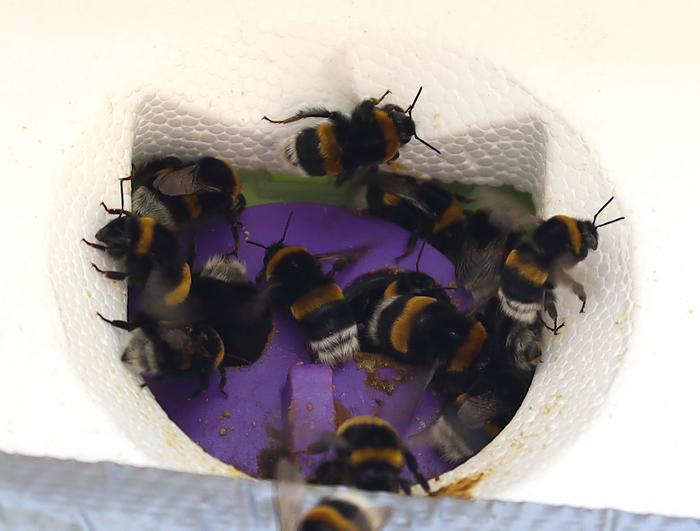
This article examines the intriguing dynamics between bumblebees and their potential threats in the ecosystem, focusing on the impact of proximity to honeybee colonies. With the backdrop of a buzzing world where pollinators perform the vital task of sustaining our food systems and natural environments, this innovative research unveils how physical distance can serve as a formidable protective barrier against parasitic infestations.
Through a comprehensive study published in Frontiers in Bee Science, a team of researchers aimed to investigate whether the principle of social distancing, which has dominated global discourse during the pandemic, can also be applicable to insect interactions. In this elaborate ecosystem, bumblebees are subjected to parasitic threats from the bumblebee wax moth, scientifically known as Aphomia sociella. The primary concern of this study was to elucidate the connection between the locations of domestic honeybee hives and the well-being of nearby bumblebee populations.
Dr. Indrikis Krams, a pioneering researcher at Daugavpils University and the University of Riga in Latvia, spearheaded this groundbreaking examination. His team’s research highlights the significant correlation between the distance from honeybee colonies and the infestation rates of bumblebee wax moths in buff-tailed bumblebee colonies, which are denoted by the scientific name Bombus terrestris. The findings indicate that bumblebee colonies situated closer to honeybee apiaries are under severe stress due to higher infestation rates, which ultimately translates to reduced reproductive output and weakened immune systems among these essential pollinators.
The experimental design utilized by Krams and his colleagues spanned over two field seasons, 2019 and 2024. They methodically placed 25 boxed bumblebee colonies at varying distances from six carefully selected apiaries, ranging from 0 to 600 meters. By regularly monitoring the colonies for the presence of wax moths, they were able to assess the levels of infestation and the state of bumblebee health in relation to their proximity to honeybee hives. The researchers meticulously recorded the number of open and closed brood cells, as well as the emergence of newly eclosed bees, providing critical insights into colony productivity.
One of the most striking findings emerged from the impact of distance on the immune response of bumblebees. The study incorporated an established immune response assay known as the encapsulation response. This technique involves introducing a sterile nylon filament into the abdominal cavity of bumblebee workers and assessing the subsequent immune reaction, which is characterized by the production of melanin by immune cells known as hemocytes. The thickness of the resulting melanin capsule served as a proxy for the strength of the immune response, revealing that colonies in closer proximity to honeybee hives exhibited a significantly compromised immune system. Specifically, for every additional meter from the apiary, the strength of the encapsulation response improved by 3.5%.
The implications of these results are profound, suggesting that the proximity of bumblebee colonies to honeybee apiaries not only heightens the risk of wax moth infestation but also inhibits colony productivity. For instance, in healthy bumblebee colonies, it was observed that the number of queen cells and worker cells increased by 0.14 and 0.44, respectively, for every additional meter away from apiaries. Conversely, infested colonies experienced an increase of 0.08 and 0.348 cells, signifying a detrimental impact on their reproductive capabilities.
The researchers proposed that the detriment to bumblebee health can be attributed to a compounded effect, where the closeness of honeybee colonies facilitates not only the dispersion of wax moths to bumblebee hives but also intensifies resource competition between these two bee species. This competition is further exacerbated by the shared reliance on flowers for sustenance, thus placing additional stress on bumblebee populations already facing decline due to anthropogenic factors such as habitat loss, pesticide use, and climate change.
Moreover, the study raises critical concerns for conservationists and beekeeping practices, suggesting a need for strategic planning regarding apiary placement. To maintain healthy bumblebee populations and protect biodiversity, it becomes imperative to avoid situating honeybee hives in areas that serve as habitats for diverse pollinator species, particularly in regions where bumblebee numbers are dwindling.
The study effectively highlights the intricate relationships within ecosystems, where human intervention through beekeeping can have unforeseen consequences on native pollinators. As bumblebee populations face mounting pressures, it becomes essential for beekeepers to adopt practices that align with conservation efforts. The research concludes with strong recommendations, advocating for collaborative strategies that promote sustainable beekeeping while mitigating adverse impacts on vulnerable bumblebee species.
This insightful exploration broadens our understanding of the interconnectedness within nature, unveiling the critical need for a balanced approach toward pollinator management in agricultural systems. As the world’s ecosystems continue to grapple with various threats, the outcomes of this study underscore a pressing call for proactive measures to preserve our indispensable pollinators and, by extension, the health of our environment.
Cite Scienmag News
Gavin Prescott. (April 10, 2025). Protecting Bumblebee Colonies from Killer Moths: The Importance of Keeping Honeybee Hives at a Distance. Scienmag. https://scienmag.com/protecting-bumblebee-colonies-from-killer-moths-the-importance-of-keeping-honeybee-hives-at-a-distance/
Gavin Prescott. "Protecting Bumblebee Colonies from Killer Moths: The Importance of Keeping Honeybee Hives at a Distance." Scienmag, 10 April 2025, https://scienmag.com/protecting-bumblebee-colonies-from-killer-moths-the-importance-of-keeping-honeybee-hives-at-a-distance/. Accessed 3 September 2026.
Gavin Prescott. "Protecting Bumblebee Colonies from Killer Moths: The Importance of Keeping Honeybee Hives at a Distance." Scienmag. April 10, 2025. https://scienmag.com/protecting-bumblebee-colonies-from-killer-moths-the-importance-of-keeping-honeybee-hives-at-a-distance/


