


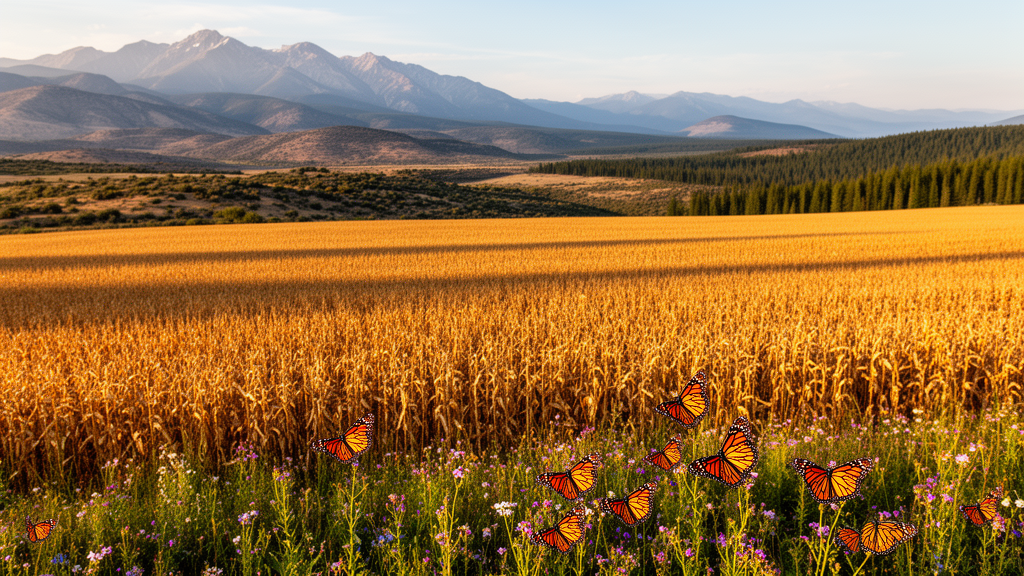
European regulators weighing the risks of insect-resistant Bt maize now have a new map-based tool for deciding which butterflies matter most where. A study carried out within the EU-funded AMIGA project has combined data on maize cultivation with the reported distributions of twenty butterfly species protected under the Habitats Directive, and mapped both across six of Europe’s biogeographic regions. The analysis shows that for several of these protected species, potential spatial exposure to Bt maize cultivation cannot be excluded at the regional level, with the Pannonian region emerging as a particular hotspot where large maize shares and widely distributed protected butterflies coincide.
The research, published in the journal BioRisk, addresses a long-standing gap in how the environmental risk assessment of genetically modified plants accounts for the different environments in which such crops would actually be grown. Under Directive 2001/18/EC and guidance from the European Food Safety Authority, authorisation of a genetically modified plant requires a case-by-case evaluation of its potential adverse effects on human health and the environment. An important aspect of that assessment is the receiving environment: the environment into which the plant will be released and where the transgene may spread, characterised by the crop, its management systems, and the geographical zones with their climates, soils, flora and fauna. Although the biogeographical regions of Europe have been proposed as a useful zoning concept for defining these receiving environments, practical experience with applying them in risk assessment has been largely limited.
The study’s authors set out to test whether these regions could serve as a practical classification scheme, and whether a geographic information system analysis could identify potential overlaps between protected butterflies and maize cultivation. They used the zoning scheme of the Habitats Directive, which defines nine biogeographic regions of Europe. Because the Macaronesian, Black Sea and Steppic regions lacked butterfly distribution data in the first Article 17 reporting period, six regions were analysed: the Alpine, Atlantic, Boreal, Continental, Mediterranean and Pannonian regions.
For the butterfly side of the analysis, the team started with all species listed in Annexes II and IV of the Habitats Directive, selecting twenty of the thirty-one listed species after excluding taxa not recognised in the Annexes, species occurring exclusively above the timberline or in Arctic latitudes, and two species for which no Article 17 assessments were available. Distribution data came from the Article 17 Report Database of the European Environment Agency, covering the first reporting period of 2001 to 2007 and EU-23 Member States, since no data were available from Romania, Bulgaria, Croatia, Malta and Cyprus. National distributions were transposed to a 10-kilometre grid to handle the heterogeneity of the national datasets.
Maize cultivation data were drawn from the EUROSTAT database for NUTS1 and NUTS2 regions, using the latest available figures between 2003 and 2012. Where a biogeographic region boundary divided a NUTS2 region, the maize area was split between the neighbouring regions in proportion to their area shares, assuming equal distribution of maize within the region. Data from Greece and Cyprus were not available. All geographic data were processed with ArcGIS software, and the results were expressed as hectares of maize per total area of each region.
The results reveal a strikingly uneven picture. Total maize area across the six regions amounts to more than 10 million hectares, roughly 2.6 percent of their combined area. The Continental region holds the largest absolute maize area, at more than 3 million hectares, but the Pannonian region has by far the highest maize share: 12.4 percent of its 11 million hectares, compared with 4.3 percent in the Atlantic, 3.6 percent in the Continental, 2.9 percent in the Alpine, 0.9 percent in the Mediterranean and just 0.1 percent in the Boreal region. Within the Pannonian region, maize cultivation is also more evenly spread across its NUTS2 regions, whereas in the Boreal, Atlantic and Alpine regions maize is concentrated in only a few of them; in the Boreal region, 90 percent of the maize area lies within about 20 percent of the region’s territory.
The butterfly distributions proved equally distinctive. The Alpine and Continental regions each host seventeen of the twenty protected species, the Mediterranean fourteen, the Pannonian thirteen, and the Atlantic and Boreal ten each. Five species occur across all six regions, including the large blue butterflies Maculinea teleius and M. arion, the marsh fritillary Euphydryas aurinia, and Lopinga achine and Lycaena dispar. Three species are endemic to the Mediterranean region. When the researchers calculated what share of each region’s area is occupied by the butterflies occurring there, the Pannonian region stood out with the largest distribution shares, hosting most species with extensive coverage. The Atlantic and Mediterranean regions showed the smallest shares, while the Boreal and Continental regions fell in between. Looking at it from the species’ perspective, the Continental region holds the highest number of species with large shares of their total distribution, whereas Apatura metis occurs almost exclusively in the Pannonian region, and Fabriciana elisa and Papilio hospiton are confined to the Mediterranean, being endemic to Corsica and Sardinia respectively.
Two case studies illustrated what these overlaps mean in practice. In the Atlantic region, the marsh fritillary Euphydryas aurinia occurs in countries such as Spain, France and the United Kingdom but not in Belgium, the Netherlands, Germany or Denmark. Although maize is cultivated throughout the Atlantic region, the majority of the butterfly’s distribution there lies in areas with low maize cultivation, such as the United Kingdom and northern Spain. Nevertheless, distribution areas of the species can also be identified within French NUTS2 regions with higher maize shares, indicating that areas of potential spatial proximity between the species and maize cultivation do exist. By contrast, the majority of the boreal distribution of Lycaena helle lies in Sweden and Finland, where maize cultivation is virtually absent; within the butterfly’s boreal range, maize is restricted to a single NUTS2 region, Lithuania.
Why does this matter for Bt maize specifically? Insect-resistant maize produces proteins from the soil bacterium Bacillus thuringiensis, and maize pollen expressing such Cry proteins can be deposited on the host plants of butterfly larvae near maize fields. Larvae feeding on those leaves may inadvertently ingest transgenic pollen, which can adversely affect them. Because few butterfly species occur inside maize fields, assessments of Bt maize effects focus on populations in off-field habitats such as field margins and natural habitats interspersed with cropland, where species of conservation concern have been observed in case studies in Austria, Germany and Switzerland. Protected or endangered butterflies are often difficult to detect in the field because of their low abundances, and laboratory testing of these species is difficult or undesirable, so current risk assessment practice relies on modelling approaches that consider a wide range of sensitivities of butterflies to the Cry toxin. Scientific controversies remain, however, over the isolation distances and buffer zones needed to protect these species.
The authors emphasise that their approach is a screening tool for the problem formulation stage of the environmental risk assessment, not a definitive risk analysis. Potential spatial overlaps can only be excluded at this geographical scale if either the butterfly species or maize cultivation is absent from a given biogeographic region, and the analysis has clear limitations: it does not cover all protected lepidopteran species because of gaps in the availability and completeness of EU-level distribution data, some Member States have not fully met their reporting obligations, and the Article 17 data record only presence or absence in each grid cell, with no information on population size or density. Moreover, actual exposure depends not only on spatial overlap but on the biology of each species. Larvae of Maculinea species, for instance, spend much of their lives as social parasites inside the nests of ants and are therefore unlikely to encounter maize pollen even when maize grows nearby, while the first instar larvae of Parnassius apollo occur in early spring and probably pupate before maize pollen is shed, making exposure unlikely for this univoltine species. The phenology of larvae in a given region and the number of generations per year are thus key factors, as is the flowering time of the maize variety itself. The authors also note that maize cultivation patterns may shift as climate change alters yield-limiting factors in European crop production, and that maize cultivation is significant in regions not covered by the study, in particular the Steppic region. With these caveats, the literature- and GIS-based approach is considered a useful first step for identifying which EU-wide protected species are most likely to be exposed when Bt maize is cultivated, and it can be transferred to other genetically modified plants, other protected species, and Natura 2000 habitats, while finer spatial resolution and the involvement of national authorities and biodiversity experts would be needed for the more detailed analyses that subsequent risk assessment steps require.
Subject of Research: A GIS-based spatial analysis of overlaps between Habitats Directive protected butterflies and maize cultivation across six European biogeographic regions to support the environmental risk assessment of Bt maize.
Article Title: Spatial analysis of the occurrence of protected butterflies in six European biogeographic regions as a tool for the environmental risk assessment of Bt maize
Article References: Marion, D., Andreas, B., & Andreas, H. (2018). Spatial analysis of the occurrence of protected butterflies in six European biogeographic regions as a tool for the environmental risk assessment of Bt maize. BioRisk, 13, 31-52. https://doi.org/10.3897/biorisk.13.20688
Image Credits: AI Generated
Keywords: Bt maize, protected butterflies, Habitats Directive, biogeographic regions, environmental risk assessment, AMIGA project, GIS analysis, maize cultivation, Pannonian region, non-target Lepidoptera, Article 17 reporting, Natura 2000
Cite Scienmag News
Alan Morgan. (October 27, 2026). Protected butterflies overlap with maize fields across six European biogeographic regions. Scienmag. https://scienmag.com/protected-butterflies-overlap-with-maize-fields-across-six-european-biogeographic-regions/
Alan Morgan. "Protected butterflies overlap with maize fields across six European biogeographic regions." Scienmag, 27 October 2026, https://scienmag.com/protected-butterflies-overlap-with-maize-fields-across-six-european-biogeographic-regions/. Accessed 27 October 2026.
Alan Morgan. "Protected butterflies overlap with maize fields across six European biogeographic regions." Scienmag. October 27, 2026. https://scienmag.com/protected-butterflies-overlap-with-maize-fields-across-six-european-biogeographic-regions/


