


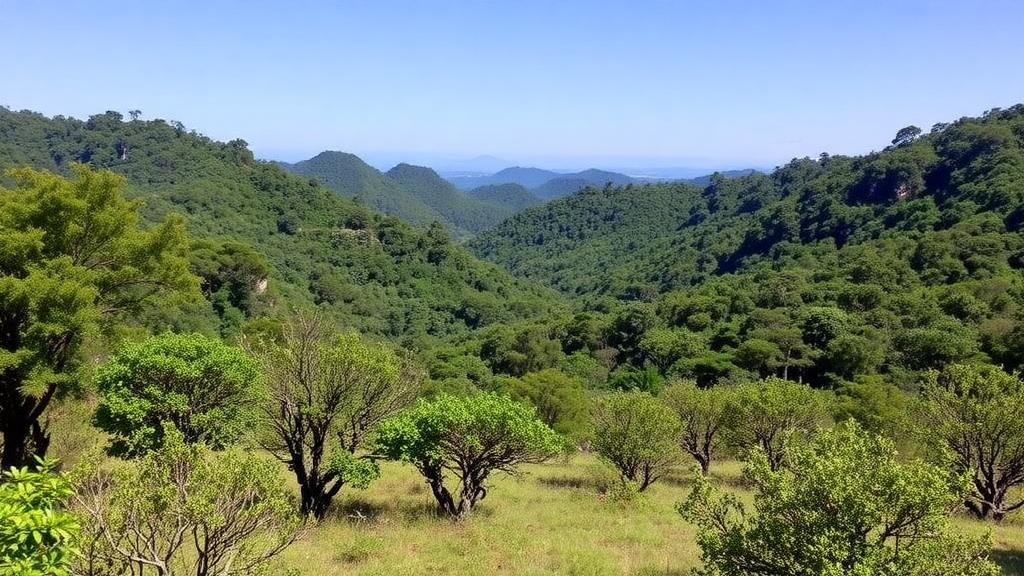
Protected areas are the world’s most widely used tool for safeguarding biodiversity, yet a new study from southern Brazil shows that simply drawing boundaries on a map is not enough. An evaluation of eleven strictly protected nature Conservation Units in the state of Rio Grande do Sul has revealed that the overwhelming majority are managed at levels ranging from mediocre to deeply deficient, and that most are failing to fulfil the very objectives for which they were created. The findings, published in the journal Neotropical Biology and Conservation, offer a sobering diagnosis of conservation on the ground and a concrete roadmap for fixing it.
The research team assessed eleven of the twenty-three Conservation Units existing in Rio Grande do Sul, all of them full-protection areas spanning two of Brazil’s most important biomes: the Atlantic Forest and the Pampa. The sample included eight State Parks, such as Turvo, Itapuã, Tainhas and Delta do Jacuí, along with the Serra Geral Biological Reserve, the Aratinga Ecological Station and the Banhado dos Pachecos Wildlife Refuge. Together these areas protect thousands of hectares of highly threatened forest and grassland, home to native flora and fauna listed in official state decrees as imperilled by habitat fragmentation, hunting and illegal wildlife trade.
To measure how well these areas are actually being run, the researchers applied an adapted version of the Measurement of the Effectiveness of Management of Protected Areas, known by its Spanish acronym EMAP. The method, originally developed in Latin America and grounded in the quality-management principles of the ISO 10004 standard, breaks protected area management down into eight scopes, from planning and administrative capacity to infrastructure, legal standing, scientific knowledge and the quality of the natural resources themselves. Within those scopes, the team scored seventy-three indicators across sixty-five evaluation scenarios, using a five-level Likert scale in which zero represents a very unsatisfactory standard and four represents excellence.
The data came from three complementary sources: a review of each unit’s management plan and official documents, face-to-face interviews with the managers conducted during visits of roughly two days per unit, and direct field observation. Fieldwork took place between March and July 2022. Because every unit in the sample already possessed a management plan, the study could focus on how well the machinery of management was actually functioning rather than simply whether the paperwork existed.
The results were stark. Ninety-one percent of the assessed units scored between average and very unsatisfactory on management effectiveness. Two units, Espinilho State Park at 31.6 percent and Ibitiriá State Park at 39.6 percent, fell into the very unsatisfactory category. Four more, Delta do Jacuí, Itapeva, Espigão Alto and Tainhas State Parks, landed in the unsatisfactory band. Four units, Turvo State Park, Aratinga Ecological Station, Itapuã State Park and Serra Geral Biological Reserve, reached only an average standard. A single unit, the Banhado dos Pachecos Wildlife Refuge, achieved a high or satisfactory score of 85.8 percent, and not one unit reached the level of excellence.
To understand the underlying structure of these results, the researchers ran ordination analyses on their data matrices. A Principal Component Analysis of the eight scopes, tested for significance with a randomisation procedure, produced a single significant axis explaining 63.8 percent of the total variation. This axis formed a clean gradient of management quality across the state, with the weakest units at one end, the strongest at the other, and every scope except the quality of natural resources and current uses correlating strongly and positively with the gradient. In other words, units that do well in one dimension of management tend to do well across the board, while struggling units tend to struggle everywhere.
A second ordination, this time across forty-three individual indicators, confirmed the same pattern at finer resolution and identified the indicators most tightly linked to management success. Biophysical knowledge topped the list with a correlation of 0.97, followed by the demarcation of unit boundaries, compliance with norms, the dynamics of organisation and planning, the existence of an advisory board, operations management programmes, the dissemination of research results, research infrastructure and, crucially, the management plan itself. Interestingly, the analysis also uncovered a moderate inverse relationship with social conflicts, suggesting that units with stronger overall management tend to record more social conflict, possibly because better-run, more visible units attract and document more stakeholder friction.
The study’s diagnosis echoes a growing body of evidence from elsewhere in Brazil and beyond. Previous EMAP assessments in Minas Gerais found that sixty percent of thirty-nine integral protection units showed unsatisfactory management, and in São Paulo State, eighty-eight percent of forty-one units fell between average and unsatisfactory. The Rio Grande do Sul results fit squarely within this national pattern, pointing to systemic weaknesses rather than isolated local failures. Among the most persistent problems identified were outdated management plans, some published more than two decades ago, chronic shortages of staff and funding, precarious or absent infrastructure, unresolved land tenure and, in several cases, the complete lack of a consultative council, which three of the parks, Delta do Jacuí, Espinilho and Ibitiriá, still lack.
The authors argue that these deficiencies prevent the units from achieving their legal conservation objectives, with cascading consequences for biodiversity, ecological processes and the social and economic benefits that protected areas are meant to provide. They recommend a package of corrective measures: adopting a quali-quantitative evaluation model, ideally through a mathematical framework, so that managers can periodically measure their own performance; increasing staff numbers and training both teams and managers; improving infrastructure and equipment; guaranteeing regular budget allocations; completing land regularisation; establishing consultative councils where they are missing; and urgently reviewing and updating management plans so that zoning, monitoring programmes and public-use rules reflect current realities.
The broader lesson is one that conservation science has been repeating for decades: creating a protected area is a necessary but insufficient act. Without sustained investment in people, planning and accountability, the boundaries of a park or reserve become little more than lines on paper. The EMAP method, the researchers note, proved to be a practical and adaptable instrument that managers themselves can apply once trained, making regular self-assessment a realistic first step. As Brazil and other biodiversity-rich nations work toward global targets for expanding protected area coverage, this study from the southern edge of the Atlantic Forest and the heart of the Pampa serves as a pointed reminder that the quality of protection matters just as much as the quantity of land set aside.
Subject of Research: Management effectiveness of strictly protected nature conservation units in Rio Grande do Sul, southern Brazil
Article Title: Management effectiveness of Nature Conservation Units in southern Brazil
Article References: Witt, P. B. R., Faria, H. H. D., Oliveira, J. D., & Oliveira, L. R. D. (2023). Management effectiveness of Nature Conservation Units in southern Brazil. Neotropical Biology and Conservation, 18(3), 209-230. https://doi.org/10.3897/neotropical.18.e103019
Image Credits: AI Generated
DOI: 10.3897/neotropical.18.e103019
Keywords: protected areas, conservation units, management effectiveness, EMAP, Atlantic Forest, Pampa, Rio Grande do Sul, biodiversity conservation, management plans, Brazil, Likert scale, PCA
Cite Scienmag News
Margaret Porter. (October 19, 2026). Protected Areas in Southern Brazil Are Failing Their Own Conservation Goals. Scienmag. https://scienmag.com/protected-areas-in-southern-brazil-are-failing-their-own-conservation-goals/
Margaret Porter. "Protected Areas in Southern Brazil Are Failing Their Own Conservation Goals." Scienmag, 19 October 2026, https://scienmag.com/protected-areas-in-southern-brazil-are-failing-their-own-conservation-goals/. Accessed 19 October 2026.
Margaret Porter. "Protected Areas in Southern Brazil Are Failing Their Own Conservation Goals." Scienmag. October 19, 2026. https://scienmag.com/protected-areas-in-southern-brazil-are-failing-their-own-conservation-goals/


