


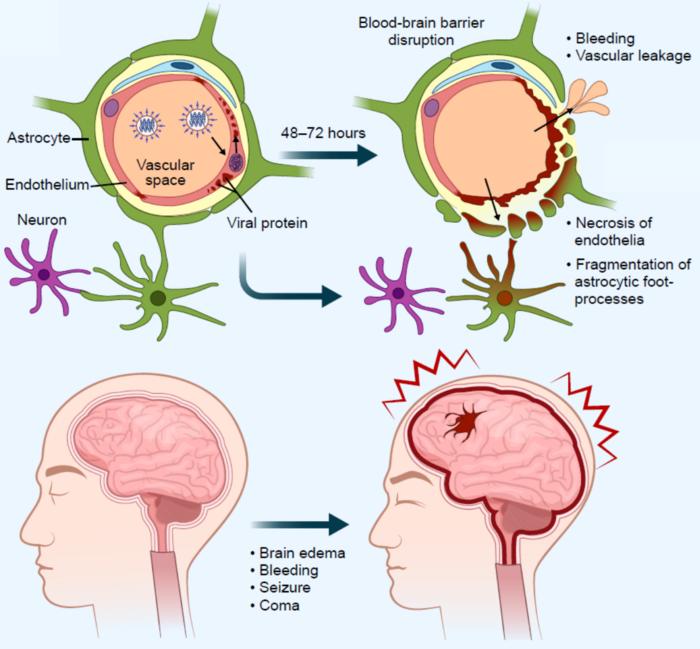
Osaka, Japan – It might start simply, with a cough or sneeze…but in some cases, the flu virus can make its way to your brain, causing serious symptoms or even death through a disease known as influenza-associated encephalopathy (IAE).

Credit: ©2024 Kimura-Ohba
Osaka, Japan – It might start simply, with a cough or sneeze…but in some cases, the flu virus can make its way to your brain, causing serious symptoms or even death through a disease known as influenza-associated encephalopathy (IAE).
Now, in a study published in Acta Neuropathologica, researchers have revealed that IAE may be caused by the virus entering the brain through a specific cell type, and have identified possible treatment strategies.
Although IAE is increasingly common, surprisingly little is known about how the influenza virus actually gets into the brain and causes symptoms of encephalopathy (a general term for brain disorders). Notably, a definitive treatment for IAE remains lacking, something that researchers from Osaka University wanted to address.
To study how influenza viruses might cause IAE, the research team used a range of methods. As well as looking for virus particles in the brains of people who died from IAE, they created a mouse model of the disease by injecting influenza A virus into the blood. They also used cell culture methods to look at how well the virus infects different cell types.
“In the human brains, the virus-injected mice, and the cultured cells, the influenza virus tended to accumulate in endothelial cells,” explains lead author of the study Shihoko Kimura-Ohba. “These cells create a barrier between the blood and the brain, and are important for protecting the brain from harmful substances.”
Accordingly, in both the human brains and the mouse model, the barrier between the blood and the brain was compromised. Furthermore, the researchers noticed that the virus wasn’t actually reproducing within these endothelial cells—but there were a lot of proteins made by the virus.
“When we saw this viral protein accumulation in the brain, we realized that antiviral medications aimed at stopping viral proliferation were unlikely to help,” says Tomonori Kimura, senior author of the study. “However, antivirals aimed at stopping viral transcription and translation—vital processes for making proteins—are also available.”
When the team tried these classes of antivirals in endothelial cells treated with influenza virus, they observed less viral proteins and cell death. In the mouse model of IAE, these antivirals were also very effective when used early enough, suggesting that they may be useful in human patients.
Given that many different kinds of viruses, including COVID-19, can cause encephalopathy, these findings have wide-ranging impacts. Moreover, although IAE care is improving, more than half of all patients die or have long-lasting symptoms. A better understanding of how viruses can cause encephalopathy will be important for developing new, effective treatments.
###
The article, “Viral entry and translation in brain endothelia provoke influenza-associated encephalopathy,” was published in Acta Neuropathologica at DOI:
About Osaka University
Osaka University was founded in 1931 as one of the seven imperial universities of Japan and is now one of Japan’s leading comprehensive universities with a broad disciplinary spectrum. This strength is coupled with a singular drive for innovation that extends throughout the scientific process, from fundamental research to the creation of applied technology with positive economic impacts. Its commitment to innovation has been recognized in Japan and around the world, being named Japan’s most innovative university in 2015 (Reuters 2015 Top 100) and one of the most innovative institutions in the world in 2017 (Innovative Universities and the Nature Index Innovation 2017). Now, Osaka University is leveraging its role as a Designated National University Corporation selected by the Ministry of Education, Culture, Sports, Science and Technology to contribute to innovation for human welfare, sustainable development of society, and social transformation.
Website:
Journal
Acta Neuropathologica
Method of Research
Experimental study
Subject of Research
Animals
Article Title
Viral entry and translation in brain endothelia provoke influenza-associated encephalopathy
Article Publication Date
30-Apr-2024
Cite Scienmag News
Cassandra Pierce. (May 2, 2024). Promising new treatment strategy for deadly flu-related brain disorders. Scienmag. https://scienmag.com/promising-new-treatment-strategy-for-deadly-flu-related-brain-disorders/
Cassandra Pierce. "Promising new treatment strategy for deadly flu-related brain disorders." Scienmag, 2 May 2024, https://scienmag.com/promising-new-treatment-strategy-for-deadly-flu-related-brain-disorders/. Accessed 6 September 2026.
Cassandra Pierce. "Promising new treatment strategy for deadly flu-related brain disorders." Scienmag. May 2, 2024. https://scienmag.com/promising-new-treatment-strategy-for-deadly-flu-related-brain-disorders/

