


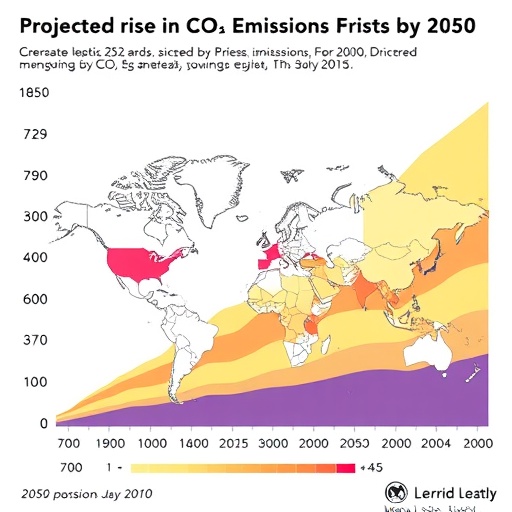
Carbon dioxide emissions from global land cover mapping are projected to increase by 2050, signifying a crucial turning point in understanding how terrestrial ecosystems interact with climate change. This research, led by Wang et al., presents alarming predictions that reverberate through the fields of climate science, ecology, and environmental policy. The implications of land cover changes on carbon emissions are pivotal for future environmental planning and management, necessitating a deep dive into the underlying mechanisms that drive these trends.
Historically, land cover mapping has been essential for understanding how different ecosystems contribute to or mitigate carbon emissions. Various landscapes, from forests to urban areas, possess distinct characteristics that influence their carbon sequestration capabilities. This study harnesses advanced modeling techniques to project how these characteristics will evolve over the coming decades, revealing a concerning trajectory of rising carbon dioxide emissions. The research underscores the urgency for targeted interventions that aim to stabilise or enhance land sinks before these projections materialize.
One of the key findings of the study is that the anticipated increase in carbon dioxide emissions is not uniform across different regions. The research identifies specific areas that are likely to experience the most significant fluctuations due to land use changes. Urbanization, agricultural expansion, and deforestation are highlighted as primary factors contributing to changes in land cover, subsequently leading to increased greenhouse gas emissions. Understanding these localized impacts is critical for formulating effective environmental policies.
Moreover, the study incorporates various scenarios to forecast the extent of emissions by 2050. Different pathways, such as aggressive conservation efforts or unchecked urban sprawl, display starkly contrasting outcomes. These scenarios illustrate the frailty of our current trajectory and the profound impact of human decisions on the global carbon cycle. The implications of this variability are enormous, as they inform policymakers and stakeholders regarding the significance of sustainable practices.
In addition to predicting emissions, the research delves into the underlying mechanisms driving these changes. Changes in land cover alter not only the physical structure of ecosystems but also their biological functions. For example, forests, which typically act as carbon sinks, can become net emitters when subjected to deforestation or degradation. This study provides compelling evidence that conservation efforts targeting these ecosystems could play a crucial role in carbon mitigation strategies.
Moreover, the research discusses the role of technology in monitoring land cover changes. Advanced remote sensing techniques allow for more accurate and timely assessments of how terrestrial landscapes are changing. Improved data accuracy can significantly enhance our understanding of emission sources and sinks, facilitating better-informed policy decisions. The integration of cutting-edge technological solutions into environmental assessment processes may lead to more proactive, rather than reactive, management strategies.
Another essential aspect of the study is its focus on the socio-economic implications of land use changes. The link between economic growth and land transformation is pronounced; therefore, efforts to mitigate emissions often face the challenge of balancing economic interests with environmental stewardship. The study’s authors argue that achieving substantial emissions reductions will necessitate a paradigm shift in how societies perceive land use—shifting towards a more sustainable model that values ecological health equally alongside economic development.
As we delve deeper into the 21st century, the need for global cooperation in tackling climate change becomes ever more pressing. The predictions put forth by Wang et al. serve as a clarion call for nations to unite in their climate actions. International agreements and collaborative strategies to manage land cover changes could lead to remarkable progress in reducing overall carbon emissions. The interconnectedness of global ecosystems necessitates a unified approach to address these challenges.
Furthermore, public awareness and education play a critical role in the success of any climate initiative. By disseminating key findings from this research, stakeholders can foster a more informed citizenry that advocates for sustainable practices. The interplay between public sentiment and policy will have lasting effects on environmental governance, emphasizing the need to keep communities engaged in these significant discussions.
While the study paints a troubling picture of the future, it also offers glimpses of hope. The recognition of the factors contributing to increased carbon emissions from land cover changes allows for strategic intervention. Policymakers can utilize the research findings to prioritize initiatives aimed at preserving and restoring ecosystems vital for carbon sequestration. This proactive approach could potentially mitigate the adverse effects forecasted for 2050.
In summary, this groundbreaking research underscores the urgent need to address the projected increases in carbon dioxide emissions stemming from global land cover mapping. As societies grapple with the implications of these findings, it becomes evident that a comprehensive, multisectoral response is required. By embracing sustainable land management practices, leveraging technology for better resource mapping, and fostering global cooperation, we can steer toward a more resilient future.
The study by Wang et al. marks an important juncture in climate research, serving as a reminder of our interconnectedness with the environment. It challenges us to reflect on our daily choices and the profound impact they have on our planet’s future. As we look ahead to 2050, it is crucial that we recognize the pathways available to us and take decisive action to ensure a healthier, more sustainable world.
Wang, H., Yao, Y., Zhao, Y. et al. Carbon dioxide emissions from global land cover mapping are projected to increase by 2050.
Commun Earth Environ 6, 1018 (2025). https://doi.org/10.1038/s43247-025-02990-y
Cite Scienmag News
Sloane Callahan. (December 18, 2025). Projected Rise in CO2 Emissions by 2050. Scienmag. https://scienmag.com/projected-rise-in-co2-emissions-by-2050/
Sloane Callahan. "Projected Rise in CO2 Emissions by 2050." Scienmag, 18 December 2025, https://scienmag.com/projected-rise-in-co2-emissions-by-2050/. Accessed 3 September 2026.
Sloane Callahan. "Projected Rise in CO2 Emissions by 2050." Scienmag. December 18, 2025. https://scienmag.com/projected-rise-in-co2-emissions-by-2050/


