


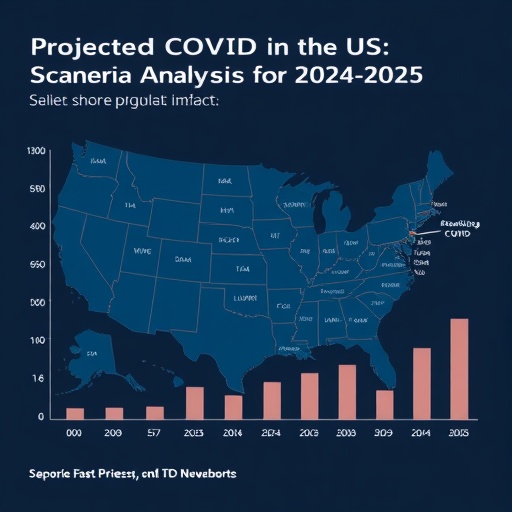
In the continuously evolving landscape of the COVID-19 pandemic, recent analytical modeling presents crucial insights into the potential burden of the disease in the United States over the next two years. A comprehensive study employing decision-analytic modeling and ensemble projections has illuminated the multifaceted impact of vaccination strategies during 2024 to 2025, emphasizing the undeniable benefits of maintaining broad vaccine availability. Amidst uncertainties stemming from the emergence of new viral variants and their immune escape capabilities, these projections underscore vaccination as a vital tool in reducing morbidity and mortality on a national scale.
The essence of this modeling study pivots around the construction of an ensemble of predictive scenarios that simulate the trajectory of COVID-19 in the U.S. under varying vaccination policies. By integrating epidemiological data and immunological parameters, researchers crafted a robust framework that accounted for differential vaccine uptake among high-risk populations versus universal vaccination approaches. This methodology allowed for nuanced comparison, highlighting the tangible reduction in disease burden when vaccination is extended beyond vulnerable groups to the wider population.
A salient feature of the study involves the incorporation of immune escape scenarios relative to emergent viral variants. Recognizing that SARS-CoV-2 continuously evolves, potentially diminishing vaccine-induced immunity, the researchers simulated multiple pathways wherein immune evasion could alter infection dynamics. The robustness of vaccination benefits across these scenarios demonstrates that, despite the possible diminished effectiveness against certain variants, broad immunization still plays a pivotal role in mitigating severe outcomes and transmission chains.
Interestingly, the ensemble projections revealed some divergence from observed disease patterns during this period. Such disparities are attributed to the unpredictability inherent in variant emergence and transmission, as well as behavioral and policy responses that influence viral spread. Nonetheless, the core takeaway remains consistent: vaccination retains a substantial positive impact even when confronted with dynamic and complex epidemiological realities.
Vaccinating high-risk groups—such as the elderly, immunocompromised individuals, and those with significant comorbidities—naturally provides critical protection to the most vulnerable. The study quantitatively confirms these benefits, demonstrating measurable reductions in hospitalizations and fatalities within these cohorts. However, restricting vaccination exclusively to these demographics limits the overall population-level impact, potentially leaving broader community transmission unchecked.
In contrast, universal vaccine recommendation policies extend protective effects through indirect community immunity. By reducing the total susceptible population and interrupting transmission chains, widespread vaccination curtails viral replication opportunities. This epidemiological principle underpins the projection that universal vaccine access could prevent thousands more deaths compared to targeted-only vaccination strategies, offering substantial public health dividends.
The modeling also integrates an understanding of vaccine waning immunity, accounting for how protective effects diminish over time and the potential need for booster doses. This temporal dimension underscores the importance of maintaining vaccine programs and public health messaging to enhance uptake and compliance, ensuring sustained immunity within the population rather than transient protection confined to isolated groups.
Immunological modeling within the study considers both humoral and cellular immunity implications for vaccine effectiveness. The simulations factor in neutralizing antibody titers and T-cell responses, which collectively contribute to the breadth and durability of immune protection. By doing so, the researchers offer a more comprehensive depiction of how vaccines modulate host responses and influence epidemic trajectories.
Delving deeper into the analytical mechanics, the study leverages advanced computational algorithms and differential equation-based frameworks to simulate viral spread under varying public health interventions. This includes sensitivity analyses to test the stability of projections against variations in parameters such as vaccine efficacy, transmission rates, and population behavior factors, thereby enhancing the credibility and applicability of the findings.
Furthermore, these insights hold substantial implications for health policymakers and epidemiologists monitoring COVID-19’s future course. The clear message advocates for sustained and universally accessible vaccination programs as a cornerstone of pandemic control, particularly given the virus’s capacity for antigenic drift and potential to evade prior immunity. Public health strategies should prioritize infrastructure and communication efforts that facilitate equitable vaccine distribution.
The study’s findings also resonate in the broader context of pandemic preparedness and response frameworks. As the world grapples with the ongoing challenges posed by COVID-19 and anticipates future pathogens with pandemic potential, integrating data-driven modeling into vaccination policy design remains a critical component. This approach enables proactive refinement of strategies that can adapt to viral evolution and shifting epidemiological landscapes.
In summary, while the future trajectory of COVID-19 is inherently uncertain due to the virus’s mutable nature, this modeling analysis robustly underscores the substantial benefits gleaned from universal vaccination approaches. By safeguarding both high-risk populations and the general public, such strategies potentiate significant reductions in disease burden. The evidence affirms vaccination as an indispensable pillar of public health, capable of saving thousands of lives amid evolving viral threats.
Corresponding Author: Sung-mok Jung, PhD (sungmok@ad.unc.edu)
References: doi:10.1001/jamanetworkopen.2025.32469
Keywords
COVID-19, United States population, Risk assessment, Vaccination, Modeling, Immunology, Observational studies, Analytical mechanics
Cite Scienmag News
Kristina Jarvis. (September 18, 2025). Projected COVID-19 Impact in the US: Scenario Analysis for 2024-2025. Scienmag. https://scienmag.com/projected-covid-19-impact-in-the-us-scenario-analysis-for-2024-2025/
Kristina Jarvis. "Projected COVID-19 Impact in the US: Scenario Analysis for 2024-2025." Scienmag, 18 September 2025, https://scienmag.com/projected-covid-19-impact-in-the-us-scenario-analysis-for-2024-2025/. Accessed 4 September 2026.
Kristina Jarvis. "Projected COVID-19 Impact in the US: Scenario Analysis for 2024-2025." Scienmag. September 18, 2025. https://scienmag.com/projected-covid-19-impact-in-the-us-scenario-analysis-for-2024-2025/


