


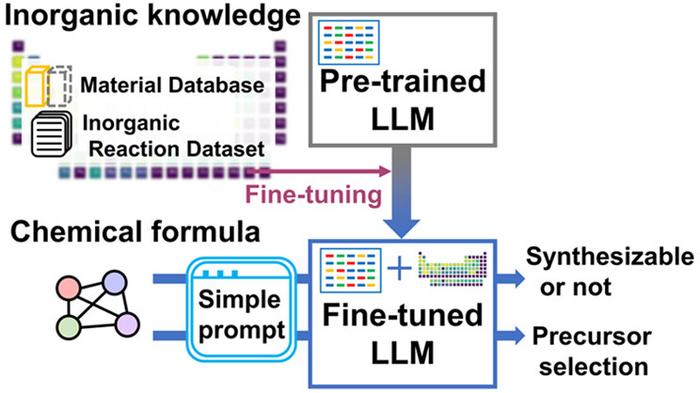
In a groundbreaking study, a research team from Seoul National University (SNU) has harnessed the power of Large Language Models (LLMs) to revolutionize the predicting of synthesizability in novel inorganic materials. This innovative approach addresses a significant gap in material science that has long hindered efficient research and development processes. In the era of rapid technological advancement, the ability to accurately forecast which materials can be feasibly synthesized is more crucial than ever. Traditional material discovery methods have relied heavily on trial and error, leading to wasted resources and extended timelines for material innovation.
The research team, led by Professor Yousung Jung from the Department of Chemical and Biological Engineering, explored how LLMs could enhance the synthesis of novel materials. Their findings suggest that these models can not only predict synthesizability more accurately than conventional methods but also provide valuable insights into the reasoning behind their assessments. This ‘explainability’ aspect of LLMs could open new avenues for understanding the complex factors influencing material synthesis, which range from thermodynamic stability to chemical interactions within crystal structures.
Currently, predicting the synthesizability of materials predominantly involves evaluating their thermodynamic stability. However, existing models have been criticized for their limited accuracy, often resulting in a significant gap between predicted and actual synthesis success rates. Despite various machine learning approaches being employed to tackle this issue, they typically lack transparency and do not elucidate the basis for their predictions. Professor Jung’s research acknowledges these challenges and showcases how fine-tuning LLMs can transcend these limitations.
The team began their study by fine-tuning a general-purpose LLM using extensive datasets related to inorganic materials. Training the model involved inputting text-based information on inorganic crystal structures to classify synthesizability, predict necessary precursor compounds, and interpret essential factors influencing synthesis. When evaluated, the modified LLM demonstrated superior predictive capabilities compared to traditional bespoke machine learning models, marking a significant advancement in the field.
An impressive aspect of this research is the dual capability of the LLM to predict and rationalize its predictions. By analyzing why specific materials are synthesizable, the study pioneers a pathway to pinpoint the reasons behind the difficulties associated with synthesizing certain hypothetical structures. This critical understanding could not only streamline the material discovery process but also foster a more strategic approach toward developing new materials.
One of the surprising outcomes of the research was the identification of previously unknown correlations that could impact synthesizability. As researchers continue to unravel the complex interplay of factors in material science, these revelations could facilitate the design of more predictable synthesis pathways for complex inorganic compounds. Such advancements hold immense potential for applications across various industries, especially those involving semiconductors and advanced battery technologies.
The potential implications of this research are vast, particularly for the South Korean advanced materials industry. By efficiently predicting and elucidating the synthesizability of materials, this innovative approach can drive competitiveness in industries, such as semiconductors and secondary batteries. Traditional material discovery methods require extensive trial-and-error experimentation; however, the insights provided by LLMs could drastically accelerate the time from idea to production.
In a rapidly evolving technological landscape, maintaining a competitive edge in material design is paramount. The South Korean government has placed a strong emphasis on securing leadership in advanced materials, particularly in sectors crucial for the nation’s future, such as electronics and renewable energy sources. The introduction of LLMs for material synthesis predictions can serve as a game changer, ensuring the country remains at the forefront of innovation.
Commercialization of this research represents an exciting prospect. If successfully implemented, the technology could provide research institutions and companies with powerful tools for identifying new materials and assessing their feasibility for mass production. The research team’s findings could dramatically shorten the timeline necessary for bringing new materials to market, creating opportunities for advancements that were previously considered impractical.
Professor Jung highlighted the significance of their work, noting that the capacity of LLMs to predict and explain synthesizability could transform the material design landscape. As these technologies progress, they are anticipated to deliver increasingly efficient and intuitive methods for novel material creation. The implications of this research extend far beyond academic curiosity; they possess the potential to redefine how industries approach material synthesis and development.
Postdoctoral Researcher Seongmin Kim’s role in the study also underscores the collaborative nature of this research. As the leading author of the paper, Kim aims to extend this work through future studies that integrate machine learning with materials science paradigms. This ongoing journey of exploration signifies a united effort to reshape the possibilities within materials development, promising a future where LLMs could become common tools at the disposal of material scientists globally.
Overall, the advancements made by this research team at SNU represent a monumental leap forward in the integration of artificial intelligence and materials science. By employing LLMs for synthesizability prediction, the scientific community can expect more reliable, explainable, and efficient methodologies in the quest for new materials. These developments promise not only to enhance material creation processes but also to pave the way for innovative breakthroughs that may redefine entire industries.
As interest in this research continues to grow, attention will likely turn towards further developments in machine learning applications within materials science. The journey toward refining the capabilities of LLMs in synthesizability predictions is just beginning, and the future holds substantial prospects for even more significant advancements in materials development.
In summary, the research conducted by Professor Jung and his team signifies a pivotal moment in the intersection of artificial intelligence and chemistry, leading to a new understanding of material synthesizability that could redefine the future of material engineering.
Keywords
Cite Scienmag News
Bethany Barker. (March 27, 2025). Professor Yousung Jung’s Research Team at SNU Leverages Large Language Models to Predict and Analyze the Synthesizability of Novel Materials. Scienmag. https://scienmag.com/professor-yousung-jungs-research-team-at-snu-leverages-large-language-models-to-predict-and-analyze-the-synthesizability-of-novel-materials/
Bethany Barker. "Professor Yousung Jung’s Research Team at SNU Leverages Large Language Models to Predict and Analyze the Synthesizability of Novel Materials." Scienmag, 27 March 2025, https://scienmag.com/professor-yousung-jungs-research-team-at-snu-leverages-large-language-models-to-predict-and-analyze-the-synthesizability-of-novel-materials/. Accessed 3 September 2026.
Bethany Barker. "Professor Yousung Jung’s Research Team at SNU Leverages Large Language Models to Predict and Analyze the Synthesizability of Novel Materials." Scienmag. March 27, 2025. https://scienmag.com/professor-yousung-jungs-research-team-at-snu-leverages-large-language-models-to-predict-and-analyze-the-synthesizability-of-novel-materials/


