


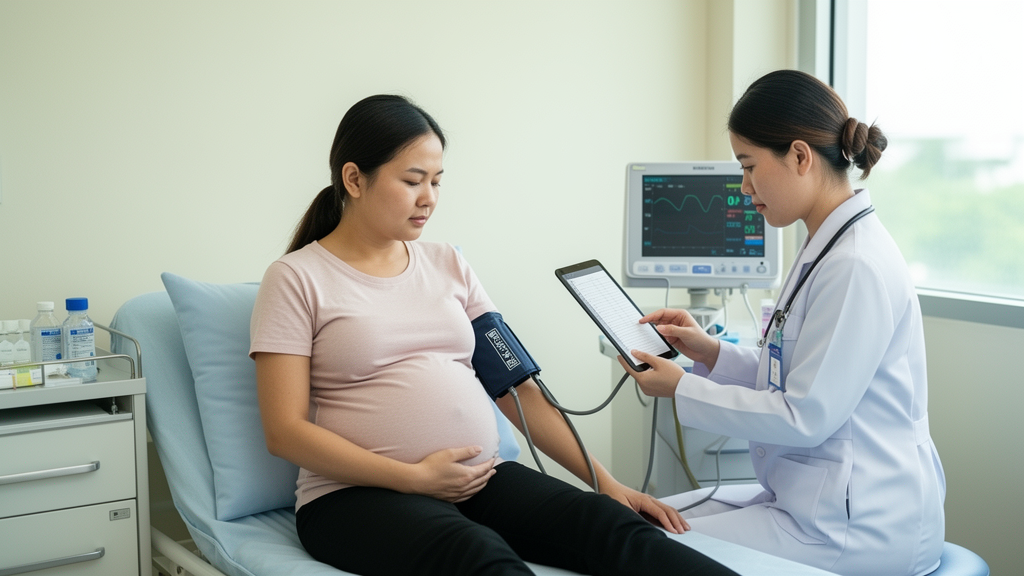
Women with a history of preeclampsia had nearly six times the adjusted odds of preeclampsia with severe features in a multicenter case–control study across four tertiary hospitals in Thailand. Higher body-mass index and moderate rather than low preeclampsia knowledge were also associated with lower adjusted odds of severe features. These observational findings identified associations but did not establish causation or show that knowledge counseling prevents severe disease.
Researchers enrolled 156 postpartum women with preeclampsia, including 52 with severe features and 104 without severe features. They separately surveyed 111 nurse–midwives working in antenatal care, labor, and postpartum units at the same hospitals. The investigators collected maternal and neonatal data through postpartum questionnaires and health records, while nurse–midwives completed questionnaires about health-service factors. Group differences were assessed with independent t-tests, chi-square tests, and Fisher’s exact tests.
Multivariable binary logistic regression examined factors associated with severe features while adjusting for antenatal-care visits and gravidity. A previous preeclampsia episode was more common among women with severe features than among those without them, affecting 32.7% and 13.5% of the respective groups, respectively. After adjustment, previous preeclampsia was associated with higher odds of severe features, with an adjusted odds ratio of 5.99 and a 95% confidence interval of 2.13–16.83. The groups also differed in body-mass-index distribution. Each additional kilogram per square meter was associated with slightly lower adjusted odds of severe features, with an adjusted odds ratio of 0.92 per kg/m² and a 95% confidence interval of 0.86–0.98.
Maternal preeclampsia knowledge showed a separate adjusted association. Compared with low knowledge, moderate knowledge was associated with lower odds of severe features, with an adjusted odds ratio of 0.13 and a 95% confidence interval of 0.04–0.50. The wide interval indicates substantial uncertainty about the magnitude of that estimate. No health-service variable, including nurse–midwife training, was independently associated with severe features after adjustment; all corresponding p-values exceeded 0.05. The final model explained 29.4% of the variance in severity, as measured by Nagelkerke’s R², and correctly classified 75.8% of cases.
Infant birth weight was lower among women with severe features than among those without them, a difference reported at p less than 0.05. Mode of delivery, length of hospital stay, birth asphyxia, and neonatal intensive-care unit admission did not differ significantly between the groups. As a case–control study, the analysis cannot determine whether prior preeclampsia, body-mass index, or maternal knowledge causally affects severity. It was also limited to postpartum women treated at four Thai tertiary hospitals, with only 52 severe cases and wide confidence intervals for some estimates. The authors called for adequately powered, multilevel studies to clarify the role of health-service factors.
Subject of Research: Maternal and health-service factors associated with severe preeclampsia in Thai tertiary hospitals
Article Title: Predictors of preeclampsia with severe features: A multi–center analysis of maternal and health system factors in Thai tertiary hospitals
Article References: Boonyaporn, T., Limruangrong, P., Ratinthorn, A., & Tankumpuan, T. (2026). Predictors of preeclampsia with severe features: A multi–center analysis of maternal and health system factors in Thai tertiary hospitals. PLOS One, 21(10), e0361195. https://doi.org/10.1371/journal.pone.0361195
Image Credits: AI Generated
DOI: 10.1371/journal.pone.0361195
Keywords: preeclampsia, severe features, pregnancy history, body-mass index, maternal knowledge, health-service factors, nurse–midwives, neonatal birth weight, Thailand, case–control study, Predictors, severe
Cite Scienmag News
Harold Sullivan. (October 26, 2026). Prior preeclampsia linked to severe features in Thai hospitals. Scienmag. https://scienmag.com/prior-preeclampsia-linked-to-severe-features-in-thai-hospitals/
Harold Sullivan. "Prior preeclampsia linked to severe features in Thai hospitals." Scienmag, 26 October 2026, https://scienmag.com/prior-preeclampsia-linked-to-severe-features-in-thai-hospitals/. Accessed 26 October 2026.
Harold Sullivan. "Prior preeclampsia linked to severe features in Thai hospitals." Scienmag. October 26, 2026. https://scienmag.com/prior-preeclampsia-linked-to-severe-features-in-thai-hospitals/


