

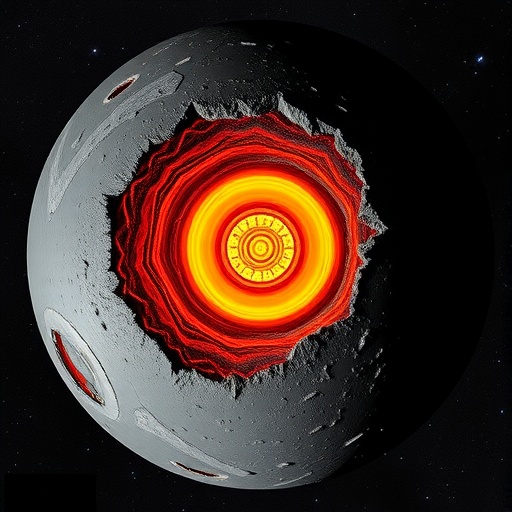
A Revolutionary Insight into Earth’s Outer Core: Primordial Magnesium as the Key to the Mysterious Low-Velocity Seismic Layer
In the intricate world of Earth sciences, the composition and behavior of our planet’s inner layers continue to intrigue and challenge geophysicists. One of the most perplexing mysteries has been the enigmatic low-velocity seismic layer detected within the Earth’s outermost outer core. Despite decades of research and advanced seismic imaging, the precise nature and cause of this anomalous zone have remained elusive. A groundbreaking study by Liu and Jing, published recently in Nature Communications, proposes a novel explanation hinging on a primordial presence of magnesium (Mg) within the outer core – a revelation that could redefine our fundamental understanding of Earth’s deep interior dynamics.
Seismic waves, generated by earthquakes and artificial sources, provide one of the most powerful tools to probe Earth’s inaccessible layers. Variations in their velocity and propagation reveal compositional and phase differences across boundaries kilometers beneath the surface. Notably, a persistent low-velocity zone has been consistently detected just beneath the core-mantle boundary within the outermost portion of the liquid outer core. This zone exhibits seismic velocities significantly lower than surrounding material, suggesting a complex chemical or physical anomaly. Traditional explanations, ranging from compositional heterogeneity to temperature anomalies and phase transitions, have failed to fully account for all observational data. Liu and Jing’s model introduces an innovative hypothesis: the relic presence of primordial magnesium in the outer core layer.
Magnesium’s involvement in deep Earth processes has long been acknowledged, primarily through its dominant presence in the Earth’s mantle minerals. However, its role in the core, traditionally thought to be dominated by iron and lighter elements like sulfur, oxygen, and silicon, has been underestimated or overlooked. The new research posits that magnesium was incorporated into the core during the Earth’s formative stages, when high pressures and temperatures allowed for unusual chemical partitioning. This primordial magnesium would thus remain sequestered in the outermost outer core, altering its density, phase state, and consequently, seismic properties.
Employing sophisticated computational models integrating mineral physics, high-pressure experiments, and seismic tomography data, Liu and Jing simulate the impact of magnesium-enriched liquid metal on seismic wave velocities. Their findings indicate that the presence of even trace amounts of magnesium can reduce the stiffness and density of the outer core fluid locally, slowing seismic wave speeds specifically within the observed anomalous zone. These velocity reductions align remarkably well with the seismic signatures detected in global measurements, lending robust support to the primordial magnesium hypothesis.
This hypothesis offers more than just an explanation for seismic anomalies; it opens the door to revising our models of core formation and compositional evolution. Traditionally, Earth’s core formation has been envisioned as a process dominated by iron segregation and differentiation during planetary accretion and magma ocean crystallization. However, the retention of significant magnesium from early accretion implies more complex geochemical processes, including incomplete segregation or late-stage accretion of Mg-rich materials. Such complexity impacts our understanding of early Earth differentiation and the chemical reservoirs that contributed to the planet’s evolution.
Furthermore, this discovery bears critical implications for the dynamics operating in the outer core, which is responsible for generating Earth’s geomagnetic field. The presence of magnesium modifies the thermodynamic and conductive properties of the outer core fluid, potentially influencing convective patterns, magnetic field generation, and even secular variation in geomagnetic activity observed at the surface. Revised core composition models incorporating magnesium must be integrated into geodynamo simulations to fully explore these effects.
The implications extend to planetary science more broadly. Understanding the detailed composition of Earth’s core sets an invaluable framework for interpreting data from other terrestrial planets and exoplanets. For instance, the unique role of magnesium might also apply to the cores of Mars, Venus, or super-Earth exoplanets, affecting their thermal and magnetic evolution. Comparative planetology stands to benefit from this refined geochemical perspective, bridging planetary formation theories with observational astronomy.
Technically, the study hinges on cutting-edge high-pressure mineral physics experiments that replicate conditions of the deep core, where pressures exceed 300 gigapascals and temperatures soar beyond 4000 Kelvin. These experiments, combined with ab initio molecular dynamics simulations, reveal how magnesium’s atomic interactions under such extreme conditions destabilize pure iron-nickel liquids. This destabilization manifests as density anomalies and decreased elastic moduli, directly correlating with observed seismic velocities. The precision of these measurements surpasses prior approximations, making the case for magnesium’s pivotal role increasingly compelling.
Aside from experimental rigor, the integration of global seismic waveform data allowed Liu and Jing to triangulate velocity anomalies with regional compositional models, confirming the magnesium hypothesis on a planetary scale rather than a localized peculiarity. This holistic approach, combining laboratory physics with geophysical observational science, exemplifies how interdisciplinary methods advance Earth science frontiers.
While magnesium was historically neglected as a core constituent due to preconceived chemical partitioning assumptions, this research confronts entrenched paradigms by highlighting the necessity to revisit these fundamental ideas in light of new evidence. This dynamic approach underscores the iterative nature of scientific inquiry, where advances in instrumentation and theory continually reshape our understanding of nature’s complexity.
Looking forward, additional seismic studies targeting the outermost outer core, complemented by next-generation experimental techniques – including synchrotron-based x-ray diffraction at core pressures – will further refine the magnesium distribution models. Coupled with new computational insights, these efforts may redefine our global models of Earth’s deep interior structure and evolution.
In essence, Liu and Jing’s discovery of primordial magnesium’s role in explaining the Earth’s low-velocity seismic layer offers a transformative lens. It melds geochemistry, high-pressure physics, and geoseismology into a coherent narrative that not only solves a decades-old puzzle but also propels the field into new realms of inquiry. The realization that magnesium remains a fingerprint of Earth’s earliest formative processes, preserved deep in the outer core, is as profound as it is elegant—a true scientific milestone illuminating the hidden heart of our planet.
This seminal work invites the scientific community to reexamine existing core composition models, embark on fresh explorations of planetary differentiation, and rethink the dynamic mechanisms driving Earth’s magnetic and seismic behaviors. Such revelations herald an exciting era of discovery, where the Earth’s most cryptic interior secrets begin to unravel under the steady light of multidisciplinary investigation.
Subject of Research:
Composition and dynamics of Earth’s outer core, seismic anomalies, geochemical partitioning in planetary interiors.
Article Title:
Presence of primordial Mg can explain the seismic low-velocity layer in the Earth’s outermost outer core.
Article References:
Liu, T., Jing, Z. Presence of primordial Mg can explain the seismic low-velocity layer in the Earth’s outermost outer core. Nat Commun (2026). https://doi.org/10.1038/s41467-026-68572-4
Image Credits: AI Generated


