

Monday, October 26, 2026
Science
No Result
View All Result
  • Login
  • HOME
  • SCIENCE NEWS
  • CONTACT US
  • HOME
  • SCIENCE NEWS
  • CONTACT US
No Result
View All Result
Scienmag
No Result
View All Result
Home Science News Medicine

Primary care practices fall short on cardiac arrest readiness, Polish survey finds

October 26, 2026
in Medicine
Ophelia Keating
By Ophelia Keating Scienmag Editorial Profile - Health Services Research
Reading Time: 3 mins read
0
Primary care practices fall short on cardiac arrest readiness, Polish survey finds

Primary care practices fall short on cardiac arrest readiness, Polish survey finds

65
SHARES
587
VIEWS
Share on FacebookShare on Twitter
ADVERTISEMENT

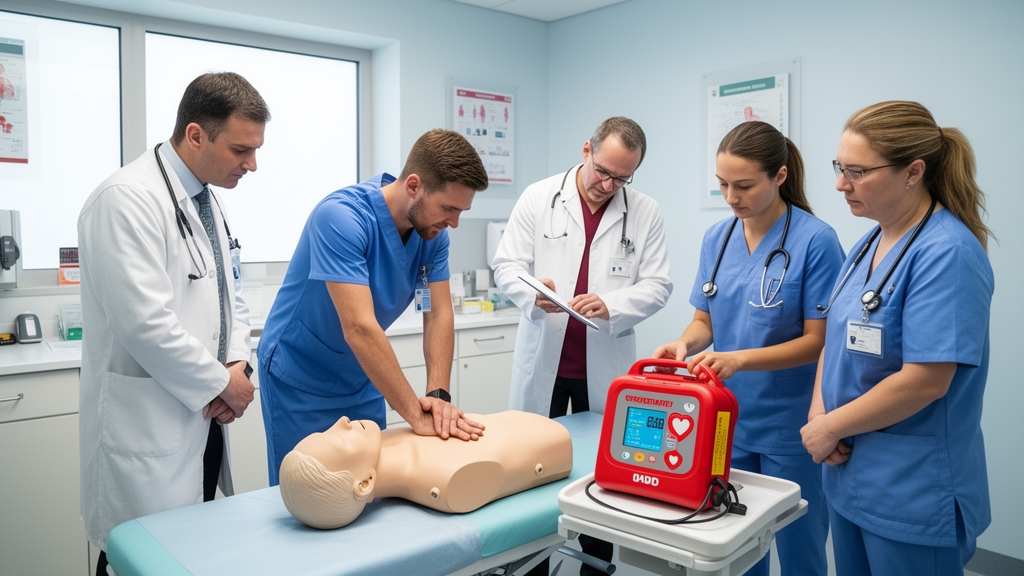
Most primary health care practices in and around the Polish city of Poznań are poorly prepared to manage out-of-hospital cardiac arrest, according to a cross-sectional survey published in BMC Health Services Research. The study, led by Tomasz Kłosiewicz and colleagues including Mateusz Puślecki, surveyed all 217 primary health care practices in Poznań and Poznań County between May and July 2025 and received 177 complete responses, a response rate of 81.6 percent. Out-of-hospital cardiac arrest is a leading resuscitation emergency, and primary care teams may be the closest trained personnel when a collapse occurs near their premises, making their readiness a direct determinant of whether guideline-concordant basic life support begins in time.

The survey assessed three domains: exposure to cardiac arrest events, basic life support training, and availability of resuscitation equipment. Data were collected through structured interviews using a standardized questionnaire, and in 104 practices the team carried out partial visual verification of the equipment reported. Events in the previous ten years were reported by 40.0 percent of county practices and 28.9 percent of urban practices, confirming that cardiac arrest is not a rare occurrence in the primary care setting. Yet formal basic life support training had been conducted in only 26.3 percent of county practices and 14.4 percent of urban practices, and within the last two years in just 10.0 percent and 5.2 percent respectively.

Equipment availability was similarly limited. Automated external defibrillators, which analyze the heart rhythm and deliver a shock for shockable arrhythmias such as ventricular fibrillation, were present in 43.8 percent of county practices and 32.0 percent of urban practices. Airway management capacity was scarcer still: supraglottic airway devices, which allow ventilation without the skill requirements of endotracheal intubation, were available in 12.5 percent of county practices and only 2.1 percent of urban practices. Suction devices were reported in 17.5 to 18.8 percent of practices, and oxygen sources in 11.3 to 17.5 percent. In multivariable logistic regression, practices that had conducted basic life support training showed greater availability of automated external defibrillators, but the authors note that because training and equipment were measured concurrently, the temporal sequence and direction of this association could not be established.

The authors conclude that the preparedness of primary health care practices for out-of-hospital cardiac arrest is insufficient, and that updating minimum equipment standards and implementing regular training programs are warranted. The study’s strengths include a near-complete census of practices in a defined geographic area and a high response rate, while its limitations include self-reported equipment data for most practices and the cross-sectional design, which precludes causal inference. The findings describe one Polish metropolitan region and do not establish how preparedness has changed over time or how it compares with other regions.

Subject of Research: Preparedness of primary health care practices for out-of-hospital cardiac arrest in Poznań, Poland

Article Title: Preparedness of primary health care practices for out-of-hospital cardiac arrest: a cross-sectional study of training, equipment, and cardiac arrest experience in a large Polish metropolitan area

Article References: Wójcik, R., Kłosiewicz, T., & Puślecki, M. (2026). Preparedness of primary health care practices for out-of-hospital cardiac arrest: a cross-sectional study of training, equipment, and cardiac arrest experience in a large Polish metropolitan area. BMC Health Services Research. https://doi.org/10.1186/s12913-026-15490-2

Image Credits: AI Generated

DOI: 10.1186/s12913-026-15490-2

Keywords: out-of-hospital cardiac arrest, primary health care, basic life support, automated external defibrillator, resuscitation equipment, cross-sectional survey, Poznań, Poland, emergency preparedness, airway management, chain of survival, health services research

Cite Scienmag News

Ophelia Keating. (October 26, 2026). Primary care practices fall short on cardiac arrest readiness, Polish survey finds. Scienmag. https://scienmag.com/primary-care-practices-fall-short-on-cardiac-arrest-readiness-polish-survey-finds/


Ophelia Keating. "Primary care practices fall short on cardiac arrest readiness, Polish survey finds." Scienmag, 26 October 2026, https://scienmag.com/primary-care-practices-fall-short-on-cardiac-arrest-readiness-polish-survey-finds/. Accessed 26 October 2026.

Ophelia Keating. "Primary care practices fall short on cardiac arrest readiness, Polish survey finds." Scienmag. October 26, 2026. https://scienmag.com/primary-care-practices-fall-short-on-cardiac-arrest-readiness-polish-survey-finds/

Tags: airway managementautomated external defibrillatoravailability of resuscitation equipmentbasic life supportbasic life support readinesschain of survivalCPR training in primary carecross-sectional surveyemergency preparednessemergency preparedness in outpatient clinicshealth services researchhealth services research on cardiac emergencieshealthcare practice survey methodologyout-of-hospital cardiac arrestout-of-hospital cardiac arrest managementPolandPolish healthcare surveyPoznańPrimary care cardiac arrest preparednessprimary care resuscitation trainingprimary health careprimary health care emergency responseresuscitation equipmentrural vs urban healthcare readiness
Share26Tweet16
Previous Post

Surgical Milestones Track Resident Skill Progression Better Than Numeric Scores

Next Post

Cybersecurity chatbots work best as assistants, not replacements, study finds

Related Posts

Personality, Family Health and Health Literacy Linked in Older Chinese Adults
Medicine

Personality, Family Health and Health Literacy Linked in Older Chinese Adults

October 26, 2026
Young and Middle-Aged Adults Use Government Fitness Trackers for Different Reasons
Medicine

Young and Middle-Aged Adults Use Government Fitness Trackers for Different Reasons

October 26, 2026
Free Summer Programs Ease Financial Strain and Benefit Whole Families, Study Finds
Medicine

Free Summer Programs Ease Financial Strain and Benefit Whole Families, Study Finds

October 26, 2026
Compressed work schedules give long-term care workers more control, slower pace
Medicine

Compressed work schedules give long-term care workers more control, slower pace

October 26, 2026
Relationships and autonomy shape provider retention in Indigenous healthcare settings
Medicine

Relationships and autonomy shape provider retention in Indigenous healthcare settings

October 26, 2026
Community survey reveals heavy neurological disorder burden in coastal South India
Medicine

Community survey reveals heavy neurological disorder burden in coastal South India

October 26, 2026
Next Post
Cybersecurity chatbots work best as assistants, not replacements, study finds

Cybersecurity chatbots work best as assistants, not replacements, study finds

  • Mothers who receive childcare support from maternal grandparents show more optimized

    Mothers who receive childcare support from maternal grandparents show more parental warmth, finds NTU Singapore study

    27656 shares
    Share 11059 Tweet 6912
  • University of Seville Breaks 120-Year-Old Mystery, Revises a Key Einstein Concept

    1061 shares
    Share 424 Tweet 265
  • Bee body mass, pathogens and local climate influence heat tolerance

    682 shares
    Share 273 Tweet 171
  • Researchers record first-ever images and data of a shark experiencing a boat strike

    546 shares
    Share 218 Tweet 137
  • Groundbreaking Clinical Trial Reveals Lubiprostone Enhances Kidney Function

    531 shares
    Share 212 Tweet 133
Science

Embark on a thrilling journey of discovery with Scienmag.com—your ultimate source for cutting-edge breakthroughs. Immerse yourself in a world where curiosity knows no limits and tomorrow’s possibilities become today’s reality!

RECENT NEWS

  • Cybersecurity chatbots work best as assistants, not replacements, study finds
  • Primary care practices fall short on cardiac arrest readiness, Polish survey finds
  • Surgical Milestones Track Resident Skill Progression Better Than Numeric Scores
  • Price Position Signals Stress Shifts in EU Carbon Futures

Categories

  • Agriculture
  • Anthropology
  • Archaeology
  • Athmospheric
  • Biology
  • Biotechnology
  • Blog
  • Bussines
  • Cancer
  • Chemistry
  • Climate
  • Earth Science
  • Editorial Policy
  • Marine
  • Mathematics
  • Medicine
  • Pediatry
  • Policy
  • Psychology & Psychiatry
  • Science Education
  • Science News
  • Social Science
  • Space
  • Technology and Engineering

Subscribe to Blog via Email

Enter your email address to subscribe to this blog and receive notifications of new posts by email.

Join 5,151 other subscribers

© 2025 Scienmag - Science Magazine

Welcome Back!

Login to your account below

Forgotten Password?

Retrieve your password

Please enter your username or email address to reset your password.

Log In
No Result
View All Result
  • HOME
  • SCIENCE NEWS
  • CONTACT US

© 2025 Scienmag - Science Magazine

Discover more from Science

Subscribe now to keep reading and get access to the full archive.

Continue reading