


Gas sensors have been widely applied in areas such as medical health, environmental monitoring, and food safety. However, current gas sensors still face several challenges, including low sensitivity, long response and recovery times, and baseline drift.

Credit: By Xinxin He, Ping Guo, Xuyang An, Yuyang Li, Jiatai Chen, Xingyu Zhang, Lifeng Wang, Mingjin Dai, Chaoliang Tan and Jia Zhang.
Gas sensors have been widely applied in areas such as medical health, environmental monitoring, and food safety. However, current gas sensors still face several challenges, including low sensitivity, long response and recovery times, and baseline drift.
Published in International Journal of Extreme Manufacturing, Prof. Zhang’s team from Harbin Institute of Technology comprehensively introduced the utilization of single atom catalysts within the field of gas sensing, proposing a new strategy to further enhance the performance of gas sensors.
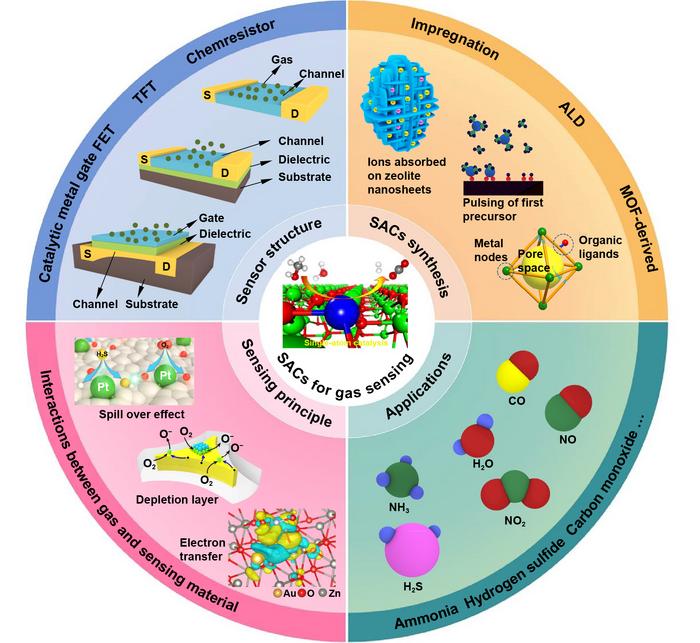
This review primarily discusses the application of single-atom catalysts in the field of gas sensing. Specifically, it summarizes the structure and principles of semiconductor-based gas sensors and reviews the latest methods for preparing single-atom catalysts.
It also analyzes the mechanisms through which single-atom catalysts enhance gas sensitivity from two perspectives, providing a detailed overview of the performance of single-atom catalysts in gas sensing.
Single-atom catalysts exhibit excellent catalytic performance due to their outstanding atomic utilization and unique physicochemical properties. This characteristic positions them as competitive candidates for gas-sensitive materials, as the core function of gas sensors relies on the catalytic process of target gas molecules on the sensitive material.
The principle of most gas sensors is based on the reaction of gas molecules with chemisorbed oxygen on the surface of the sensing material. This reaction alters the number of charge carriers within the conduction band of the sensing material, thereby inducing a change in the material’s resistance.
According to the research findings, the interaction between single atoms and gas molecules can promote reactions of gases on the surface of sensitive materials. Additionally, the heterogeneous structures formed inside sensitive materials can facilitate the electron transfer within the sensing material significantly. Consequently, gas sensors based on single-atom catalysts can achieve higher sensitivity and shorter response times.
Currently, the synthesis methods for single-atom catalysts include impregnation, co-precipitation, one-pot pyrolysis, atomic layer deposition, sacrificial template methods, metal-organic frameworks (MOFs) derived methods, etc.
However, single atoms tend to aggregate into clusters during both the synthesis and utilization processes. To synthesize single-atom catalysts with high loading and stability, it is necessary to enhance the interaction between single atoms and supports by modifying the coordination environment of single atoms, among other methods.
Also, the selection of gas-sensitive materials for a specific gas relies on experimental results and lacks theoretical guidance. Investigating the mechanisms by which single atoms enhance gas sensing performance may facilitate the understanding of active sites, thereby establishing a theoretical foundation for the rational design of gas-sensitive materials.
As a gas-sensitive material, single-atom catalysts possess the advantages of low detection limits and high selectivity, making them a promising material with broad application prospects. They are expected to make significant contributions to further enhancing the sensitivity and selectivity of gas sensors.
Additionally, they are highly likely to facilitate the development of high-performance gas sensors operating in special environments such as low temperature, low pressure, and oxygen-free conditions.
About IJEM:
International Journal of Extreme Manufacturing (IF: 14.7, 1st in the Engineering, Manufacturing category in JCR 2023) is a new multidisciplinary, double-anonymous peer-reviewed and diamond open-access without article processing charge journal uniquely covering the full spectrum of extreme manufacturing.
The journal is devoted to publishing original articles and reviews of the highest quality and impact in the areas related to the science and technology of manufacturing functional devices and systems with extreme dimensions (extremely large or small) and/or extreme functionalities, ranging from fundamental science to cutting-edge technologies that support the manufacturing of high-performance products involving emerging techniques and breaking the limits of currently known theories, methods, scales, environments, and performance.
Visit our webpage, Like us on Facebook, and follow us on Twitter and LinkedIn.
Journal
International Journal of Extreme Manufacturing
Article Title
Preparation of single atom catalysts for high sensitive gas sensing
Article Publication Date
28-Mar-2024
Cite Scienmag News
Bethany Barker. (April 22, 2024). Preparation of single atom catalysts for high sensitive gas sensing. Scienmag. https://scienmag.com/preparation-of-single-atom-catalysts-for-high-sensitive-gas-sensing/
Bethany Barker. "Preparation of single atom catalysts for high sensitive gas sensing." Scienmag, 22 April 2024, https://scienmag.com/preparation-of-single-atom-catalysts-for-high-sensitive-gas-sensing/. Accessed 4 September 2026.
Bethany Barker. "Preparation of single atom catalysts for high sensitive gas sensing." Scienmag. April 22, 2024. https://scienmag.com/preparation-of-single-atom-catalysts-for-high-sensitive-gas-sensing/

