


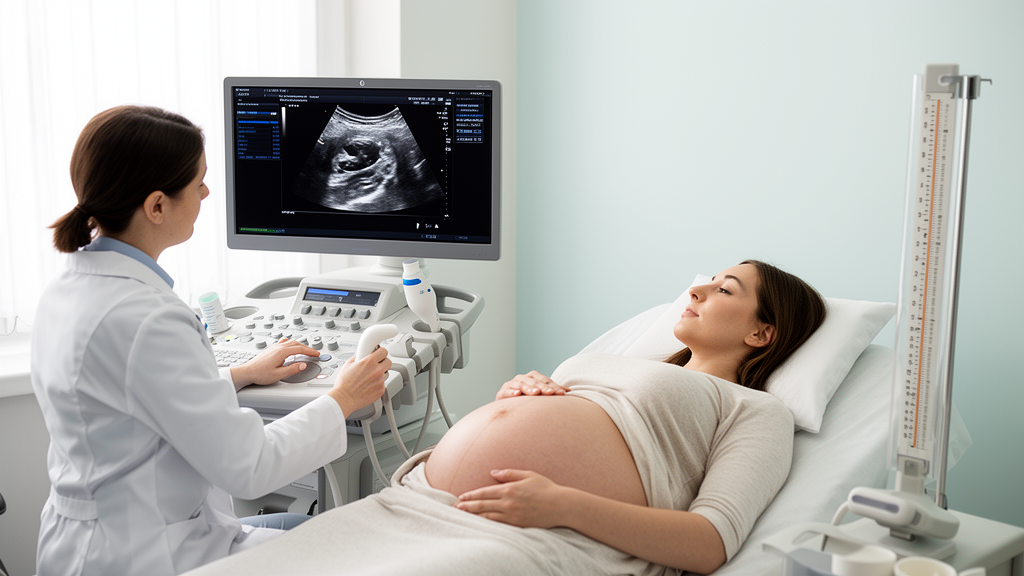
A prenatal ultrasound estimate that was relatively high compared with the newborn’s eventual birthweight was associated with a higher risk of cesarean delivery in a retrospective cohort study of 353 women delivering at term for the first time. In the primary model, each additional 100-gram discrepancy between sonographic estimated fetal weight and neonatal birthweight was associated with an 11% higher risk of cesarean delivery after accounting for actual birthweight and other prespecified covariates. The adjusted risk ratio was 1.11, with a 95% confidence interval of 1.04 to 1.20 and p=0.003.
The findings describe an association and do not establish that knowing the ultrasound estimate caused a cesarean delivery. The research was conducted at Vinmec Times City International Hospital in Hanoi, Vietnam, and included pregnancies managed between January and September 2024. Eligible participants were nulliparous women with singleton, cephalic, term pregnancies who entered spontaneous labor or underwent induction of labor and had a sonographic fetal-weight estimate recorded within seven days of delivery.
Among the 353 women included, 168 underwent cesarean delivery, a proportion of 47.6%. Mean sonographic estimated fetal weight was 3,205 ± 267 grams, while mean neonatal birthweight was 3,178 ± 314 grams. The mean signed error of the ultrasound estimate was +27.1 grams, indicating that the estimates were higher than measured birthweights on average across the cohort.
The study evaluated how accurately prenatal ultrasound estimates corresponded with subsequent birthweights. Pearson correlation between estimated and actual weight was 0.78, showing a positive relationship between the two measurements. Mean absolute percentage error was 5.15%, and 89.0% of estimates were within ±10% of birthweight.
Agreement was assessed with signed error, mean absolute percentage error, the proportion within ±10%, and Bland–Altman analysis. These measures summarize the overall agreement and variability of the estimates but do not explain why delivery mode differed among individual patients. For the main analysis, the researchers used a modified Poisson model to examine the association between the estimated-weight minus birthweight discrepancy and cesarean delivery.
The model accounted for neonatal birthweight and was also adjusted for maternal age, gestational age at delivery, fetal sex, and the interval between the ultrasound scan and delivery. Results from prespecified sensitivity analyses were consistent with the primary analysis, producing adjusted risk ratios ranging from 1.11 to 1.14. This consistency indicates that the reported association remained across the alternative specifications examined, although it does not remove the limitations inherent in an observational analysis.
The authors cautioned that residual confounding remains possible and that each ultrasound estimate carries individual-level uncertainty. The retrospective, single-center design also restricts how broadly the results can be generalized beyond the defined population of nulliparous women with singleton, cephalic, term deliveries who had an ultrasound estimate close to delivery. The most direct conclusion is that, among term first-time mothers in the study, a relatively higher prenatal fetal-weight estimate compared with the newborn’s eventual weight was linked to a higher risk of cesarean delivery, even after statistical adjustment for actual birthweight and several maternal and pregnancy characteristics.
Subject of Research: Association between prenatal fetal-weight discrepancy and cesarean delivery in term nulliparous pregnancies
Article Title: Association of sonographic estimated fetal weight with primary cesarean delivery after adjustment for neonatal birthweight in term nulliparous pregnancies
Article References: Pham, B.-N., Chu, Q.-C., Nguyen, V.-A., Dang, P.-T., Do, T.-T., Doan, M.-T., & Nguyen, P.-T. (2026). Association of sonographic estimated fetal weight with primary cesarean delivery after adjustment for neonatal birthweight in term nulliparous pregnancies. Frontiers in Medicine, 13, Article 1989181. https://doi.org/10.3389/fmed.2026.1989181
Image Credits: AI Generated
DOI: 10.3389/fmed.2026.1989181
Keywords: estimated fetal weight, cesarean delivery, birthweight, prenatal ultrasound, nulliparous pregnancy, term pregnancy, retrospective cohort, obstetrics, Association, sonographic, estimated, fetal
Cite Scienmag News
Harold Sullivan. (October 22, 2026). Prenatal weight overestimate linked to cesarean risk in first-time term births. Scienmag. https://scienmag.com/prenatal-weight-overestimate-linked-to-cesarean-risk-in-first-time-term-births/
Harold Sullivan. "Prenatal weight overestimate linked to cesarean risk in first-time term births." Scienmag, 22 October 2026, https://scienmag.com/prenatal-weight-overestimate-linked-to-cesarean-risk-in-first-time-term-births/. Accessed 22 October 2026.
Harold Sullivan. "Prenatal weight overestimate linked to cesarean risk in first-time term births." Scienmag. October 22, 2026. https://scienmag.com/prenatal-weight-overestimate-linked-to-cesarean-risk-in-first-time-term-births/


