Warming a restorative resin-based composite to 70 °C before applying it to an etched feldspathic ceramic made the ceramic measurably stronger in the laboratory than the conventional resin cements used to seat porcelain laminate veneers, according to an in vitro study published on 19 June 2026 in a Springer Nature journal covering biomedical materials science. The work, led by Kristýna Hynková and Dan L. Romanyk with colleagues including Marina Roscoe, Owen Addison and Adam McCourt, tested five cementation protocols on 100 ceramic discs and found that the preheated composite coating produced the highest biaxial flexural strength of any group examined.
Porcelain laminate veneers are thin ceramic facings bonded to minimally prepared teeth, and because they are used mainly for aesthetic enhancement, feldspathic porcelains and glass-ceramics remain the preferred materials, offering better optical performance and adhesive bonding than stronger polycrystalline ceramics. Their clinical longevity depends on the mechanical coupling of these fragile ceramic shells to the tooth structure. While decades of research have optimised surface treatments for both ceramic and enamel, the authors argue that the reinforcing role of the resin layer itself has often been underestimated from a materials science perspective. Experimental studies cited in the paper indicate that resin cementation can raise the flexural strength and reliability of glass-ceramic restorations by 20 to 40%, with the outcome shaped by the stiffness and thickness of the cement and the conditions under which the restoration is seated.
The study compared a conventional photo-activated resin cement, Rely-X Veneer, against a highly filled restorative composite, Filtek Supreme XTE, a material not marketed as a luting agent. The authors stress that the purpose was to explore mechanisms that may contribute to resin strengthening through pre-warming, not to advocate the specific materials or experimental variables used. Ceramic discs 10 mm in diameter and about 1.05 mm thick, cut from CAD-CAM blocks of VITABLOCS Mark II, were polished to a consistent finish, etched for 60 seconds with 5% hydrofluoric acid, rinsed, dried and treated with a silane coupling agent. The specimens were then randomly divided into five groups of 20. Group A received the resin cement at room temperature, representing the conventional approach. Group B was coated with the restorative composite at room temperature. Group C received a thin layer of uncured adhesive before the room-temperature composite. Groups D and E were coated with the composite preheated to 70 °C, with Group E also receiving the adhesive interlayer first.
To hold layer thickness constant across groups, the researchers used a three-dimensional printed jig with a Mylar film window that concentrically enclosed each disc, allowing manual pressing of the resin to a consistent thickness before excess material was removed and the layer photocured for 40 seconds with a light-curing unit measured at 620 mW/cm². For the preheated groups, both the composite and the ceramic discs were warmed in a sealed bag in a 70 °C water bath for one hour to limit heat loss during application. After curing, the coated discs were stored in a light-excluding container at 21 ± 1 °C and 55 ± 1% relative humidity for at least 48 hours before testing.
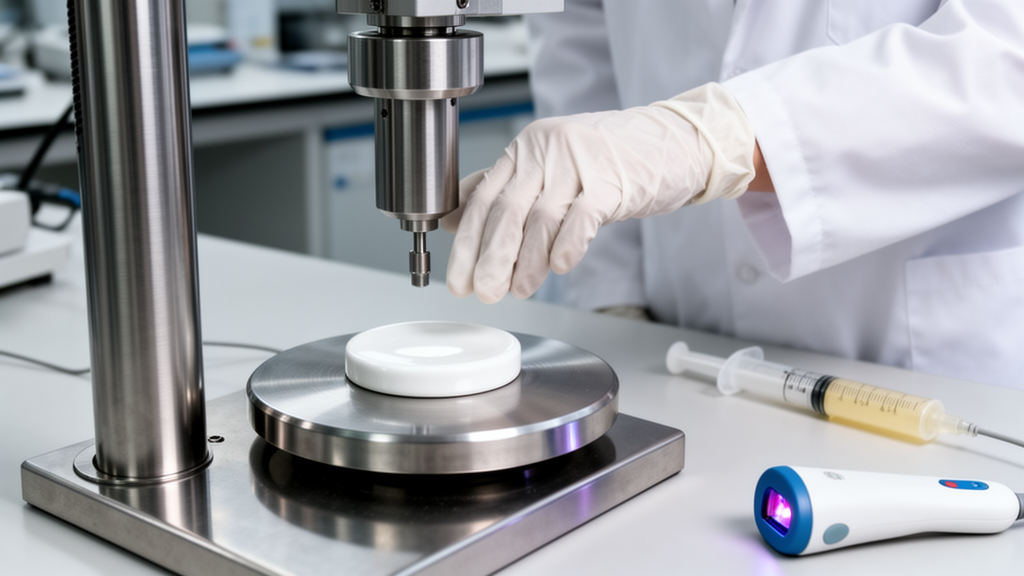
Strength was measured with a biaxial flexural test in a ball-on-ring geometry on a universal testing machine, loading the specimens centrally at a crosshead speed of 1 mm/min and calculating the stress at the ceramic-resin interface with a multilayer analytical solution. A one-way analysis of variance followed by post-hoc Tukey tests at a significance level of 0.05 revealed a statistically significant difference among the group means, with p below 0.01. Conventional resin cementation produced a mean biaxial flexural strength of 133 ± 9.8 MPa. Simply substituting the restorative composite at room temperature, without any warming, raised the mean by about 13% to 150 ± 11.1 MPa. Pre-warming the composite to 70 °C delivered a further gain of roughly 12%, reaching 168 ± 10.5 MPa, the highest value in the study and about a quarter above the conventional cement group. Survival probability plots built with a Weibull-based approach showed similar distributions of fracture strength across these groups, shifted to higher values as the coating protocol improved.
The adhesive interlayer told a different story depending on temperature. At room temperature, adding the unfilled resin before the composite left the mean strength and the distribution of fracture data essentially unchanged compared with the composite alone. But in the preheated groups, the interlayer significantly reduced the mean strength, dropping it from 168 ± 10.5 MPa to 157 ± 10.8 MPa, a difference the authors report as statistically significant at p below 0.01. The researchers suggest two possible explanations: a dilution effect in which the unfilled resin intermixed with the composite and compromised the luting layer, or stress relaxation, in which the softer adhesive allowed the beneficial compressive stresses generated by polymerisation shrinkage at the bonded interface to dissipate.
Scanning electron microscopy of fracture fragments offered a qualitative window on the interfaces behind these numbers. Specimens coated at room temperature generally showed more interfacial porosities and localised discontinuities along the bonded interface, while those prepared with preheated composite displayed comparatively more homogeneous adaptation, with fewer visible voids and irregularities. The authors note that the interfacial morphology appeared consistent with the mechanical findings, in that reduced porosity at the composite-ceramic interface was associated with greater ceramic reinforcement. They also caution that occasional localised interfacial separation features were observed qualitatively, but that no systematic fractographic or failure mode analysis was performed.
The mechanistic reasoning draws on the physics of dimethacrylate polymerisation and viscous flow. Photo-activated resin cements typically plateau at degrees of conversion between 50 and 75%, leaving unreacted monomer that lowers strength, promotes water sorption and degradation, and raises concerns about leaching and discoloration. Elevated curing temperatures enhance radical diffusion and collision frequency, promoting higher crosslink density, while pre-warming also improves flow and adaptation. The literature reports that composite viscosity falls by 47 to 92% at 69 °C compared with 37 °C, and that preheating increases monomer mobility and improves filler particle distribution, with some microstructural benefits persisting after the material cools. Yet the working window is narrow: composites preheated to 68 °C lose 45 to 61% of that heat within 15 seconds and up to 96% within a minute, which is why the study preheated the ceramic substrates as well to minimise dissipation during application.
On the question of the adhesive layer, the findings add to existing uncertainty. A recent systematic review cited in the paper reported no significant improvement in bond strength from adhesive application, and the authors conclude that the additional step of applying an adhesive layer after surface treatment of veneer restorations may be unnecessary, particularly given the greater susceptibility of adhesive layers to long-term degradation and the technical sensitivity of their application. They note that incomplete infiltration and unfilled interfacial regions can act as stress concentrators, potentially undermining mechanical performance, and that most studies in this field have focused on bond strength rather than actual strengthening outcomes.
The authors are careful about the limits of the work. As an in vitro study with a standardised comparison of cementation protocols, it cannot capture the clinical variables that may affect performance, including rapid thermal dissipation during handling, film thickness variations, temperature fluctuations, masticatory forces and humidity. Degree of conversion, polymerisation shrinkage stress and failure modes were not directly evaluated, and the mechanistic interpretations require further validation. Long-term aging and clinical studies are needed to establish whether the laboratory benefits persist under routine conditions. Within those limits, the conclusion stands as a materials science observation: preheated restorative composite coating significantly improved the flexural strength of the feldspathic ceramic over conventional resin cementation, suggesting a simple route to optimising the fracture resistance of porcelain laminate veneers that now awaits translational testing.
Subject of Research: In vitro testing of preheated resin-based composite coatings and adhesive interlayers for strengthening feldspathic porcelain laminate veneer ceramic
Article Title: Effect of preheated resin-based composites and resin coating on the strengthening of a porcelain laminate veneer material
Article References: Hynková, K., Roscoe, M., Addison, O., McCourt, A., & Romanyk, D. L. (2026). Effect of preheated resin-based composites and resin coating on the strengthening of a porcelain laminate veneer material. Biomedical Materials Science, 1(1), Article 5. https://doi.org/10.1186/s44495-026-00005-2
Image Credits: AI Generated
DOI: 10.1186/s44495-026-00005-2
Keywords: porcelain laminate veneer, feldspathic ceramic, resin-based composite, preheating, biaxial flexural strength, resin cement, adhesive layer, hydrofluoric acid etching, silane, scanning electron microscopy, dental materials, in vitro study
Cite Scienmag News
Denise Maddox. (October 28, 2026). Preheated resin composite boosts strength of porcelain veneer ceramic in lab test. Scienmag. https://scienmag.com/preheated-resin-composite-boosts-strength-of-porcelain-veneer-ceramic-in-lab-test/
Denise Maddox. "Preheated resin composite boosts strength of porcelain veneer ceramic in lab test." Scienmag, 28 October 2026, https://scienmag.com/preheated-resin-composite-boosts-strength-of-porcelain-veneer-ceramic-in-lab-test/. Accessed 29 October 2026.
Denise Maddox. "Preheated resin composite boosts strength of porcelain veneer ceramic in lab test." Scienmag. October 28, 2026. https://scienmag.com/preheated-resin-composite-boosts-strength-of-porcelain-veneer-ceramic-in-lab-test/