


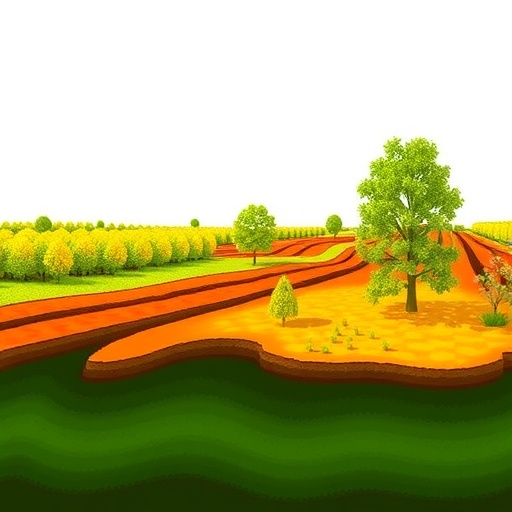
In recent years, the understanding of soil carbon dynamics has gained significant attention, especially in the context of climate change and environmental sustainability. The study conducted by Kalpana et al. in 2025 delves deep into the realm of spatial prediction of soil carbon, applying innovative deterministic and covariate-integrated geostatistical models. This research contributes essential insights into how soil carbon can be effectively monitored and managed, offering a pathway towards more sustainable agriculture practices and effective mitigation of greenhouse gas emissions.
Soil carbon is pivotal for maintaining soil health, fertility, and structural integrity. It acts as a reservoir for nutrients, thereby playing a crucial role in plant growth and ecosystem functionality. The measurement and prediction of soil carbon content are vital for understanding the ecological balance and for potential agricultural practices that can enhance carbon sequestration. The study by Kalpana and team meticulously explores various methodologies to predict soil carbon levels across different geographic landscapes, presenting a thorough analysis of the techniques deployed.
One of the core components of the research is the employment of deterministic models, which rely on predetermined equations to predict soil carbon based on existing environmental and biological factors. These models hinge on the assumption that the structures underlying soil carbon pools can be mathematically modeled, thus allowing for predictions across extensive areas. By utilizing such frameworks, the authors provide a reliable mechanism for estimating soil carbon stocks, which is paramount for researchers and policymakers.
However, deterministic models alone may not account for the multitude of variables intricately woven into soil systems. To address this limitation, Kalpana et al. incorporated covariate-integrated geostatistical models into their methodology. These models consider the influence of various covariates, such as land use, climate variations, topography, and human interventions, thereby generating more nuanced predictions. This advancement marks a significant step forward in soil carbon research, as it harnesses complex datasets to drive predictive accuracy and relevance.
The research team meticulously collected soil samples across different spatial dimensions, leading to an extensive dataset that serves as the foundation for their predictive analysis. By leveraging advanced geostatistical techniques, they ensured a robust representation of spatial variability within soil carbon stocks. This attention to detail in data collection underscores the importance of empirical evidence in crafting reliable predictive models.
In their findings, the authors illustrate how integrating various spatial covariates substantially improves the predictability of soil carbon stocks. The elevation, slope, and proximity to water sources were among the critical covariates analyzed. Such parameters were systematically integrated into the modeling process, allowing for a comprehensive understanding of how environmental factors interplay with soil carbon dynamics. This level of granularity in analysis is essential for fostering targeted interventions in soil management and conservation efforts.
Furthermore, the study presents a comparison of the various models used for soil carbon prediction. By juxtaposing deterministic models against the covariate-integrated approaches, the authors highlight the strengths and weaknesses inherent in each methodology. The findings suggest that while deterministic models may offer a generalized understanding, they may fall short in contexts where ecological data is rich and heterogeneous. In contrast, covariate-integrated models provide layers of insights that encourage nuanced analysis and informed decision-making.
An essential outcome of the study is its potential applicability in real-world scenarios. The methodologies and models developed by Kalpana et al. can serve as crucial tools for agricultural planners and environmentalists. By understanding the spatial distribution of soil carbon, stakeholders can devise strategies that promote carbon sequestration, thereby contributing to broader climate action initiatives. This application extends beyond academic discourse into grassroots efforts aimed at fostering sustainable land use practices.
The implications of the research also resonate with global climate policies, particularly in the context of carbon trading and carbon credits. Accurate predictions of soil carbon content can enhance the credibility of carbon offset projects, promoting a more robust and transparent market for greenhouse gas reductions. As nations strive to meet their climate commitments, this research underscores the importance of scientific inquiry in shaping effective policy frameworks.
Moreover, the integration of cutting-edge technology, such as remote sensing and geographic information systems (GIS), into the methodology signifies a modern approach to environmental research. These tools allow for the visualization and analysis of large datasets in ways previously unattainable, thus enhancing predictive capabilities. Embracing technological advancements not only fosters precision in research but also engages a broader audience, raising awareness about the importance of soil carbon.
As the dialogue around climate change evolves, studies like that of Kalpana et al. illuminate the connections between soil health, biodiversity, and climate resilience. The emphasis on soil carbon underscores its critical role in supporting ecosystem services essential for human survival. The relationships between soil carbon and various ecological indicators provide fertile ground for further research, pushing the boundaries of scientific understanding.
Collaboration across disciplines emerges as a vital theme in addressing the complexities surrounding soil carbon dynamics. The teamwork illustrated by the authors showcases how interdisciplinary approaches can yield comprehensive insights. Engaging ecologists, agronomists, climatologists, and statisticians fosters a rich exchange of knowledge, paving the way for innovative solutions grounded in scientific evidence.
In conclusion, the research by Kalpana et al. serves as a cornerstone for future studies in soil carbon prediction. By seamlessly blending deterministic and covariate-integrated models, the authors have set a precedent for how environmental research can inform sustainable practices and policy decisions. This study is a testament to the power of science in navigating the pressing challenges of our time, as it empowers stakeholders to make informed decisions that resonate with both ecological integrity and economic viability.
As we look ahead, the integration of technology and refined methodologies in soil carbon research promises to pave the way for enhanced monitoring and management of soil resources. The ongoing dialogue must extend from academic circles to local communities, fostering an understanding of the significance of soil health in the collective effort towards a sustainable future. With each advancement in research, we move closer to a world where ecological balance and human prosperity coexist harmoniously.
Cite Scienmag News
Alan Morgan. (October 31, 2025). Predicting Soil Carbon: Integrating Geostatistical Models. Scienmag. https://scienmag.com/predicting-soil-carbon-integrating-geostatistical-models/
Alan Morgan. "Predicting Soil Carbon: Integrating Geostatistical Models." Scienmag, 31 October 2025, https://scienmag.com/predicting-soil-carbon-integrating-geostatistical-models/. Accessed 3 September 2026.
Alan Morgan. "Predicting Soil Carbon: Integrating Geostatistical Models." Scienmag. October 31, 2025. https://scienmag.com/predicting-soil-carbon-integrating-geostatistical-models/


