


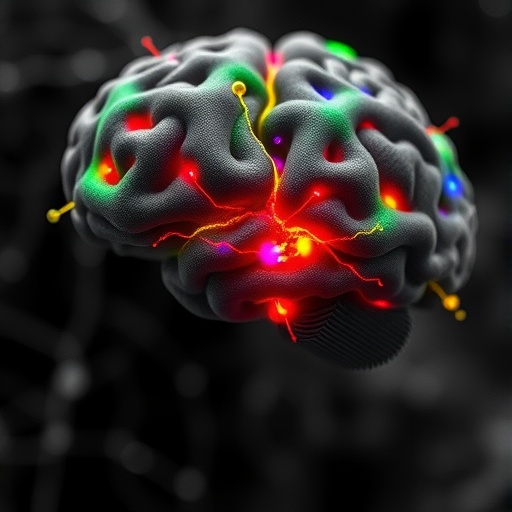
In a groundbreaking study poised to reshape our understanding of brain development, researchers have unveiled the existence of preconfigured neuronal firing sequences within human brain organoids. These firing patterns, traditionally thought to arise from sensory experience and environmental stimuli, appear to be innately programmed during neurodevelopment, challenging long-held assumptions about the brain’s early information processing architecture. This revelation not only deepens our grasp of neuronal circuit formation but also elevates the value of brain organoids as faithful models for investigating the complexities of human neurobiology.
Neuronal firing sequences—the precise order and timing of action potentials within neural circuits—form the fundamental building blocks by which the brain encodes, processes, and transmits information. Until now, the developmental timeline and origins of these sequences remained largely unknown, with the prevailing hypothesis attributing their emergence to experience-dependent plasticity, shaped dynamically by sensory inputs during early life. However, the new findings presented by van der Molen et al. point to an alternative mechanism rooted in intrinsic developmental programs.
Human brain organoids, three-dimensional cellular models derived from pluripotent stem cells, have surged in popularity as cutting-edge platforms for modeling human brain development in vitro. By replicating key aspects of brain tissue organization and cellular diversity, these organoids serve as invaluable proxies for investigating neuronal circuit assembly under controlled conditions. Importantly, this study compared both unguided human brain organoids and those directed toward forebrain identity, alongside ex vivo slices from neonatal mouse somatosensory cortex, offering a robust cross-species and methodological validation of their observations.
Employing advanced electrophysiological recordings, the researchers detected temporally structured firing sequences during spontaneous activity in these organoids and neonatal cortical slices. Remarkably, these sequences manifested in both “rigid” and “flexible” temporal patterns, reflecting stereotyped yet dynamic neural firing motifs reminiscent of in vivo networks. Contrastingly, dissociated primary cortical cultures—where neurons grow isolated without the structured architecture—were devoid of such sequential firing, underscoring the critical role of spatial organization and connectivity.
The distinction between rigid and flexible firing patterns hints at a sophisticated network orchestration, balancing stability with adaptability. Rigid sequences likely represent hardwired neuronal motifs providing baseline computational scaffolding, while flexible sequences may enable modulation and integration of diverse neural information. This duality suggests that the brain’s intrinsic circuitry is prearranged to support both reliable signal transmission and plastic response capacity from the earliest developmental stages.
One of the most profound implications of this study is the demonstration that structured firing sequences do not necessitate sensory experience or external stimuli for their genesis. Instead, these patterns emerge spontaneously, constrained by a preconfigured neural architecture established during prenatal neurodevelopment. This discovery shifts the paradigm from experience-dependent to experience-augmented models of circuit maturation, with considerable ramifications for developmental neuroscience and neurodevelopmental disorder research.
In addition to shedding light on fundamental developmental biology, these results bolster the argument for brain organoids as authentic in vitro models for dissecting neuronal circuit formation. The fidelity with which organoids recapitulate in vivo-like firing patterns validates their relevance for exploring the molecular and cellular mechanisms governing neural assembly, as well as for screening pharmacological agents or studying disease-related alterations without the confounds inherent in animal models.
The study further opens exciting avenues for investigating critical windows of neurodevelopment when preconfigured sequences first emerge and stabilize. Understanding this timeline could inform strategies to intervene in developmental neuropathologies characterized by disrupted circuit formation, such as autism spectrum disorders or epilepsy. Moreover, the findings raise intriguing questions about the genetic and epigenetic blueprints orchestrating this intrinsic patterning and how environmental factors might modulate or refine preexisting firing motifs.
The cross-species comparison incorporating both human brain organoids and murine cortical slices highlights an evolutionary conservation of these developmental principles. Such conservation reinforces the notion that fundamental aspects of neural circuit assembly are hardwired across mammals, reflecting an evolutionary advantage conferred by preassembled temporal sequences crucial for efficient information processing from birth.
Technically, the team leveraged high-density multielectrode arrays and computational algorithms capable of resolving millisecond-scale firing order across neuronal populations. This methodological rigor ensured that the observed patterns were not artifacts but genuine emergent properties of developing neural circuits. Complementary analyses excluded the possibility that firing sequences simply reflected random synchronous activity, emphasizing their structured and reproducible nature.
Furthermore, the lack of similar firing sequences in dissociated cortical cultures—where spatial relationships and synaptic connectivity are disrupted—highlights the indispensable role of three-dimensional tissue architecture in supporting complex temporal dynamics. This finding reiterates the critical interdependence between form and function in neural systems, cementing the importance of studying neurons within their native-like tissue context.
Intriguingly, the coexistence of rigid and flexible sequences might mirror early phases of functional specialization within cortical networks, where foundational pathways establish baseline connectivity, subsequently modulated by plastic adaptations as sensory experience is incorporated postnatally. This dynamic interplay offers a potential mechanistic substrate for how the brain balances genetic programming with environmental shaping during early life.
In light of these discoveries, future research is poised to dissect the molecular underpinnings guiding sequence preconfiguration, identify the cell classes involved, and explore how perturbations in these processes relate to developmental disorders. Moreover, leveraging brain organoids for such mechanistic studies promises to accelerate translational progress toward targeted therapeutic interventions.
Overall, van der Molen and colleagues’ work decisively reframes our understanding of neuronal sequence emergence by revealing that temporal firing patterns are intrinsically embedded within the brain’s developmental blueprint. This breakthrough not only enriches fundamental neuroscience but also frames brain organoids as vital platforms for unraveling the enigmatic choreography of neuronal circuit assembly.
As neuroscientists grapple with the formidable complexity of brain development, these findings offer a clarifying perspective: the brain arrives pre-equipped with structured firing sequences, poised to underpin cognition and behavior even before the first external experiences sculpt its circuitry.
Cite Scienmag News
Cassandra Pierce. (November 24, 2025). Preconfigured Neuronal Firing in Human Brain Organoids. Scienmag. https://scienmag.com/preconfigured-neuronal-firing-in-human-brain-organoids/
Cassandra Pierce. "Preconfigured Neuronal Firing in Human Brain Organoids." Scienmag, 24 November 2025, https://scienmag.com/preconfigured-neuronal-firing-in-human-brain-organoids/. Accessed 4 September 2026.
Cassandra Pierce. "Preconfigured Neuronal Firing in Human Brain Organoids." Scienmag. November 24, 2025. https://scienmag.com/preconfigured-neuronal-firing-in-human-brain-organoids/


