


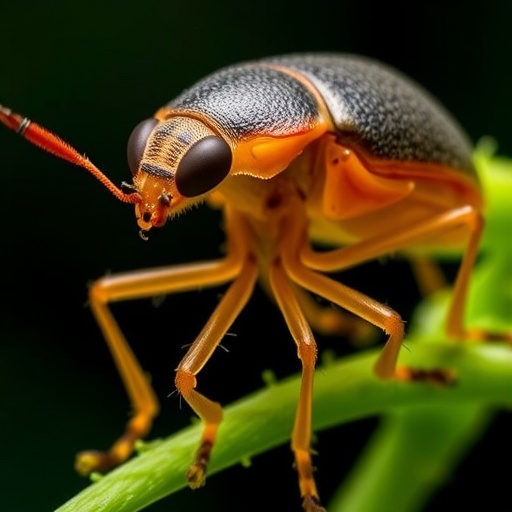
Surviving the unforgiving conditions of winter poses a significant challenge to many insect species, especially those inhabiting temperate climates. One of the most fascinating evolutionary strategies to overcome this seasonal adversity is the production of overwintering eggs characterized by hardened, darkly pigmented shells. These eggs can resist extreme cold, moisture loss, and invasion by pathogens, thereby ensuring the persistence of insect populations until favorable conditions return. Recently, a groundbreaking study led by Professor Shuji Shigenobu at the National Institute for Basic Biology (NIBB) in Japan has unveiled the molecular underpinnings that grant the pea aphid (Acyrthosiphon pisum) such remarkable egg resilience.
The research centered on the Laccase2 (Lac2) gene, a well-known player in the pigmentation and sclerotization processes in insects but never before conclusively linked to overwintering egg adaptation in aphids. By employing a highly refined CRISPR/Cas9 genome-editing protocol, the researchers knocked out the Lac2 gene in the pea aphid, unveiling its indispensable role in the production of the protective black shell that shields the embryo during the cold months. This discovery provides unprecedented insight into the molecular biology of seasonal adaptation—a key evolutionary trait for survival in fluctuating environments.
A critical innovation enabling this research was the development and application of the “DIPA-CRISPR” technique, specially optimized for aphid biology. Aphids have long posed a formidable challenge for genetic manipulation due to their diminutive egg size, complex life cycles involving parthenogenesis and sexual reproduction, and the presence of obligate symbiotic bacteria. The newly tailored genome editing workflow meticulously overcomes these obstacles, significantly improving the efficiency and precision of gene editing tools in these insects and opening new avenues for functional genomics in aphids and related species.
The study’s results vividly demonstrated that disruption of Lac2 resulted in eggs that completely lacked the characteristic black pigmentation, instead appearing translucent and revealing the developing embryo within. This visual cue reflected a deeper biochemical deficiency—the absence of melanin and related sclerotizing compounds critical for egg shell hardening. Mechanical assays confirmed that Lac2 knockout eggs were markedly softer, which correlated with an increased vulnerability to environmental stresses and microbial infections, ultimately leading to failure in hatching success.
These findings underscore the dual role of Lac2 in both pigmentation and structural integrity, highlighting its evolutionary significance in the survival of overwintering eggs. Melanin deposition serves not only aesthetic functions but also acts as a physical and immunological barrier against harsh external factors. By decoding this single gene’s role, the study paints a broader picture of how insects finely tune their reproductive strategies to endure and thrive across seasons marked by dramatic environmental fluctuations.
Beyond its biological implications, the research delivers a powerful technological leap for the field of insect genetics. The precision and accessibility of the refined CRISPR/Cas9 methods tailored to aphids surpass previous limitations, which often hindered functional genetic studies in non-traditional model organisms. This toolkit is poised to accelerate research into aphid biology, enabling the study of intricate phenomena such as host plant interactions, symbiosis, pesticide resistance, and lifecycle regulation with unprecedented molecular resolution.
Professor Shigenobu emphasizes that while Lac2’s centrality in overwintering egg protection is a groundbreaking revelation, the broader impact of this work lies in its methodological advancements. “Our optimized genome editing platform unlocks the potential to explore a vast landscape of biological questions in aphids,” he remarked. “From dissecting the genetic basis of their complex reproductive cycles to unraveling how symbiotic relationships influence their physiology, the possibilities are truly exciting.”
The research team is committed to democratizing access to these cutting-edge techniques. Comprehensive protocols, instructional materials, and practical tips are freely available on the Shigenobu Lab website, fostering an open resource environment. Furthermore, active workshops are organized to train researchers globally, empowering a new generation of scientists to harness genome editing technologies in aphids and other emerging insect models.
One particularly remarkable aspect of the study is the integration of bioengineering with ecological and evolutionary biology. By linking gene-editing outcomes to phenotype, survival, and ecological fitness, the work bridges molecular function with whole-organism and population-level processes. This integrative approach exemplifies modern biology’s trajectory towards holistic understanding, where single genes illuminate complex adaptive landscapes shaped by environmental pressures.
The use of CRISPR/Cas9 in this context is not merely a tool for validation but a driver for discovery. It enables functional interrogation of genes with precise, heritable changes, overcoming the trial-and-error nature of classical mutagenesis. In aphids, such advancements are transformative, given their economic importance as agricultural pests and their unique biology shaped by symbiosis and phenotypic plasticity.
This research paves the way for novel pest management strategies. Understanding the genetic and molecular bases for traits linked to survival and reproduction could lead to targeted interventions that disrupt overwintering success, ultimately reducing aphid populations more sustainably and with less environmental impact than chemical controls. Such approaches could revolutionize agroecosystems by offering smarter, gene-informed pest regulation methods.
Moreover, the study reinforces the profound utility of melanin and sclerotization pathways in insect physiology. These mechanisms are evolutionarily conserved and integral to cuticle formation, immune defense, and environmental resilience. The elucidation of Lac2’s role in aphid eggs enriches this narrative and stimulates comparative studies across insect taxa to dissect convergent or divergent evolutionary solutions to seasonal challenges.
In summary, the meticulous demonstration of Lac2’s essential function in the overwintering egg adaptation of pea aphids represents a landmark contribution to both insect molecular biology and functional genomics. Coupled with the pioneering CRISPR/Cas9 and DIPA-CRISPR methodologies, this work not only solves a longstanding biological puzzle but also equips the scientific community with transformative tools to probe the intricate biology of aphids and beyond. As diverse insect populations confront environmental changes and anthropogenic pressures, such foundational knowledge and technologies will be indispensable for both fundamental biology and applied sciences.
Cite Scienmag News
Juliet Wilcox. (August 8, 2025). Precision Genome Editing in Aphids Uncovers Crucial Gene for Overwintering Egg Adaptation. Scienmag. https://scienmag.com/precision-genome-editing-in-aphids-uncovers-crucial-gene-for-overwintering-egg-adaptation/
Juliet Wilcox. "Precision Genome Editing in Aphids Uncovers Crucial Gene for Overwintering Egg Adaptation." Scienmag, 8 August 2025, https://scienmag.com/precision-genome-editing-in-aphids-uncovers-crucial-gene-for-overwintering-egg-adaptation/. Accessed 5 September 2026.
Juliet Wilcox. "Precision Genome Editing in Aphids Uncovers Crucial Gene for Overwintering Egg Adaptation." Scienmag. August 8, 2025. https://scienmag.com/precision-genome-editing-in-aphids-uncovers-crucial-gene-for-overwintering-egg-adaptation/


