


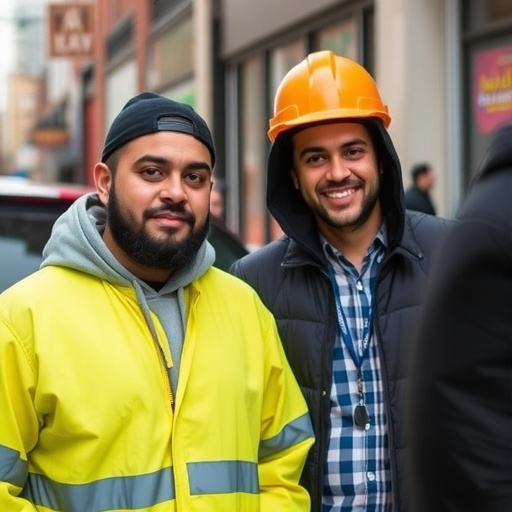
Toronto is one of the most multicultural cities on Earth: roughly half of its residents were born outside Canada, yet beneath the skyline’s promise of opportunity lies a labour market that treats its workers very unevenly. A new study published in Scientific Reports turns its attention to a group whose working lives are shaped by forces that never appear on a pay slip: gay, bisexual, and queer men who came to Canada as immigrants or refugees and who hold down precarious jobs. Led by A. Xu, D. J. Kinitz, and B. Yanar with colleagues, the research asks a deceptively simple question — how do these men make meaning of work, health, and wellbeing? — and, in answering it, illuminates a dimension of health equity that conventional occupational research has largely overlooked. The study arrives as unstable employment becomes the norm for a growing share of the workforce, and as the collision of migration status, sexual identity, and labour-market vulnerability draws fresh scrutiny from public health scientists.
To understand why the study matters, it helps to be precise about what precarious employment actually means. Occupational health researchers define it not simply as part-time or temporary work, but as a multidimensional condition in which employment is uncertain, unpredictable, and risky from the worker’s point of view. Its dimensions include temporality — contracts that can end without notice; material rewards — wages too low to cover basic needs and the absence of benefits such as paid sick leave, drug coverage, or pensions; regulatory protection — work that falls outside the effective reach of labour standards and safety enforcement; and powerlessness — the inability to refuse unsafe tasks or negotiate conditions because replacement is easy and recourse is not. Crucially, precarity is not distributed randomly. Decades of labour research show that it clusters among workers whose social position — immigration status, race, language, gender, sexuality — limits their options and weakens their bargaining power. Precarity, in other words, is as much a social arrangement as an economic one.
The men at the centre of the new research stand at a particularly sharp point of that arrangement. Immigrants and refugees in Canada commonly confront the non-recognition of foreign credentials, language barriers, discrimination in hiring and promotion, and — for those without permanent status — the persistent fear that an employer’s control over work can become control over one’s right to remain in the country. Refugees may additionally carry the health consequences of displacement, persecution, and interrupted lives. Gay, bisexual, and queer men face a further, distinct layer of vulnerability: stigma rooted in sexuality, which can surface as outright harassment, as subtler exclusion from the informal networks through which careers advance, or as the exhausting internal labour of deciding, day after day, whom to be out to and whom to conceal oneself from. Each of these pressures is well documented on its own. What is far less documented — and what the Toronto study takes up — is how they compound when they converge in a single working life.
Methodologically, the study belongs to a tradition of qualitative health research whose logic differs fundamentally from that of a survey or a clinical trial. Rather than beginning with predefined variables and measuring them, qualitative inquiry asks people to describe their experiences in their own words and then subjects those accounts to systematic analysis, identifying patterns, tensions, and exceptions until a coherent picture emerges. The phrase in the study’s title, “make meaning of,” signals this interpretive ambition: the researchers were not primarily counting how many participants held temporary contracts, but exploring how the men themselves understand the connections between what they do for a living and how they feel, function, and imagine their futures. Drawing on detailed qualitative accounts from precariously employed gay, bisexual, and queer immigrant and refugee men in Toronto, the team treated participants not as data points but as interpreters of their own lives. The approach matters clinically, because the meanings people attach to work and illness shape whether they seek care, disclose distress, and endure hardship.
Although the researchers’ analysis stands on its own, the study speaks directly to several influential bodies of theory. The first is minority stress theory, which holds that sexual minorities experience chronic stress not only through discrete acts of discrimination — the distal stressors — but also through internal processes such as the expectation of rejection, the concealment of identity, and the internalization of stigma — the proximal stressors. Employment settings are among the most consequential arenas for these stressors, because workplace disclosure carries material stakes: a supervisor’s reaction can affect shifts, references, and livelihoods. The second is the social determinants of health framework, the now-mainstream epidemiological insight that income, housing, working conditions, and social inclusion shape health more powerfully than many clinical interventions. The third is intersectionality, the analytic tradition that examines how systems of disadvantage — racism, homophobia, xenophobia, class inequality — do not simply add together but interact, producing forms of vulnerability that cannot be understood by studying any single identity in isolation.
Against that backdrop, the patterns the researchers trace acquire their full significance. Work, in the men’s accounts, is rarely a simple exchange of labour for money; it is bound up with survival and obligation — remittances to family abroad, the costs of maintaining immigration status, the imperative to accept whatever job exists regardless of its conditions. It is also a stage on which identity is managed: the analysis highlights the constant calculus of concealment and disclosure in workplaces where being known as gay, bisexual, or queer may feel unsafe, and the particular strain of performing that self-editing while also holding down physically or emotionally demanding jobs. Health, meanwhile, tends to be negotiated around work rather than protected by it — appointments postponed because shifts cannot be missed, symptoms endured because sick pay does not exist, mental strain treated as the price of getting by. Wellbeing, in this account, is not the mere absence of illness: it involves dignity, belonging, community, and a sense of the future — resources that precarious work can either sustain or strip away.
These qualitative insights align with a growing quantitative literature on the biology and epidemiology of precarious work. Chronic insecurity — the low-level vigilance of never knowing whether next month’s hours will materialize — activates the body’s stress physiology in ways that are increasingly well understood: prolonged activation of the hypothalamic–pituitary–adrenal axis and sustained elevation of stress hormones contribute to what researchers call allostatic load, the cumulative wear and tear on cardiovascular, metabolic, and immune systems. Population studies across high-income countries have linked precarious employment to elevated rates of depression and anxiety, higher occupational injury rates, and delayed or forgone medical care. In Canada, the stakes are sharpened by gaps in the social safety net: many newcomers face waiting periods before public health insurance takes effect, refugee claimants rely on time-limited interim coverage, and workers without employer benefits absorb medication and dental costs directly. For gay, bisexual, and queer men, continuity of care carries additional weight, since services from mental health support to HIV prevention require stable schedules, safe disclosure, and trust in providers — all of which precarious work undermines.
The implications extend across several policy portfolios at once. Labour-market measures — stronger enforcement of employment standards, protection for workers regardless of immigration status, and portable benefits that do not depend on a single employer — address precarity at its source. Settlement and refugee services, the study suggests, cannot be divorced from employment policy: credential recognition, language training, and LGBTQ+-competent employment support shape whether newcomers translate their skills into decent work or are channelled into survival jobs. Health systems, for their part, have a stake in making care accessible to people whose hours are not their own, through evening and weekend clinics, walk-in services, and providers trained to create safety for disclosure. There is also a measurement problem the study exposes simply by existing: national labour and health surveys rarely capture sexual orientation and immigration status together, which means the compounded precarity of groups like this one can vanish from official statistics — and therefore from policy agendas.
The publication of the work in Scientific Reports, a journal spanning the natural and social sciences, is itself noteworthy: it signals that questions of labour, identity, and health equity are being treated as mainstream scientific problems rather than niche concerns. The timing matters. The pandemic-era expansion of platform-based gig work has multiplied the forms precarity can take, while global displacement has pushed migration to historic highs, delivering more people into labour markets that are structurally unprepared to protect them. Research of this kind offers what large administrative datasets cannot: a view of how macro-level forces — immigration systems, labour deregulation, stigma — are lived at the scale of a single shift, a single withheld disclosure, a single postponed appointment. That granular understanding is not a luxury; historically, it is precisely the knowledge that has allowed public health to move from describing inequities to designing interventions that reach the people most affected.
In the end, the study’s central contribution may be conceptual. It insists that work is not merely an exposure, like a toxin or a virus, but a site of meaning where identity, security, and hope are negotiated together. For the precariously employed gay, bisexual, and queer immigrant and refugee men of Toronto, the question “Is your job bad for you?” is too simple. The better questions are the ones the researchers pursue: What does work demand of you, and what does it give back? Where must you hide, and where can you be whole? As precarious employment continues to expand and cities grow ever more diverse, those questions no longer belong only to the men in this study. They are becoming questions about the future of work itself — and about whether labour laws, health systems, and societies are prepared to recognize that a job is never just a job.
Cite Scienmag News
Phoebe Ingram. (August 29, 2026). Precarious work shapes health and identity for queer immigrant men in Toronto. Scienmag. https://scienmag.com/precarious-work-shapes-health-and-identity-for-queer-immigrant-men-in-toronto/
Phoebe Ingram. "Precarious work shapes health and identity for queer immigrant men in Toronto." Scienmag, 29 August 2026, https://scienmag.com/precarious-work-shapes-health-and-identity-for-queer-immigrant-men-in-toronto/. Accessed 3 September 2026.
Phoebe Ingram. "Precarious work shapes health and identity for queer immigrant men in Toronto." Scienmag. August 29, 2026. https://scienmag.com/precarious-work-shapes-health-and-identity-for-queer-immigrant-men-in-toronto/


