

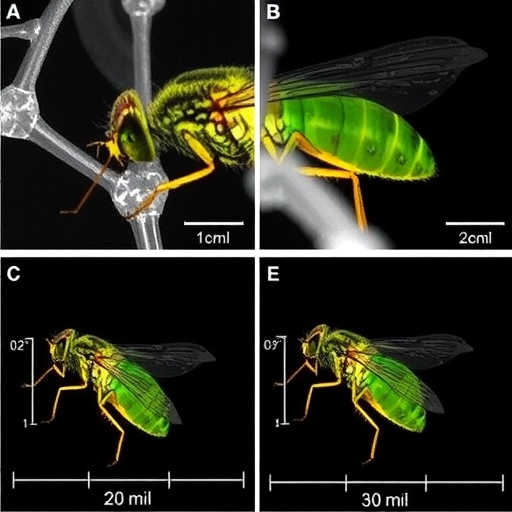
In a remarkable leap forward for neurobehavioral genetics and sensory processing research, a team of scientists has unveiled groundbreaking findings on the modulation of escape responses in the adult fruit fly, Drosophila melanogaster, via a phenomenon known as pre-pulse inhibition (PPI). This research, soon to be published in Translational Psychiatry, masterfully bridges the gap between invertebrate nervous systems and fundamental principles of sensorimotor gating, revealing profound implications for understanding neurological disorders across species, including humans.
Escape responses in animals are crucial, evolutionarily conserved behaviors enabling survival through the rapid evasion of threats. In Drosophila, these reflexive responses can be triggered by sudden sensory stimuli—such as abrupt visual, acoustic, or tactile cues—eliciting a swift flight or jump. What this new study elucidates is how a sub-threshold, non-startling pre-stimulus (or pre-pulse) can suppress or tune down the subsequent startle response triggered by a more intense stimulus. This regulatory mechanism, known as pre-pulse inhibition, reflects the nervous system’s capacity to filter and prioritize incoming stimuli, preventing overstimulation and allowing more adaptive behavioral reactions.
Traditionally, PPI has been extensively characterized in vertebrates, particularly mammals, as a model for sensory gating deficits commonly observed in neuropsychiatric disorders such as schizophrenia and bipolar disorder. However, until now, the precise neural and genetic underpinnings of PPI remained elusive in simpler model organisms like fruit flies. The new findings decisively establish Drosophila as a viable and powerful platform for dissecting the molecular and circuit-level mechanisms underlying PPI, providing a novel window into the evolution and functional significance of sensory gating.
The research team, led by Viragh, Asztalos, Fenckova, and colleagues, employed an integrated approach combining behavioral assays, electrophysiological recordings, and genetic manipulation to systematically characterize PPI in adult fruit flies. They designed carefully calibrated pre-pulse and pulse stimuli to measure how preceding subtle sensory cues modulate the subsequent escape jump reflex—a behavior robustly quantifiable thanks to Drosophila’s well-mapped neural circuitry.
One of the study’s pivotal discoveries was that while the initial tactile pre-pulse alone elicited no overt startle, it significantly reduced the magnitude of the escape response triggered by a subsequent stronger sensory pulse. This inhibition was consistent across experimental replicates, underscoring a reliable sensorimotor gating phenomenon. Importantly, the effect was stimulus-parameter dependent, highlighting intricate temporal and intensity thresholds governing neural integration in the fly’s nervous system.
Delving deeper, the researchers explored the genetic substrates implicated in this sensorimotor filtering process. Leveraging powerful genetic tools unique to Drosophila, including targeted mutations and neuron-specific silencing, they identified key molecules and neuronal populations critical for PPI expression. Notably, modulation of neurotransmitter systems previously associated with mammalian PPI—such as dopaminergic and glutamatergic pathways—produced significant alterations in the pre-pulse inhibitory response, suggesting conserved neurochemical mechanisms.
These findings have profound implications beyond entomological interest. By dissecting how the fruit fly brain implements sensory gating, scientists can draw parallels to human neuropsychiatric conditions characterized by disrupted PPI and sensory processing anomalies. The simplicity and genetic tractability of Drosophila afford unparalleled opportunities to uncover new candidate genes, signaling pathways, and circuit dynamics that may underlie disorders marked by impaired sensorimotor gating.
Moreover, the methods established in this study pave the way for high-throughput screening of neuroactive pharmacological compounds within a genetically defined framework. This advancement could accelerate preclinical testing pipelines for drugs targeting sensorimotor gating dysfunction, propelling translational research from bench to bedside with greater efficiency.
Intriguingly, the demonstration of PPI in an invertebrate species also adds a new dimension to understanding how complex adaptive behaviors evolve and are maintained across phylogenetic hierarchies. It challenges the notion that such sophisticated neural filtering mechanisms are exclusive to vertebrate brains, suggesting an ancient evolutionary origin and potentially convergent evolution of sensory gating.
The study further elaborates on the temporal architecture of PPI, revealing that the timing between the pre-pulse and the main pulse stimulus is critical—a feature shared with vertebrate systems. This temporal dependency implies a tightly regulated internal clock mechanism that orchestrates sensory processing and motor output, a fascinating target for future in vivo imaging and computational modeling studies.
Beyond individual neurons, the authors propose that networks encompassing interneurons within the Drosophila central nervous system integrate multisensory information to modulate escape behaviors adaptively. This network-level perspective echoes emerging views in neuroscience that sensory gating arises from distributed neural circuits interacting dynamically rather than isolated loci.
Importantly, the research takes a holistic approach by combining behavioral phenotyping with molecular and electrophysiological data, illustrating a multi-dimensional understanding of sensorimotor gating. This integrative methodology exemplifies the future of neuroscience, where bridging scales from molecules to behavior leads to transformative insights.
As the global scientific community seeks models that can balance complexity and experimental accessibility, this study elevates the fruit fly as an indispensable organism for neuropsychiatric research innovation. The ability to monitor and manipulate discrete neural circuits responsible for PPI in a live behaving animal situates Drosophila in the forefront of systems neuroscience.
In sum, the authors have compellingly demonstrated that adult Drosophila exhibit robust pre-pulse inhibition of escape responses, governed by genetically conserved neural mechanisms. This discovery does more than fill a gap—it opens a vast new research domain linking fundamental neurobiology with translational psychiatry, presenting an elegant and practical system to unravel the mysteries of sensory processing and behavioral modulation.
With this pivotal work, the scientific community is now poised to harness the power of Drosophila genetics and neurophysiology to deepen our understanding of brain function and dysfunction, ultimately guiding the development of novel therapies for disabling neuropsychiatric conditions characterized by sensory gating deficits. The future of sensorimotor research has taken flight, propelled by the humble fruit fly’s remarkable behavioral repertoire.
Subject of Research: Pre-Pulse Inhibition and sensorimotor gating mechanisms in adult Drosophila melanogaster.
Article Title: Pre-Pulse Inhibition of an escape response in adult fruit fly, Drosophila melanogaster.
Article References:
Viragh, E., Asztalos, L., Fenckova, M. et al. Pre-Pulse Inhibition of an escape response in adult fruit fly, Drosophila melanogaster. Transl Psychiatry (2026). https://doi.org/10.1038/s41398-025-03717-5
Image Credits: AI Generated


