


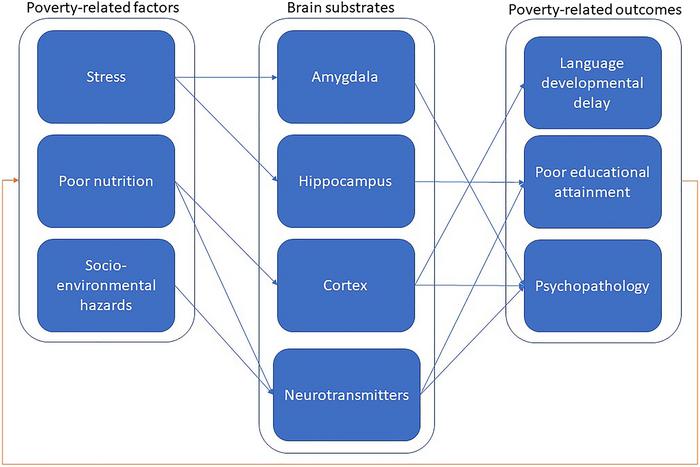
What determines mental health, school performance, and even cognitive development? A new review in De Gruyter’s Reviews in the Neurosciences suggests that poverty and low socioeconomic status (SES) are key contributory factors. Other studies have examined the isolated effects of poverty on the brain or on behavior. However, this new review provides the first unified framework that uses evidence from the literature to directly link the brain changes that result from low SES to behavioral, pathological, and developmental consequences.

Credit: Eid Abo Hamza et al./De Gruyter
What determines mental health, school performance, and even cognitive development? A new review in De Gruyter’s Reviews in the Neurosciences suggests that poverty and low socioeconomic status (SES) are key contributory factors. Other studies have examined the isolated effects of poverty on the brain or on behavior. However, this new review provides the first unified framework that uses evidence from the literature to directly link the brain changes that result from low SES to behavioral, pathological, and developmental consequences.
SES refers to the social standing of an individual or family, and involves factors such as wealth, occupation, educational attainment, and living conditions. As well as affecting day-to-day life, perhaps surprisingly SES can also have far-reaching consequences for our brains that begin in childhood and persist into adulthood.
So, how can poverty and low SES change the brain? The review examines the negative effects of poor nutrition, chronic stress, and environmental hazards (such as pollution and inadequate housing conditions), which are more likely to affect low SES families. These factors can impair the brain development of children, which in turn can influence their language skills, educational attainment, and risk of psychiatric illness.
For instance, families with low SES are more likely to experience increased stress levels, and these can affect their children from an early age. Sustained stress can reduce levels of neurogenesis — the growth of new neurons — in the hippocampus, which may impair learning abilities and negatively affect educational attainment and career opportunities in later life.
The unified framework proposed by the researchers also helps to explain generational poverty, which can leave the children of SES families unable to escape their situation when they grow up and become parents themselves. This vicious cycle can be hard to break.
Interestingly, the researchers provide an extensive list of proposed studies that could test the validity of their framework and find new ways to break the generational poverty cycle. These include focusing on the effects of low SES in specific brain regions, and identifying techniques to enhance the performance of affected children in school.
The review is timely, as inequalities in society widen. Identifying specific mechanisms behind generational poverty could help researchers and policy makers to develop new early interventions. The new framework takes account of the multifactorial nature of generational poverty, and could pave the way for more holistic and sophisticated societal interventions that acknowledge this complexity.
“This research sheds light on the profound ways in which poverty and SES affect not just the present living conditions of individuals, but also their cognitive development, mental health, and future opportunities,” said Dr. Eid Abo Hamza of Al Ain University in the United Arab Emirates, who is first author of the review. “By understanding these relationships, society can better address inequalities and support those in disadvantaged situations, potentially leading to interventions that can help break the cycle of poverty.”
Journal
Reviews in the Neurosciences
Method of Research
Systematic review
Subject of Research
People
Article Title
The impact of poverty and socioeconomic status on brain, behaviour, and development: a unified framework
Article Publication Date
15-Apr-2024
COI Statement
Authors state no conflict of interest.
Cite Scienmag News
Cassandra Pierce. (April 15, 2024). Poverty linked with brain changes that contribute to behavior, illness, and development. Scienmag. https://scienmag.com/poverty-linked-with-brain-changes-that-contribute-to-behavior-illness-and-development/
Cassandra Pierce. "Poverty linked with brain changes that contribute to behavior, illness, and development." Scienmag, 15 April 2024, https://scienmag.com/poverty-linked-with-brain-changes-that-contribute-to-behavior-illness-and-development/. Accessed 4 September 2026.
Cassandra Pierce. "Poverty linked with brain changes that contribute to behavior, illness, and development." Scienmag. April 15, 2024. https://scienmag.com/poverty-linked-with-brain-changes-that-contribute-to-behavior-illness-and-development/

