


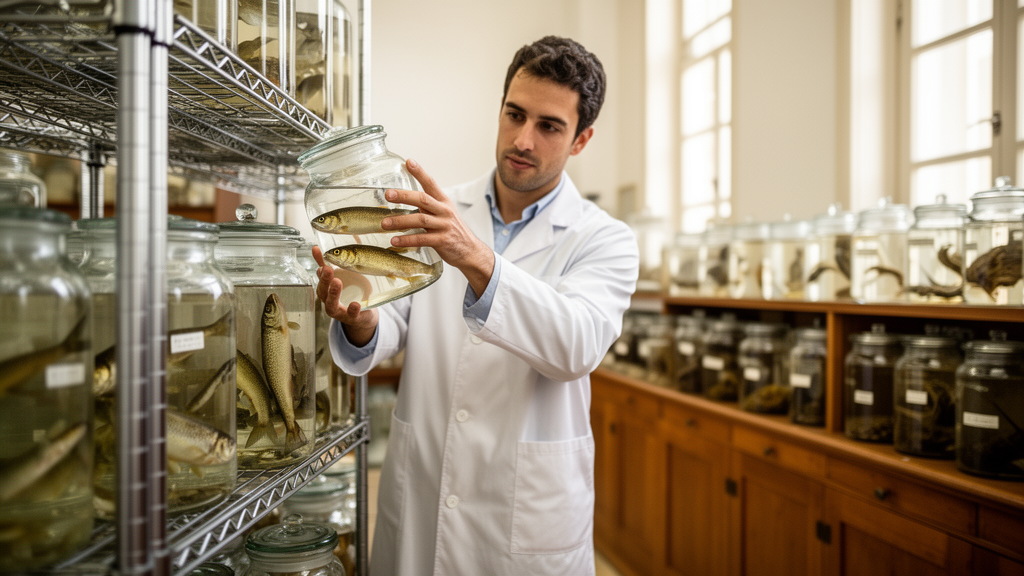
Portugal’s rivers and streams are home to some of Europe’s most threatened fish species, yet the museum collections that should be documenting this biodiversity are falling dangerously short. A comprehensive new analysis of Portuguese natural history collections has revealed that while nearly all of the country’s freshwater fish species are represented in national museums, the depth and breadth of that representation is far from adequate. The findings, published in Natural History Collections and Museomics, paint a troubling picture of gaps that could undermine conservation efforts for decades to come.
The study examined five major Portuguese collections: the Museu Nacional de História Natural e da Ciência da Universidade de Lisboa (MNHNC), the Museu da Ciência da Universidade de Coimbra (MCUC), the Museu de História Natural e da Ciência da Universidade do Porto (MHNC-UP), the Aquário Vasco da Gama (AVG), and the Museu de História Natural do Funchal (MMF). Together, these institutions hold 50,228 specimens distributed across 2,990 lots, representing 64 of the 66 freshwater fish taxa currently known to occur in Portugal. On the surface, that sounds impressive. But dig deeper, and the cracks begin to show.
Nearly 40 percent of the assessed species are represented by fewer than 50 specimens, and approximately 70 percent are known from fewer than 50 lots. Four species—the Vettonian spined-loach, the Prussian carp, the northern pike, and the Atlantic salmon—are each represented by just a single specimen. The recently-described Almada spined-loach and an unidentified Phoxinus species are entirely absent from the collections. This thin representation means that for many species, scientists have almost no material to work with when conducting taxonomic revisions, genetic analyses, or historical baselines.
The geographic coverage is equally concerning. Using a 10 by 10 kilometre grid system, the researchers found that the collections cover just 36.7 percent of Portuguese territory. The MNHNC alone accounts for 34.8 percent of that coverage, while the other four institutions contribute a combined total of less than 2 percent. One fifth of the country’s freshwater fish species have less than 10 percent of their known range represented in the assessed collections. The Guadiana, Tejo, and Douro River Basins—the three largest in the country—dominate the holdings, accounting for nearly two-thirds of all specimens, while smaller basins like the Neiva are barely documented at all.
The temporal patterns reveal yet another layer of inadequacy. The oldest specimen in the collections is a sturgeon skull collected in 1844, now held at the MHNC-UP. The MNHNC collection was almost entirely destroyed in a devastating fire in 1978, and only 605 specimens from 94 lots survived. From 1978 to the late 1980s, there was intensive collecting, followed by a decrease in the 1990s, a peak in the late 2000s, and then a steady decline from the 2010s onwards. The MCUC collection’s most recent accessions of Portuguese freshwater fishes date back to 1942, while the MHNC-UP collection growth occurred primarily during the 1910s. This pattern of opportunistic, project-based collecting rather than sustained, programmatic deposition means the collections cannot serve as robust time series for monitoring biodiversity change.
The conservation implications are stark. Sixty percent of Portugal’s native freshwater fish species are currently classified as threatened with extinction according to the national Red List, yet threatened species represent only about one quarter of all extant specimens. The Iberian Peninsula has the highest number of dams per land area and per capita worldwide, and has experienced an exceptionally high rate of non-native fish introductions. Thirteen new native species have been described in Portugal in the present century alone, ten of which are Portuguese endemics. Eight new non-native species have been recorded during the same period. The sturgeon, regionally extinct since the 1980s, is represented by just nine specimens, the most recent dating from 1972—a poignant reminder of what is lost when collections fail to keep pace with biodiversity decline.
Non-native species account for approximately one third of all freshwater fish taxa known from Portugal and slightly over one quarter of all assessed specimens. The eastern mosquitofish and the pumpkinseed are the second and third most common species in the collections, with 6,182 and 4,346 specimens respectively. Half of the species represented by fewer than 10 specimens are exotic, including several typically large-bodied taxa such as the Wels catfish, the northern pike, and the channel catfish. The researchers noted that, since 1998, there has been an average gap of slightly over four years between the moment a new exotic taxon is first recorded for Portugal and the deposition of a vouchered specimen in a natural history collection—a lag that hampers efforts to monitor the spread of invasive species.
The concentration of research and voucher deposition almost exclusively at the MNHNC represents what the authors describe as an overall risk for Portuguese ichthyology. The MNHNC holds 76 times more freshwater fish specimens than the other four institutions combined. While collection redundancy—spreading vouchers across multiple institutions—creates security, that practice is not common in the current Portuguese scenario. The catastrophic fire that destroyed the MNHNC’s historical zoological collections in 1978, and more recently the devastating blaze at the National Museum of Rio de Janeiro in 2018, serve as sobering warnings about the fragility of concentrated holdings.
The study also found that fishing species—those targeted by recreational and professional anglers—make up 68.4 percent of all specimens in the collections. Amongst them are the most common taxa, including the calandino with 11,438 specimens and the pumpkinseed with 4,346, as well as some of the least represented species like the northern pike and the Prussian carp, each known from a single specimen. This bias towards commercially or recreationally relevant species reflects historical collecting priorities but leaves ecologically important yet less charismatic species underrepresented.
The researchers conclude that Portuguese freshwater fish collections follow the same troubling pattern observed for the country’s herpetology, mammal, and bird collections, and align with a global decline in collecting practices and specimen accession. While the renewed importance of natural history collections for future research and biodiversity conservation is beyond doubt, insufficient funding, shortage of new professionals, and persistent infrastructural challenges threaten not only the integrity of these collections but also the capacity of science to generate knowledge, document biodiversity, and inform conservation. Ensuring sustained, programmatic collecting and investment in natural history collections is therefore essential, as these collections remain the irreplaceable foundation for both current and future scientific understanding of Portugal’s freshwater ecosystems.
Subject of Research: A taxonomic, geographic and temporal assessment of Portuguese freshwater fishes in Portuguese ichthyological collections
Article Title: A taxonomic, geographic and temporal assessment of Portuguese freshwater fishes in Portuguese ichthyological collections
Article References: Santos, B. S., da Costa, L. M., Alves, M. J., & Ceríaco, L. M. P. (2026). A taxonomic, geographic and temporal assessment of Portuguese freshwater fishes in Portuguese ichthyological collections. Natural History Collections and Museomics, 3, Article e186661. https://doi.org/10.3897/nhcm.3.186661
Image Credits: AI Generated
Keywords: taxonomic, geographic, temporal, assessment, Portuguese, freshwater, fishes, ichthyological, collections, scientific research
Cite Scienmag News
Margaret Porter. (October 16, 2026). Portugal’s freshwater fish collections reveal dangerous gaps in biodiversity record. Scienmag. https://scienmag.com/portugals-freshwater-fish-collections-reveal-dangerous-gaps-in-biodiversity-record/
Margaret Porter. "Portugal’s freshwater fish collections reveal dangerous gaps in biodiversity record." Scienmag, 16 October 2026, https://scienmag.com/portugals-freshwater-fish-collections-reveal-dangerous-gaps-in-biodiversity-record/. Accessed 16 October 2026.
Margaret Porter. "Portugal’s freshwater fish collections reveal dangerous gaps in biodiversity record." Scienmag. October 16, 2026. https://scienmag.com/portugals-freshwater-fish-collections-reveal-dangerous-gaps-in-biodiversity-record/


