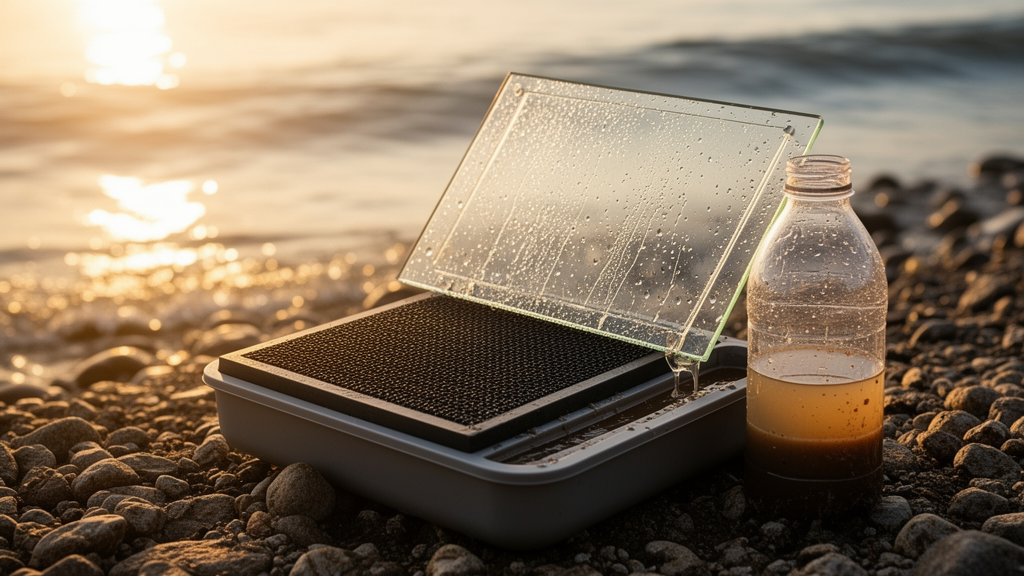
Engineers have unveiled a compact desalination device that pairs solar electricity with a clever heat-trapping design to produce freshwater at high rates, even in challenging outdoor conditions. The system, described in Nature Water, is built around what the researchers call an interlayer electrothermal evaporator, or IEE, and it is designed to turn sediment-laden water, oily water, high-salinity wastewater and strongly acidic water into usable freshwater.
Electrothermal desalination, in which electricity heats water directly to drive evaporation, has long been viewed as a promising route to green-energy-driven, miniaturized, high-flux freshwater systems. Its Achilles heel, according to the study, is heat loss. Traditional bulk electrothermal evaporators leak significant amounts of heat to their surroundings, which caps the apparent energy efficiency, drives up energy consumption and forces reliance on bulky equipment.
The new design attacks that problem by restructuring the evaporator itself. By placing the electrothermal heating element in an interlayer configuration, the device reduces heat loss and cuts energy consumption by nearly two-thirds compared with a bulk electrothermal evaporator, the authors report. The comparison between bulk evaporators, interlayer-free evaporators and the new IEE design is illustrated in the paper’s performance evaluation figures.
When the photothermal effect of sunlight is factored in, the IEE reaches an apparent energy efficiency of 93.31 percent, with a freshwater flux of 69.46 litres per square metre per hour. Those figures, reported in the abstract of the study, represent the headline performance of the device under the conditions described by the authors.
What makes the system genuinely portable is its power and optics. The IEE draws its electricity from solar cells, and a Fresnel lens concentrates incoming solar energy onto the system. Together these components form a self-contained freshwater production unit intended for outdoor use, an arrangement the researchers tested in field scenarios depicted in the study’s outdoor production figures.
The field results are striking in their scale. Using an evaporator area of only 30.72 square centimetres, the solar-operated system produced 1.64 litres of freshwater within eight hours. According to the authors, that output is sufficient to meet the daily needs of an individual, even when the source water is sediment water, oily water, high-salinity wastewater or strongly acidic water.
The motivation behind the work is starkly practical. The authors note that as conflicts and frequent natural disasters intensify, timely access to freshwater from multiple resources becomes extremely important for human survival. A device that can run on sunlight alone, fit in a portable footprint and tolerate contaminated or extreme water sources is aimed squarely at emergency and off-grid scenarios where conventional infrastructure is absent or destroyed.
The study frames the IEE system as a sustainable and scalable solution to mitigate freshwater scarcity, enabling high-flux freshwater production across diverse scenarios. The reported efficiency and flux figures come from the authors’ own characterization and simulation work, presented in figures covering electrothermal evaporation performance, theoretical simulation of the three evaporator designs, and the freshwater flux of the solar-operated IEE.
As with any newly reported device, the published results describe the performance achieved under the study’s reported conditions, and the abstract does not report long-term durability data, cost figures or deployment results beyond the described outdoor tests. Readers should treat the 93.31 percent efficiency and the 1.64-litre, eight-hour output as the study’s reported findings rather than independently verified field performance. The full paper, published on 28 October 2026, is available in Nature Water, with the complete technical characterization contained in the article’s figures and methods.
Subject of Research: A solar-driven interlayer electrothermal evaporator for high-flux freshwater production from multiple challenging water sources
Article Title: Solar-operated interlayer electrothermal evaporator enabling instant high-flux freshwater production across multiple scenarios
Article References: Yang, H., Zuo, J., Zang, Y., Zhao, B., Xie, C., Dai, C., Liang, Z., Peng, M., Sun, Y., & Jiang, L. (2026). Solar-operated interlayer electrothermal evaporator enabling instant high-flux freshwater production across multiple scenarios. Nature Water. https://doi.org/10.1038/s44221-026-00734-6
Image Credits: AI Generated
DOI: 10.1038/s44221-026-00734-6
Keywords: solar desalination, electrothermal evaporation, freshwater scarcity, interlayer evaporator, solar cells, Fresnel lens, energy efficiency, portable water system, Nature Water, wastewater treatment, Solar-operated, interlayer
Cite Scienmag News
Violet Maxwell. (October 28, 2026). Portable solar-powered evaporator delivers high-flux freshwater from tough water sources. Scienmag. https://scienmag.com/portable-solar-powered-evaporator-delivers-high-flux-freshwater-from-tough-water-sources/
Violet Maxwell. "Portable solar-powered evaporator delivers high-flux freshwater from tough water sources." Scienmag, 28 October 2026, https://scienmag.com/portable-solar-powered-evaporator-delivers-high-flux-freshwater-from-tough-water-sources/. Accessed 28 October 2026.
Violet Maxwell. "Portable solar-powered evaporator delivers high-flux freshwater from tough water sources." Scienmag. October 28, 2026. https://scienmag.com/portable-solar-powered-evaporator-delivers-high-flux-freshwater-from-tough-water-sources/