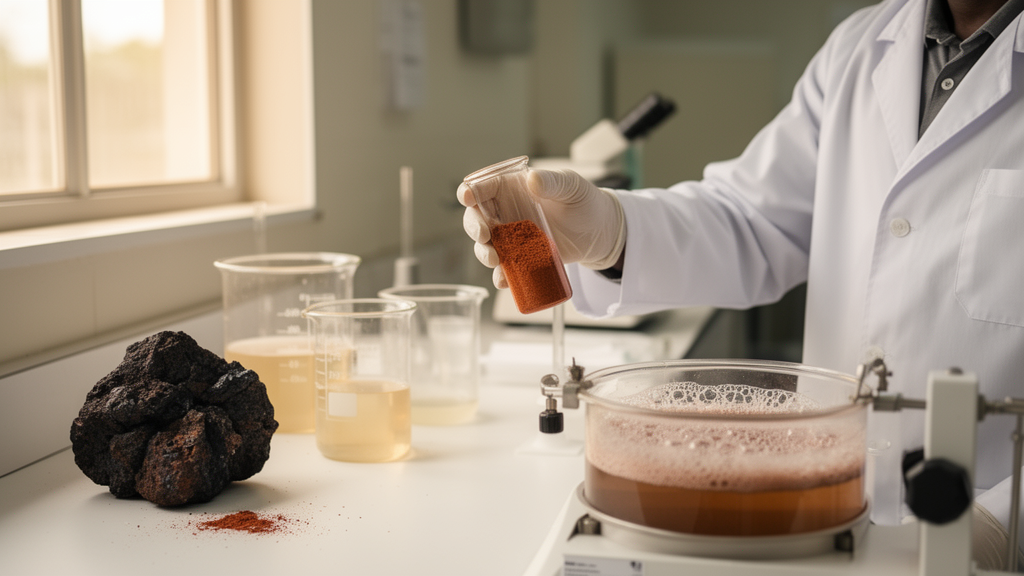
Researchers have reported a full processing route that takes a hematite-dominated copper ore from Akiri village in Nasarawa State, Nigeria, and upgrades it from 3.65% copper in the as-received ore to a metallic copper powder of 97.21% purity, with iron impurities cut from 18.66% Fe down to 0.785% Fe. The team, led by T. J. Ayodele with colleagues including A. A. Daniyan, A. A. Adeleke and C. Mbohwa, set out to establish an economical hydrometallurgical alternative to the energy-intensive electrometallurgical and pyrometallurgical routes that dominate industrial copper extraction.
The ore itself is a distinctive and challenging feedstock. Characterisation by X-ray diffraction, X-ray fluorescence, scanning electron microscopy with energy-dispersive spectroscopy, and atomic absorption spectrometry showed that the copper occurs as chalcopyrite, covellite and cuprite, while the gangue is dominated by hematite and quartz. XRF analysis identified three major oxides in the ore: hematite at 76.04 wt%, copper oxide at 11.3 wt% and silicon oxide at 5.3 wt%, making iron, copper and silicon the major elements, with aluminium, magnesium, sulphur, titanium, manganese, calcium, carbon and potassium present as minor components. Optical microscopy of the head sample under plane polarised light revealed three mineral phases — brassy yellow chalcopyrite, reddish brown hematite and whitish silica minerals — and confirmed that the major phase is hematite. Notably, the mineral grains are separated by clear boundaries with no interlocking, and particle sizes range from 63 to 355 micrometres, a texture the authors say means the minerals can be freed from each other relatively easily during comminution, reducing the energy needed for liberation.
Before any processing, the sample was crushed in a jaw crusher, ball milled with 50 mm steel balls at 60% mill speed, and sieved to 100% passing 106 micrometres, a size chosen because it falls within the liberation range of the copper minerals. The mineralogical work was carried out at Afe Babalola University in Ado Ekiti and the Central Science Laboratory of the University of Ibadan, while atomic absorption analysis was performed at Obafemi Awolowo University in Ile-Ife. The AAS analysis of the as-received ore confirmed 3.65% Cu and 18.66% Fe, and the XRD pattern identified chalcopyrite at 2.24%, covellite at 1.76% and cuprite at 1.29% in composition, alongside gangue minerals including calcite, quartz, chlorite, mica, K-feldspar and plagioclase. The XRD instrument was unable to detect the hematite phase directly, possibly due to its configuration limit, so the team turned to microscopy and chemical analysis to confirm its presence.
The beneficiation stage used bench-scale froth flotation in a Denver cell, designed as a 2³ full factorial experiment with collector concentration, activator dosage and frother dosage as the variables. Each test used 50 grams of minus-106-micrometre material at 30% pulp density, with the pH adjusted to 9 using sodium hydroxide. Potassium xanthate served as the collector, copper sulphate as the activator, corn starch as a depressant for iron, silica and other gangue minerals, and pine oil as the frother. The optimum combination turned out to be a high collector concentration of 750 grams per tonne, a low activator dosage of 500 grams per tonne and a high frother concentration of 2 grams per tonne, which produced a froth product assaying 5.40% Cu with a copper recovery of 89.34% and an iron content of 14.38% Fe.
The factorial analysis yielded instructive effect estimates for each reagent. The collector had the largest main effect at 7.0875, meaning that raising its concentration from 150 to 750 grams per tonne increased the yield of froth product by rendering more particle surfaces hydrophobic. The activator showed a negative effect of −0.4525: increasing copper sulphate from 500 to 1500 grams per tonne actually decreased the yield, because excess activator activates unwanted minerals, consumes collector, alters mineral surfaces and reduces selectivity. The frother’s main effect was −1.1175, attributed to increased bubble coalescence at higher dosage, so only a small concentration is needed. Interaction terms also mattered: the collector–activator interaction was estimated at −3.1175, the activator–frother interaction at −3.822, while the collector–frother interaction was positive at 1.3675, indicating that the two reagents reinforce each other’s effects on froth yield.
The flotation concentrate then underwent leaching with analytical-grade sulphuric acid under optimal conditions drawn from earlier work: 1.5 M acid concentration, 90 °C temperature, 90 minutes of contact time and 400 rpm stirring, at a solid-to-liquid ratio of 1:5 grams per millilitre in a 300-millilitre reactor. This leaching step acted as a further beneficiation process, raising the copper grade from 5.4% Cu to 15.99% Cu, although the recovery fell from 89.43% to 78.93%, and the iron content dropped from 14.38% Fe to 11.25% Fe. The filtrate, a pregnant leach solution, was then fed forward to the metal recovery stage. Kinetic analysis of the dissolution using shrinking core models gave activation energies of 13.2 kilojoules per mole for liquid film diffusion control and 25.67 kilojoules per mole for diffusion through a product layer, small values that the authors say confirm the leaching rate is diffusion-controlled.
Copper was recovered from the pregnant solution by cementation with zinc dust, following the reaction in which copper sulphate and zinc produce zinc sulphate and metallic copper. The cementation experiments were also designed as a 2³ factorial study, with temperature, zinc-to-copper molar ratio and contact time as variables, using 25 or 75 millilitres of pregnant solution in 250-millilitre beakers, about 1.0 gram of 95% pure zinc dust, a pH held at 1.5 with sodium bicarbonate, and constant stirring at 400 rpm. The optimum combination was a temperature of 50 °C, a molar ratio of 1 and a 15-minute contact time, which yielded 0.499 grams of copper powder at a 99.8% recovery ratio. Copper recovery increased from 98.6% to 99.8% as temperature rose from 303 to 323 K at 15 minutes, but the main effect of temperature was estimated at only −0.6 and was statistically insignificant, leading the authors to conclude the process can be carried out at room temperature.
The molar ratio behaved counterintuitively: it had a positive estimated effect of 3.7 on recovery, yet at a molar ratio of 3 with 50 °C and 10 minutes of contact, copper recovery was only 72.8%, compared with 97% at a molar ratio of 1 under the same conditions. The authors attribute the poorer performance at the higher ratio to insufficient zinc powder actually available to precipitate the copper, leaving some copper ions unreacted. Contact time showed a positive effect of 10.5, with precipitation efficiency reaching its maximum of 99.8% at 15 minutes and plateauing thereafter. An Arrhenius plot of the cementation data gave an apparent activation energy of 18.13 kilojoules per mole, a value within the 8 to 25 kilojoules per mole range typical of diffusion-controlled processes, indicating that the rate of cementation is governed by diffusion.
The cemented copper powder still contained significant iron and aluminium, so it was purified by digestion in a mixture of 0.5 M sulphuric acid and 0.1 M sodium carbonate at 50 °C in a 10% solids slurry at pH 2.0 for 30 minutes, conditions chosen to prevent excessive dissolution of copper. XRF analysis of the final powder showed 97.21% Cu, 0.785% Fe and 2.005% other elements, and the EDS spectrum recorded 97.21% copper with no detectable oxygen, suggesting zinc had been removed as contact time increased. The cemented copper exhibits a high surface area with a porous, dendritic structure, and the authors attribute the residual iron impurities mainly to solution chemistry — iron ions and hydroxide precipitation — and to physical entrapment of impurities within the porous copper structure.
The study concludes that the Akiri hematite-laden copper ore was successfully upgraded and extracted through the combined flotation–hydrometallurgy route, and the authors suggest that the iron-rich tailings, reported at 56.64% Fe, could be further treated to produce iron ore concentrate for Nigerian steel plants at Ajaokuta and Delta, which require 63% and 67% Fe respectively. They also recommend exploring additional beneficiation techniques for the hematite-rich ore, including falcon gravity separation, wet high-intensity magnetic separation and electrostatic separation, and note that leaching in a pressure reactor could achieve higher copper dissolution. As a bench-scale study on a single Nigerian deposit, the results establish an optimised process window for this specific ore rather than a demonstrated industrial flowsheet, but they add regional data on a deposit whose beneficiation and extraction behaviour had not previously been reported in the literature.
Subject of Research: Hydrometallurgical extraction of copper from a hematite-dominated copper ore deposit in Nasarawa State, Nigeria
Article Title: Hydrometallurgical copper extraction from hematite-dominated copper ore
Article References: Ayodele, T. J., Daniyan, A. A., Adeleke, A. A., & Mbohwa, C. (2026). Hydrometallurgical copper extraction from hematite-dominated copper ore. Discover Minerals, 3(1), Article 5. https://doi.org/10.1007/s44346-026-00017-8
Image Credits: AI Generated
DOI: 10.1007/s44346-026-00017-8
Keywords: copper extraction, hydrometallurgy, froth flotation, hematite, sulphuric acid leaching, cementation, zinc dust, Nigeria, Akiri ore deposit, chalcopyrite, leaching kinetics, mineral processing
Cite Scienmag News
Violet Maxwell. (October 28, 2026). Nigerian Hematite-Rich Copper Ore Yields 97% Pure Copper Powder via Flotation and Leaching. Scienmag. https://scienmag.com/nigerian-hematite-rich-copper-ore-yields-97-pure-copper-powder-via-flotation-and-leaching/
Violet Maxwell. "Nigerian Hematite-Rich Copper Ore Yields 97% Pure Copper Powder via Flotation and Leaching." Scienmag, 28 October 2026, https://scienmag.com/nigerian-hematite-rich-copper-ore-yields-97-pure-copper-powder-via-flotation-and-leaching/. Accessed 4 November 2026.
Violet Maxwell. "Nigerian Hematite-Rich Copper Ore Yields 97% Pure Copper Powder via Flotation and Leaching." Scienmag. October 28, 2026. https://scienmag.com/nigerian-hematite-rich-copper-ore-yields-97-pure-copper-powder-via-flotation-and-leaching/