


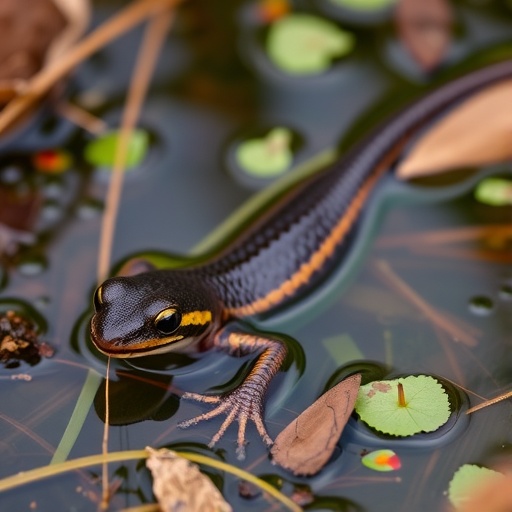
The California tiger salamander (Ambystoma californiense) has long been a symbol of the fragile balance sustaining amphibian populations in the fragmented ecosystems of the western United States. This species, which depends heavily on seasonal ponds to complete its complex breeding cycle, has recently been facing mounting threats from invasive hybrid salamanders. Introduced during the mid-20th century primarily as fishing bait, barred tiger salamanders have hybridized with native populations, creating hybrids that outperform both parent species in size, growth rate, and competitive dominance. These hybrids have rapidly altered pond ecosystems, creating urgent conservation challenges that demand innovative and multifaceted management strategies.
For decades, the spread of these invasive hybrid salamanders has posed a significant existential threat to the native California tiger salamander populations. These hybrids exhibit increased growth rates and voracious appetites, which allow them to dominate resources within breeding ponds, often excluding native species by the season’s end. Understanding the mechanisms underpinning this dominance and developing effective intervention strategies have become priorities for conservation biologists. A recent study led by a team at Virginia Tech sheds illuminating light on the complex interplay between pond ecology, hybridization dynamics, and demographic outcomes for these endangered species.
To unravel how environmental and genetic factors interact to affect salamander survival and population viability, the researchers employed a suite of genomically-informed demographic models. These models integrate extensive field data from over three years of observation in 18 experimental ponds, alongside genetic analyses that distinguish native individuals from hybrids with high precision. Using this comprehensive dataset, the models simulate population trajectories under varying pond hydroperiods—that is, the duration for which ponds retain water each season—and different intensities and timing of hybrid removal. Such simulations offer critical insight into which management interventions might tilt the ecological balance back in favor of natives.
One of the study’s most striking findings is the overriding importance of pond hydroperiod length in determining population outcomes. Ponds that maintain water presence for longer than approximately 110 days consistently support larger, more stable salamander populations. In contrast, ponds drying within 90 days are prone to population crashes irrespective of the genetics of the resident amphibians. This insight highlights hydroperiod as a potent environmental lever that interacts deeply with the biological characteristics of both native and hybrid salamanders, influencing survival rates, breeding success, and competition dynamics.
Yet hydroperiod management alone cannot fully address the threat posed by invasive hybrids. Even under optimal pond conditions, hybrids tend to outperform native salamanders, often exhibiting superior growth and resource acquisition capabilities. This elevated performance underpins the challenge of solely relying on habitat manipulation to conserve the endangered California tiger salamander. Recognizing this, the study explores integrated management approaches that combine hydroperiod adjustment with targeted removal of hybrids through rapid genetic screening technologies, a cutting-edge tool enabling efficient identification and elimination of invasive individuals.
The study’s simulations demonstrate that tailoring pond hydroperiods to local genetic composition yields the best outcomes. In ponds inhabited primarily by native salamanders, extending water permanence beyond 120 days fosters robust population growth and recovery. Conversely, in hybrid zones, shortening the hydroperiod reduces the competitive edge of hybrids and facilitates their controllability via removal efforts. By coupling habitat management with genetics-informed culling, conservationists can significantly slow the advance of invasive hybrids and protect native populations from demographic collapse.
An essential aspect uncovered by this research is the timing and intensity of hybrid removal. Successful management hinges on early, intensive intervention rather than delayed or sporadic efforts. Hybrids that establish and spread undetected become far harder and costlier to control, rapidly undermining native salamander recovery. The advent of rapid, field-deployable genetic tests promises to revolutionize this aspect of invasive species management, allowing near-real-time decisions that keep control programs both economically and ecologically viable.
The research team’s dedication to data collection speaks volumes about the challenges inherent in amphibian conservation. Most salamander habitats lie on private lands, requiring painstaking negotiations and permits to enable experimental pond creation. Continuous daily monitoring across several seasons enabled the assembly of a rich dataset encompassing growth measures, survival rates, and genetic profiles. This detailed, longitudinal data forms the backbone of the models and lends robust predictive power to the management scenarios tested.
Physically, the disparity between hybrids and native California tiger salamanders is profound. Hybrids are visibly larger and more robust—a fact not merely cosmetic but reflective of underlying genetic and ecological advantages. This increased body size correlates strongly with superior competitive ability for food and breeding sites, further exacerbating the threat they pose to native salamander persistence. Such stark phenotypic differentiation underscores why hybrid dominance in pond ecosystems translates directly into native decline.
Crucially, this study exemplifies the potential to apply integrative conservation biology to complex ecological issues. By synthesizing molecular genetics, demographic modeling, and detailed field ecology, the researchers have crafted a flexible and powerful framework. This approach extends beyond salamanders; it serves as a blueprint for managing hybridization threats in a range of endangered species facing similar invasive pressures worldwide. The study underscores how collaborative, interdisciplinary science can illuminate paths toward effective species recovery.
The positive takeaway is the resilience and rebound capacity of California tiger salamander populations when given appropriate ecological and management conditions. Provided that conservationists act swiftly and employ informed strategies prioritizing hydroperiod management and removal of hybrids, these populations can recover and even thrive. This affirms the vital role of evidence-based stewardship in safeguarding biodiversity amid the accelerating challenges posed by invasive species and environmental change.
Emerging technologies, especially in genetic testing, represent a pivotal advance supporting conservation goals. Rapid, cost-effective genetic identification expedites the pinpointing of hybrids, enabling timely and targeted removals that maximize the conservation payoff of management actions. This complementarity between technological innovation and ecological insight is emblematic of the direction modern conservation must take to cope with multifaceted threats.
In summary, the fate of the California tiger salamander hinges on nuanced, context-dependent management that integrates habitat quality with genetic realities. By adapting pond hydroperiods in line with local population genetics and coupling this with intensive hybrid removal conducted early in the invasion process, managers can effectively counter hybrid dominance. These findings herald a promising beacon for amphibian conservation and provide a scalable model for tackling invasive-hybrid dilemmas globally, reaffirming that strategic, science-informed interventions can yield tangible, lasting benefits for endangered species preservation.
News Publication Date: 23-Oct-2025
Web References: Web-based model app
References: DOI 10.1002/eap.70116
Cite Scienmag News
Margaret Porter. (November 4, 2025). Pond Management Strategies Could Boost Native Salamander Conservation. Scienmag. https://scienmag.com/pond-management-strategies-could-boost-native-salamander-conservation/
Margaret Porter. "Pond Management Strategies Could Boost Native Salamander Conservation." Scienmag, 4 November 2025, https://scienmag.com/pond-management-strategies-could-boost-native-salamander-conservation/. Accessed 3 September 2026.
Margaret Porter. "Pond Management Strategies Could Boost Native Salamander Conservation." Scienmag. November 4, 2025. https://scienmag.com/pond-management-strategies-could-boost-native-salamander-conservation/


