


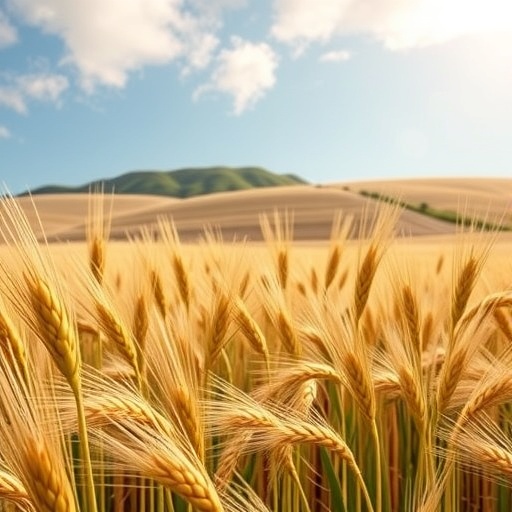
In a groundbreaking study that could reshape the future of global food security, researchers have revealed the intricate plasticity of source-sink dynamics in wheat plants as a crucial factor behind yield stability. This discovery, published in Nature Communications, offers unprecedented insights into how wheat, one of the world’s staple crops, dynamically regulates the balance between its photosynthetic “source” tissues and carbohydrate-consuming “sink” organs to buffer against environmental fluctuations and maintain consistent production levels.
Yield stability in crop plants has long been a paramount concern for agronomists and food scientists alike, particularly in the face of climate change-induced stresses such as drought, temperature extremes, and nutrient variability. The fundamental biological interplay between the source leaves, which produce photosynthates through photosynthesis, and the sink organs, primarily developing grains that require energy and carbon compounds to grow, underpins this stability. The study’s authors delve deep into this source-sink relationship, employing a multi-disciplinary approach that integrates physiological, genetic, and computational modeling techniques for a holistic understanding.
At the heart of the research lies the concept that wheat plants are not rigid in allocating resources; instead, they exhibit remarkable plasticity by modulating the capacity and strength of either source or sink tissues based on environmental cues. This plasticity allows the crop to optimize its internal resource economy efficiently, ensuring that when photosynthetic output decreases under stress conditions, sink strength adapts accordingly to avoid yield loss. Conversely, under favorable conditions that enhance photosynthesis, sinks expand their capacity to capitalize on the surplus assimilates, driving greater grain filling.
The study draws on extensive phenotyping of diverse wheat cultivars exposed to a spectrum of environmental conditions, ranging from optimum growth settings to simulated stress scenarios. Utilizing cutting-edge imaging and biochemical assays, the researchers quantified photosynthetic rates in leaves alongside carbohydrate transport pathways leading into developing grains. These intricate measurements were paired with gene expression profiling to decode the molecular networks regulating source-sink interplay.
One of the pivotal findings demonstrates that genetic variation among wheat lines governs the capacity for source-sink plasticity. Some cultivars featured heightened responsiveness in photosynthetic assimilation efficiency, while others showed more flexible sink organ growth. The interplay between these traits defined the plasticity landscape and was strongly correlated with observed yield stability across trials. This nuanced genotype-dependent modulation challenges the traditional breeding paradigms that focus largely on maximizing either source or sink traits independently.
To translate these biological insights into predictive frameworks, the research team developed a sophisticated mechanistic model integrating environmental inputs, genotypic traits, and physiological responses. The model accurately forecasted yield outcomes based on altered source-sink parameters, revealing potential pathways to engineer crops with enhanced buffering capacity against climate variability. Simulation experiments suggested that optimizing plasticity in both source activity and sink demand could mitigate yield penalties under stress without compromising peak productivity during optimal seasons.
Importantly, this work underscores the significance of temporally dynamic regulation in wheat development. The timing of source activity adjustment and sink strength is critical; too early or delayed responses may either waste resources or restrict grain filling. The authors also highlight novel regulatory genes acting as key modulators of these timing mechanisms, opening new avenues for gene editing and molecular breeding strategies aimed at yield stability.
The implications of these findings extend far beyond scientific curiosity. With global wheat demand expected to rise sharply over the next decades amid increasingly erratic climatic conditions, enhancing yield stability is vital to avoid food shortages and price volatility. Current agricultural practices often struggle to sustain productivity during unfavorable seasons, leading to wide fluctuations in supply. By harnessing source-sink plasticity, breeders can design cultivars that inherently adapt resource allocation dynamically, offering a biological insurance policy against uncertainty.
Beyond agricultural resilience, the revealed plasticity mechanisms also hold promise for precision farming approaches. By monitoring real-time physiological indicators governing source-sink balance, agronomists could tailor nutrient and irrigation management to amplify the plant’s natural buffering capacity. Such integrative crop management would synergize genetic potential with environmental modulation, maximizing resource use efficiency.
Moreover, the research paves the way for biotechnological interventions. Gene-editing tools like CRISPR-Cas9 can target the identified key regulators of source and sink plasticity, engineering wheat variants with custom-tuned responsiveness. This prospective capability transcends incremental yield gains, offering paradigm shifts in how crops cope with stress while sustaining high productivity.
While this study primarily focuses on wheat, the authors suggest that plastic source-sink dynamics likely represent a universal adaptive strategy among many cereal crops such as rice and maize. Future research is needed to validate and exploit these mechanisms across species, potentially revolutionizing food security globally.
In conclusion, uncovering the cellular and genetic basis of source-sink plasticity in wheat provides a transformative framework for sustainable yield stability. This multifaceted biological flexibility enables plants to navigate environmental uncertainties with optimized resource allocation, securing grain production under variable conditions. As food systems grapple with climate change challenges, leveraging these fundamental plant physiological principles offers a timely and powerful tool to safeguard global nutrition and agricultural sustainability for generations to come.
Cite Scienmag News
Alan Morgan. (April 24, 2026). Plasticity in Source-Sink Dynamics Enhances Wheat Yield Stability. Scienmag. https://scienmag.com/plasticity-in-source-sink-dynamics-enhances-wheat-yield-stability/
Alan Morgan. "Plasticity in Source-Sink Dynamics Enhances Wheat Yield Stability." Scienmag, 24 April 2026, https://scienmag.com/plasticity-in-source-sink-dynamics-enhances-wheat-yield-stability/. Accessed 4 September 2026.
Alan Morgan. "Plasticity in Source-Sink Dynamics Enhances Wheat Yield Stability." Scienmag. April 24, 2026. https://scienmag.com/plasticity-in-source-sink-dynamics-enhances-wheat-yield-stability/


