


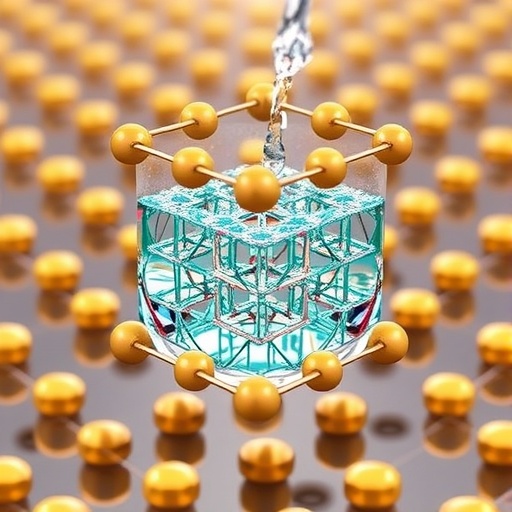
In the relentless quest for clean and sustainable energy, the efficient splitting of water into hydrogen and oxygen using sunlight—the process known as photocatalytic water splitting—has long stood as a holy grail. Hydrogen, as a carbon-neutral fuel, promises a future where energy demands are met without exacerbating climate change. However, the devil lies in the details: traditional photocatalytic systems often rely on multiple, separate components that complicate the reaction, reduce efficiency, and increase costs. A groundbreaking development reported recently in Nature Chemistry by Guan, Suzuki, Kamiya, and colleagues could revolutionize this landscape. Their study unveils the remarkable capabilities of two-dimensional metal-organic frameworks (2D MOFs) as complete, all-in-one cocatalysts tailored for the photochemical overall splitting of water.
Metal-organic frameworks are crystalline substances composed of metal ions bridged by organic linkers, creating porous, well-defined architectures. While their versatility in catalysis, gas storage, and sensing has been extensively explored for years, their potential in photocatalysis—particularly as integrated catalytic systems—has faced significant challenges. The key hurdle has been engineering these frameworks to promote both the oxygen evolution reaction (OER) and the hydrogen evolution reaction (HER) simultaneously, without resorting to external cocatalysts that add complexity and may suffer from poor interfacial charge transfer. The innovation presented by Guan et al. disrupts this paradigm by harnessing the intrinsic multifunctionality of 2D MOFs.
The researchers designed and synthesized specific 2D MOFs that not only effectively absorb visible light but also exhibit unparalleled catalytic activity for both half-reactions of water splitting. This synergy arises from meticulous control over the framework’s composition and topology, which optimizes the electronic structure to favor efficient generation and separation of photogenerated charge carriers. The ultrathin two-dimensional nature of these materials affords a maximized exposure of active sites, enhancing reactant accessibility and facilitating rapid interfacial electron transfer. Essentially, these MOFs act as ‘all-in-one’ cocatalysts, negating the need for additional noble metal cocatalysts such as platinum or iridium oxides.
A crucial advancement lies in the precisely engineered spatial distribution of catalytic sites within the 2D MOF matrix. Guan and colleagues were able to strategically position metal centers that catalyze the oxygen evolution and hydrogen evolution reactions separately but within the same coherent framework. This spatial separation reduces recombination losses of photogenerated electrons and holes—a persistent issue in traditional photocatalysis—and directs the redox reactions along distinct pathways. The result is a dramatic increase in overall water splitting efficiency under simulated sunlight conditions.
In their experiments, the authors demonstrated that these 2D MOFs achieve unprecedented performance metrics in terms of photocatalytic activity and stability. Not only did the materials sustain prolonged illumination without degradation—a critical factor for real-world applications—but they also outperformed many benchmark photocatalysts operated under comparable conditions. The materials displayed robust oxygen and hydrogen evolution rates with near stoichiometric ratios, confirming true overall water splitting rather than partial or side reactions. These outcomes indicate a significant stride toward practical implementation of photocatalytic hydrogen production.
Underlying the functional success is a sophisticated interplay between molecular design, electronic band alignment, and material morphology. The researchers employed advanced spectroscopic and electrochemical techniques to elucidate how the MOFs’ conduction and valence bands align perfectly with the redox potentials of water splitting. Additionally, they revealed how the coordination environment of the metal centers influences the catalytic activity and selectivity. Density functional theory calculations provided deep insights into the reaction pathways and the energetics of charge carrier migration within the framework.
A standout aspect of this work is the strategic use of earth-abundant and cost-effective metals as catalytic centers, marking a valuable departure from reliance on precious metals. Transition metals like cobalt and nickel embedded within the MOF scaffold function as active sites for oxygen evolution, while other metals catalyze hydrogen evolution. This approach not only reduces the overall material cost but also echoes the principles of green chemistry by utilizing sustainable elements.
Moreover, the ultrathin nature of the 2D MOFs contributes to their exceptional charge carrier dynamics. Within these nanosheets, photogenerated electrons and holes can rapidly reach the surface, minimizing bulk recombination losses that plagues thicker, bulk photocatalysts. The modulated interlayer interactions and the accessible surface area further expedite mass transfer, allowing water molecules to interact efficiently with the catalytic sites. These nanoscale properties, combined with the versatile structural tunability of MOFs, establish a new standard for designing photocatalytic materials.
The implications of this discovery extend beyond water splitting alone. Such multifunctional 2D MOFs could find applications in various other photocatalytic reactions, including CO2 reduction and pollutant degradation, where the integration of multiple catalytic processes within a single material remains elusive. Furthermore, the synthetic strategy outlined by Guan et al. provides a blueprint for forging tailored MOF architectures fine-tuned toward diverse photochemical applications.
Scaling up production while preserving the unique properties of these 2D MOFs remains a challenge. However, the researchers have taken initial steps toward reasonable scalability, employing solution-based synthesis routes compatible with industrial protocols. Future work will likely explore integrating these materials into photoelectrochemical devices or solar fuel reactors, bridging the gap between laboratory breakthroughs and commercial technology.
Another exciting direction is the possibility of synergistic coupling between these MOFs and semiconductor substrates, forming hybrid systems that combine light harvesting, charge separation, and catalysis in a streamlined workflow. Such hybridization could further augment stability and efficiency, bringing photocatalytic overall water splitting closer to economic viability and widespread adoption.
This pioneering research underscores the transformative potential of molecularly designed, two-dimensional metal-organic frameworks in reshaping renewable energy strategies. By embedding multifunctional catalytic competencies within a single, coherent nanosheet architecture, Guan and colleagues have charted a path forward toward practical, cost-effective solar-driven hydrogen production. As the world intensifies efforts to transition away from fossil fuels, innovations like this may become foundational pillars of a sustainable energy infrastructure.
In sum, the demonstration that 2D MOFs can serve as all-in-one cocatalysts for photocatalytic overall water splitting represents a landmark achievement. It challenges existing conventions, merging material science, coordination chemistry, and photocatalysis to solve one of the most enduring problems in clean energy. The road ahead will involve refining these materials’ performance, integrating them into functional devices, and exploring their broader catalytic capabilities. Yet, the promise of converting sunlight and water into a green fuel in an efficient, modular, and scalable manner brings hope that a hydrogen economy could soon transition from vision to reality.
The study by Guan, Suzuki, Kamiya, and their team marks a new chapter in the evolving narrative of metal-organic frameworks and their role in solar energy conversion. As researchers worldwide build upon these findings, the dream of sustainable hydrogen powered by sunlight inches closer to fruition, fueled by the power of molecular engineering and innovative material design.
Cite Scienmag News
Bethany Barker. (April 24, 2026). 2D Metal–Organic Frameworks Boost Water Splitting. Scienmag. https://scienmag.com/2d-metal-organic-frameworks-boost-water-splitting/
Bethany Barker. "2D Metal–Organic Frameworks Boost Water Splitting." Scienmag, 24 April 2026, https://scienmag.com/2d-metal-organic-frameworks-boost-water-splitting/. Accessed 4 September 2026.
Bethany Barker. "2D Metal–Organic Frameworks Boost Water Splitting." Scienmag. April 24, 2026. https://scienmag.com/2d-metal-organic-frameworks-boost-water-splitting/


