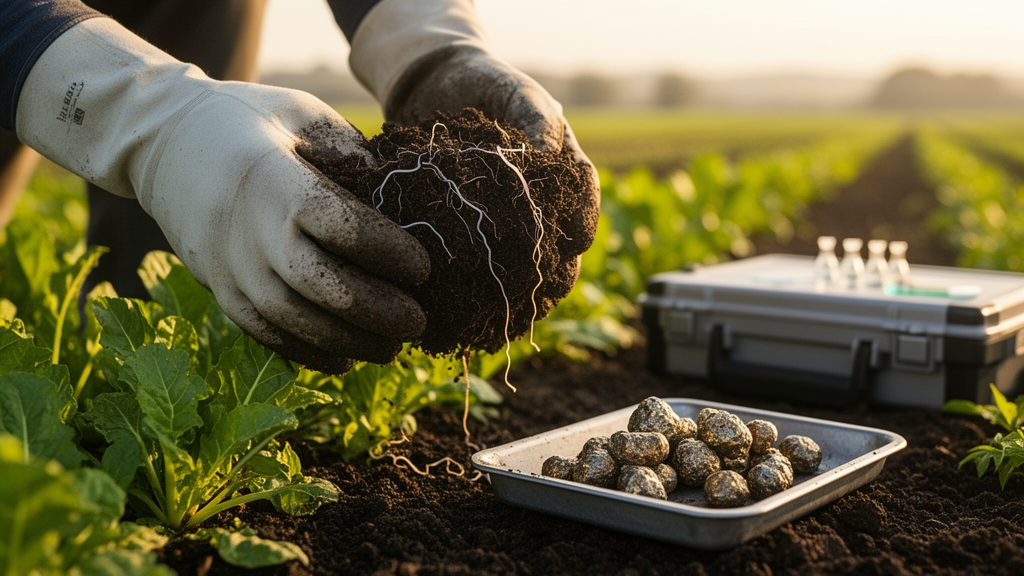
Contaminated soil is usually treated as a problem to be cleaned and forgotten. A new review argues that this linear approach wastes an opportunity: the plants grown to strip pollutants from land could themselves become feedstock for energy, fertilisers, construction materials, and even mined metals. Published in Green Technology, Resilience, and Sustainability, the paper by Satchidananda Mishra, Abhijeet Das, and Krishna Pada Bauri lays out a framework that repositions phytoremediation — the use of plants and their associated microbes to extract, stabilise, degrade, or volatilise contaminants — as a circular resource recovery platform rather than a simple cleanup technique.
The review’s central hypothesis is that integrating phytoremediation with rhizosphere microbial processes, safe biomass valorisation, and circular resource recovery can transform soil remediation from a linear pollutant-removal exercise into an environmentally regenerative and economically viable system. The authors, who adopt a structured narrative review approach drawing on literature published between 2000 and 2026 from databases including Scopus, Web of Science, and ScienceDirect, synthesise advances across soil science, microbial ecology, environmental biotechnology, and circular bioeconomy principles. They argue that the greatest gains come not from any single remediation mechanism but from the synergistic integration of biological, technological, and circular resource management processes.
The stakes are considerable. According to figures cited in the review, nearly 40 percent of the world’s soils are already moderately to severely degraded, and more than 90 percent may be affected by 2050. Erosion on cultivated and grazed lands occurs at rates far exceeding natural soil formation, reducing yields by up to 50 percent in affected areas. At the same time, contamination is becoming more complex: beyond conventional pollutants such as petroleum hydrocarbons and heavy metals, pharmaceutical residues, pesticides, nanomaterials, and wastewater-derived pollutants increasingly coexist in the same environments, creating multi-polluted systems that are considerably harder to remediate than single-contaminant sites.
Phytoremediation itself is not new. It exploits the natural ability of plants to remove, immobilise, transform, volatilise, or degrade contaminants through mechanisms including phytoextraction, phytostabilisation, phytodegradation, rhizodegradation, phytovolatilisation, and rhizofiltration. Performance is commonly assessed with the bioconcentration factor, the ratio of contaminant concentration in plant tissue to that in soil, and the translocation factor, which measures movement from roots to shoots. Species with both factors above one are suited to phytoextraction, where harvestable above-ground biomass carries the pollutants away; species that accumulate contaminants in roots but do not translocate them are better for phytostabilisation, which immobilises rather than removes pollution.
The review emphasises that plants rarely do this work alone. Root exudates — organic acids, amino acids, sugars, and secondary metabolites — selectively enrich hydrocarbon-degrading microbial populations in the rhizosphere, the narrow zone of soil influenced by roots. Plant growth-promoting rhizobacteria such as Bacillus, Pseudomonas, Enterobacter, and Klebsiella contribute nitrogen fixation, nutrient solubilisation, biosurfactant production, siderophore-mediated metal chelation, and phytohormone regulation. Arbuscular mycorrhizal fungi, which form symbioses with more than 80 percent of terrestrial plant species, extend the reach of roots through extraradical hyphal networks, improve phosphorus and nitrogen uptake, immobilise metals within fungal tissues, and produce glomalin-related soil proteins that enhance aggregation and long-term carbon sequestration. Ectomycorrhiza-associated bacteria add a further layer, promoting fungal symbiosis and metal immobilisation in forest soils.
Some of the most striking numbers in the review come from bioaugmentation experiments. In one cited study, inoculation with indole-3-acetic acid-producing microbes combined with chelation increased lead accumulation in the shoots of Sesbania drummondii by more than 1200 percent, with the metal preferentially localised in vascular tissues. Bacteria producing the enzyme 1-aminocyclopropane-1-carboxylate deaminase lower stress ethylene levels in plants, preventing the ethylene-induced inhibition of root elongation that otherwise limits metal uptake. In pesticide-contaminated agricultural soils, indigenous Exiguobacterium strains degraded approximately 96 percent of the insecticide dimethoate while simultaneously promoting plant growth. Co-cropping systems also show promise: a field-relevant study found that co-cropping Festuca arundinacea, Salix miyabeana, and Medicago sativa maintained functional stability in soils with mixed organic and inorganic contaminants while producing biomass yields and metal extraction on par with or better than monocultures.
The circular element of the framework concerns what happens after harvest. Rather than treating contaminated biomass as hazardous waste, the authors catalogue pathways for converting it into value: anaerobic digestion produces methane-rich biogas while retaining most accumulated metals in the digestate, which can then be recycled as a nutrient-rich soil amendment after contaminant assessment; pyrolysis yields biochar that can sequester carbon, improve water retention in sandy soils, and, when combined with metal-containing residues, serve as a catalytic material for dye removal in wastewater treatment. Willow biomass has shown potential for biochar production, Populus biomass for bioenergy, pulp, and plywood, and high-cellulose residues from remediation plantings can be processed into cellulose pulp, cellulose nanocrystals, and composites for paper and construction.
Phytomining extends the resource recovery logic to metals themselves. Hyperaccumulator species such as Alyssum murale, Berkheya coddii, Brassica juncea, and Pteris vittata can recover nickel, cadmium, gold, and arsenic from contaminated soils and low-grade ores, producing metal-rich biomass described as bio-ore. Nickel phytoextraction using Alyssum is described as one of the most successful examples of biological metal recovery, and recent agronomic advances — including nutrient management, optimised harvesting, and inoculation with Arthrobacter sp. LA44 — have improved biomass production and nickel recovery enough to raise the economic feasibility of agromining systems. Nutrient regeneration matters too: biochar-based sorbents derived from waste biomass have recovered plant-available phosphorus from sludge water, and activated-char systems recover phosphorus from biogas fermentation residues.
The review is candid about limitations, and this caution is central to its argument. Much of the published evidence comes from laboratory-scale or greenhouse experiments using small sample volumes, simplified contaminant mixtures, or analytical-grade reagents, conditions that may not represent the heterogeneity and operational constraints of real sites. Many studies examine single contaminants, individual plant species, or specific inoculants, whereas contaminated sites typically contain complex pollutant mixtures shaped by diverse soil properties, climates, and land-use histories. Relatively few studies provide long-term field validation, harmonised life cycle assessment, techno-economic assessment, or comprehensive cost-benefit analysis, making direct comparisons among remediation strategies difficult. The authors also flag unresolved safety questions: phytostabilisation immobilises rather than removes contaminants, phytovolatilisation requires careful assessment of atmospheric emissions, and the fate of contaminants during biomass processing and energy conversion must be tracked to prevent secondary pollution.
To close these gaps, the authors identify priorities including optimisation of plant-microbe-algae consortia, artificial intelligence-assisted decision support, nano-enabled remediation technologies, long-term field validation, harmonised life-cycle and techno-economic assessments, and supportive regulatory frameworks. Emerging tools range from CRISPR/Cas9-mediated modification of metal-binding proteins and stress-response pathways to functionalized nanoparticles that enhance pollutant uptake, digital twins that simulate biomass conversion before large-scale deployment, and machine learning algorithms that optimise dark fermentation for renewable hydrogen production. The review links these developments to Sustainable Development Goals on hunger, water, energy, consumption, climate, and life on land. Whether circular phytoremediation can move from promising case studies — willow plantations stabilising metals on fly-ash soils, harvested biomass diverted to bioethanol and composting — to routine industrial practice will depend on demonstrating environmental safety and long-term profitability under field conditions, with governance, stakeholder acceptance, and market incentives playing as large a role as the biology itself.
Subject of Research: A circular bioeconomy framework for phytoremediation and soil restoration
Article Title: From soil remediation to resource recovery: a circular phytoremediation framework for sustainable restoration
Article References: Mishra, S., Das, A., & Bauri, K. P. (2026). From soil remediation to resource recovery: a circular phytoremediation framework for sustainable restoration. Green Technology, Resilience, and Sustainability, 6(1), Article 13. https://doi.org/10.1007/s44173-026-00040-0
Image Credits: AI Generated
DOI: 10.1007/s44173-026-00040-0
Keywords: phytoremediation, soil restoration, circular bioeconomy, plant-microbe interactions, biomass valorisation, phytomining, biochar, anaerobic digestion, heavy metals, rhizosphere, bioenergy, soil contamination
Cite Scienmag News
Morgan Morrow. (October 28, 2026). Plants and microbes could turn contaminated soil cleanup into resource recovery. Scienmag. https://scienmag.com/plants-and-microbes-could-turn-contaminated-soil-cleanup-into-resource-recovery/
Morgan Morrow. "Plants and microbes could turn contaminated soil cleanup into resource recovery." Scienmag, 28 October 2026, https://scienmag.com/plants-and-microbes-could-turn-contaminated-soil-cleanup-into-resource-recovery/. Accessed 4 November 2026.
Morgan Morrow. "Plants and microbes could turn contaminated soil cleanup into resource recovery." Scienmag. October 28, 2026. https://scienmag.com/plants-and-microbes-could-turn-contaminated-soil-cleanup-into-resource-recovery/