


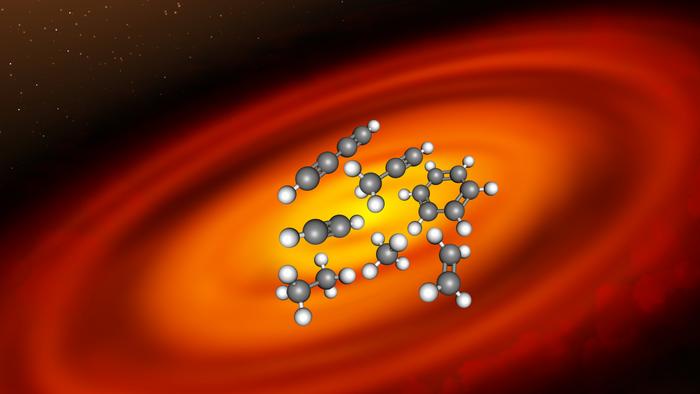
Planets form in disks of gas and dust, orbiting young stars. The MIRI Mid-INfrared Disk Survey (MINDS), led by Thomas Henning from the Max Planck Institute for Astronomy (MPIA) in Heidelberg, Germany, aims to establish a representative disk sample. By exploring their chemistry and physical properties with MIRI (Mid-Infrared Instrument) on board the James Webb Space Telescope (JWST), the collaboration links those disks to the properties of planets potentially forming there. In a new study, a team of researchers explored the vicinity of a very low-mass star of 0.11 solar masses (known as ISO-ChaI 147), whose results appear in the journal Science.

Credit: ALMA (ESO/NAOJ/NRAO) / MPIA
Planets form in disks of gas and dust, orbiting young stars. The MIRI Mid-INfrared Disk Survey (MINDS), led by Thomas Henning from the Max Planck Institute for Astronomy (MPIA) in Heidelberg, Germany, aims to establish a representative disk sample. By exploring their chemistry and physical properties with MIRI (Mid-Infrared Instrument) on board the James Webb Space Telescope (JWST), the collaboration links those disks to the properties of planets potentially forming there. In a new study, a team of researchers explored the vicinity of a very low-mass star of 0.11 solar masses (known as ISO-ChaI 147), whose results appear in the journal Science.
JWST opens a new window to the chemistry of planet-forming disks
“These observations are not possible from Earth because the relevant gas emissions are absorbed by its atmosphere,” explained lead author Aditya Arabhavi of the University of Groningen in the Netherlands. “Previously, we could only identify acetylene (C2H2) emission from this object. However, JWST’s higher sensitivity and the spectral resolution of its instruments allowed us to detect weak emission from less abundant molecules.”
The MINDS collaboration found gas at temperatures around 300 Kelvin (ca. 30 degrees Celsius), strongly enriched with carbon-bearing molecules but lacking oxygen-rich species. “This is profoundly different from the composition we see in disks around solar-type stars, where oxygen-bearing molecules such as water and carbon dioxide dominate,” added team member Inga Kamp, University of Groningen.
One striking example of an oxygen-rich disk is the one of PDS 70, where the MINDS program recently found large amounts of water vapour. Considering earlier observations, astronomers deduce that disks around very low-mass stars evolve differently than those around more massive stars such as the Sun, with potential implications for finding rocky planets with Earth-like characteristics there. Since the environments in such disks set the conditions in which new planets form, any such planet may be rocky but quite unlike Earth in other aspects.
What does it mean for rocky planets orbiting very low-mass stars?
The amount of material and its distribution across those disks limits the number and sizes of planets the disk can supply with the necessary material. Consequently, observations indicate that rocky planets with sizes similar to Earth form more efficiently than Jupiter-like gas giants in the disks around very low-mass stars, the most common stars in the Universe. As a result, very low-mass stars host the majority of terrestrial planets by far.
“Many primary atmospheres of those planets will probably be dominated by hydrocarbon compounds and not so much by oxygen-rich gases such as water and carbon dioxide,” Thomas Henning pointed out. “We showed in an earlier study that the transport of carbon-rich gas into the zone where terrestrial planets usually form happens faster and is more efficient in those disks than the ones of more massive stars.”
Although it seems clear that disks around very low-mass stars contain more carbon than oxygen, the mechanism for this imbalance is still unknown. The disk composition is the result of either carbon enrichment or the reduction of oxygen. If the carbon is enriched, the cause is probably solid particles in the disk, whose carbon is vaporised and released into the gaseous component of the disk. The dust grains, stripped of their original carbon, eventually form rocky planetary bodies. Those planets would be carbon-poor, as is Earth. Still, carbon-based chemistry would likely dominate at least their primary atmospheres provided by disk gas. Therefore, very low-mass stars may not offer the best environments for finding planets akin to Earth.
JWST discovers a wealth of organic molecules
To identify the disk gases, the team used MIRI’s spectrograph to decompose the infrared radiation received from the disk into signatures of small wavelength ranges – similar to sunlight being split into a rainbow. This way, the team isolated a wealth of individual signatures attributed to various molecules.
As a result, the observed disk contains the richest hydrocarbon chemistry seen to date in a protoplanetary disk, consisting of 13 carbon-bearing molecules up to benzene (C6H6). They include the first extrasolar ethane (C2H6) detection, the largest fully-saturated hydrocarbon detected outside the Solar System. The team also successfully detected ethylene (C2H4), propyne (C3H4), and the methyl radical CH3 for the first time in a protoplanetary disk. In contrast, the data contained no hint of water or carbon monoxide in the disk.
Sharpening the view of disks around very low-mass stars
Next, the science team intends to expand their study to a larger sample of such disks around very low-mass stars to develop their understanding of how common such exotic carbon-rich terrestrial planet-forming regions are. “Expanding our study will also allow us to understand better how these molecules can form,” Thomas Henning explained. “Several features in the data are also still unidentified, warranting additional spectroscopy to interpret our observations fully.”
Background information
The study was funded in the framework of the ERC Advanced Grant “Origins – From Planet-Forming Disks to Giant Planets” (Grant ID: 832428, PI: Thomas Henning, DOI: 10.3030/832428).
The MPIA scientists involved in this study are Thomas Henning, Matthias Samland, Giulia Perotti, Jeroen Bouwman, Silvia Scheithauer, Riccardo Franceschi, Jürgen Schreiber, and Kamber Schwartz.
Other researchers include Aditya Arabhavi (University of Groningen, the Netherlands [Groningen]), Inga Kamp (Groningen), Ewine van Dishoeck (Leiden University, the Netherlands and Max Planck Institute for Extraterrestrial Physics, Garching, Germany), Valentin Christiaens (University of Liege, Belgium), and Agnes Perrin (Laboratoire de Météorologie Dynamique/IPSL CNRS, Palaiseau, France).
The MIRI consortium consists of the ESA member states Belgium, Denmark, France, Germany, Ireland, the Netherlands, Spain, Sweden, Switzerland, and the United Kingdom. The national science organisations fund the consortium’s work – in Germany, the Max Planck Society (MPG) and the German Aerospace Center (DLR). The participating German institutions are the Max Planck Institute for Astronomy in Heidelberg, the University of Cologne, and Hensoldt AG in Oberkochen, formerly Carl Zeiss Optronics.
JWST is the world’s premier space science observatory. It is an international program led by NASA jointly with its partners, ESA (European Space Agency) and CSA (Canadian Space Agency).
Journal
Science
Method of Research
Observational study
Subject of Research
Not applicable
Article Title
Abundant hydrocarbons in the disk around a very-low-mass star
Article Publication Date
7-Jun-2024
Cite Scienmag News
Grant Pearson. (June 6, 2024). Planet-forming disks around very low-mass stars are different. Scienmag. https://scienmag.com/planet-forming-disks-around-very-low-mass-stars-are-different/
Grant Pearson. "Planet-forming disks around very low-mass stars are different." Scienmag, 6 June 2024, https://scienmag.com/planet-forming-disks-around-very-low-mass-stars-are-different/. Accessed 4 September 2026.
Grant Pearson. "Planet-forming disks around very low-mass stars are different." Scienmag. June 6, 2024. https://scienmag.com/planet-forming-disks-around-very-low-mass-stars-are-different/

