


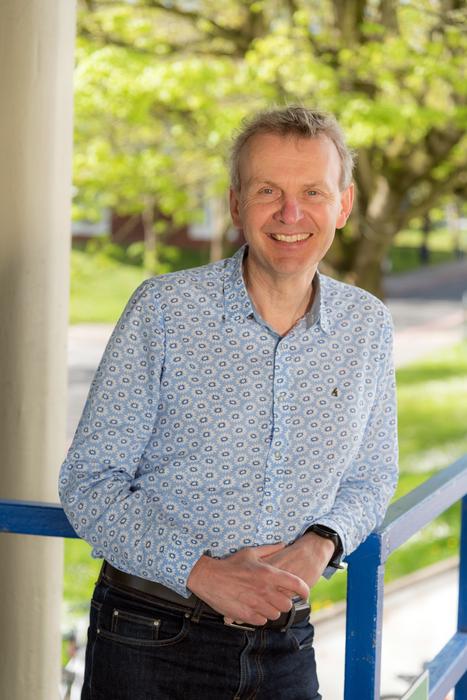
A pioneering academic from the University of Warwick has been elected as a Fellow of the Royal Society, the UK’s national academy of sciences.
Professor Patrick Unwin, Head of the University’s Department of Chemistry, has been recognised for his invaluable contributions to science. An eminent scientist in the field of electrochemistry, his groundbreaking research has shaped instrumental techniques applicable across many disciplines.
His inventions in the fields of electrochemical imaging and nanoelectrochemistry allow the key building blocks and features of complex electrodes to be targeted and studied in exquisite detail. The resulting knowledge of nanoscale structure-activity is important for the development of next generation electrochemical devices – spanning fuel cells, batteries and sensors. The instruments can even be used to probe the electrochemical environment around living cells, revealing information on biological processes vital for medical research.
Professor Unwin recently co-authored a study showing how the structure of graphene could be crucial in using hydrogen as a source of clean energy.
Alongside his revolutionary research, Professor Unwin has helped to train 75 PhD students, along with 35 postdoctoral fellows. Many have also gone on to run their own groups in institutions around the world and others work in a wide range of industries.
Professor Unwin, who also founded the internationally recognised Warwick Electrochemistry & Interfaces Group (WEIG), said: “I have spent my entire independent career at the University of Warwick and have had the opportunity to work with so many talented students and colleagues here and around the world. They have made research so much fun and hugely enjoyable, and I am overjoyed that our achievements over the past three decades have been recognized by the Royal Society.”
Professor Unwin is among 90 exceptional researchers from across the world have this year been elected to the Fellowship of the Royal Society, the UK’s national academy of sciences. The elected Fellows are leaders in their fields.
On the announcement of the new Fellows, Sir Adrian Smith, President of the Royal Society, said: “I am pleased to welcome such an outstanding group into the Fellowship of the Royal Society.
“This new cohort have already made significant contributions to our understanding of the world around us and continue to push the boundaries of possibility in academic research and industry.
“From visualising the sharp rise in global temperatures since the industrial revolution to leading the response to the Covid-19 pandemic, their diverse range of expertise is furthering human understanding and helping to address some of our greatest challenges.
“It is an honour to have them join the Fellowship.”
Find out more about Professor Unwin here:
Notes to Editors
Statistics about this year’s intake of Fellows:

Credit: Credit: University of Warwick
A pioneering academic from the University of Warwick has been elected as a Fellow of the Royal Society, the UK’s national academy of sciences.
Professor Patrick Unwin, Head of the University’s Department of Chemistry, has been recognised for his invaluable contributions to science. An eminent scientist in the field of electrochemistry, his groundbreaking research has shaped instrumental techniques applicable across many disciplines.
His inventions in the fields of electrochemical imaging and nanoelectrochemistry allow the key building blocks and features of complex electrodes to be targeted and studied in exquisite detail. The resulting knowledge of nanoscale structure-activity is important for the development of next generation electrochemical devices – spanning fuel cells, batteries and sensors. The instruments can even be used to probe the electrochemical environment around living cells, revealing information on biological processes vital for medical research.
Professor Unwin recently co-authored a study showing how the structure of graphene could be crucial in using hydrogen as a source of clean energy.
Alongside his revolutionary research, Professor Unwin has helped to train 75 PhD students, along with 35 postdoctoral fellows. Many have also gone on to run their own groups in institutions around the world and others work in a wide range of industries.
Professor Unwin, who also founded the internationally recognised Warwick Electrochemistry & Interfaces Group (WEIG), said: “I have spent my entire independent career at the University of Warwick and have had the opportunity to work with so many talented students and colleagues here and around the world. They have made research so much fun and hugely enjoyable, and I am overjoyed that our achievements over the past three decades have been recognized by the Royal Society.”
Professor Unwin is among 90 exceptional researchers from across the world have this year been elected to the Fellowship of the Royal Society, the UK’s national academy of sciences. The elected Fellows are leaders in their fields.
On the announcement of the new Fellows, Sir Adrian Smith, President of the Royal Society, said: “I am pleased to welcome such an outstanding group into the Fellowship of the Royal Society.
“This new cohort have already made significant contributions to our understanding of the world around us and continue to push the boundaries of possibility in academic research and industry.
“From visualising the sharp rise in global temperatures since the industrial revolution to leading the response to the Covid-19 pandemic, their diverse range of expertise is furthering human understanding and helping to address some of our greatest challenges.
“It is an honour to have them join the Fellowship.”
Find out more about Professor Unwin here:
Notes to Editors
Statistics about this year’s intake of Fellows:
· 30% of this year’s intake of Fellows, Foreign Members and Honorary Fellows are women
· New Fellows have been elected from 23 UK institutions, including The University of Nottingham, British Antarctic Survey, University of Strathclyde and the Natural History Museum
· They have been elected from countries including Brazil, China, Japan, Mexico and Singapore
Cite Scienmag News
Bethany Barker. (May 16, 2024). Pioneering professor at The University of Warwick announced as Fellow of the Royal Society. Scienmag. https://scienmag.com/pioneering-professor-at-the-university-of-warwick-announced-as-fellow-of-the-royal-society/
Bethany Barker. "Pioneering professor at The University of Warwick announced as Fellow of the Royal Society." Scienmag, 16 May 2024, https://scienmag.com/pioneering-professor-at-the-university-of-warwick-announced-as-fellow-of-the-royal-society/. Accessed 4 September 2026.
Bethany Barker. "Pioneering professor at The University of Warwick announced as Fellow of the Royal Society." Scienmag. May 16, 2024. https://scienmag.com/pioneering-professor-at-the-university-of-warwick-announced-as-fellow-of-the-royal-society/

