


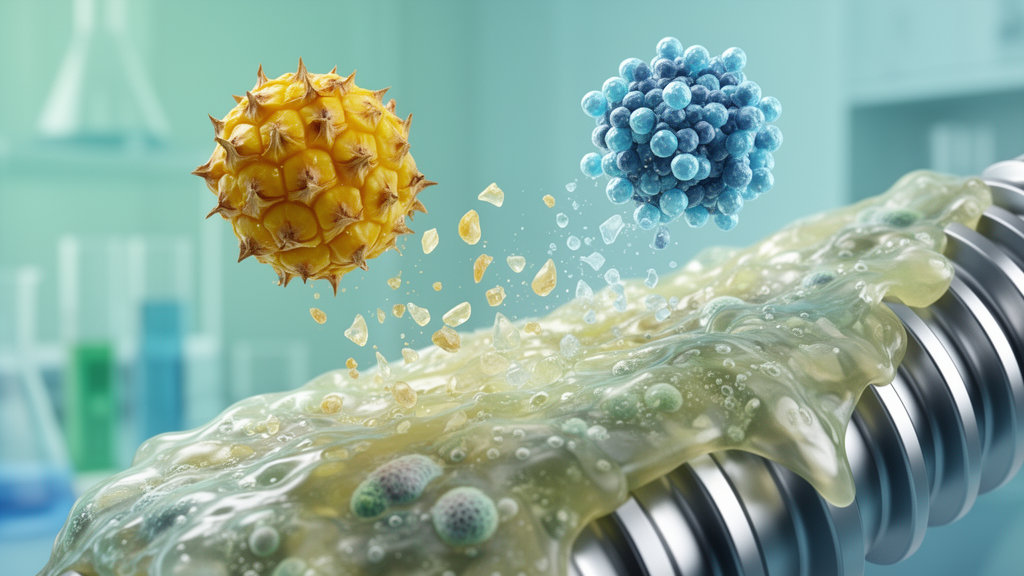
When a hip or knee replacement becomes infected, the consequences can be devastating. Prosthetic joint infection complicates between 0.5 and 2 percent of the more than one million total joint arthroplasties performed worldwide each year, and it remains the leading cause of implant failure after hip and knee surgery. The reason these infections are so stubborn lies not with the bacteria themselves but with what they build: a slimy, self-made fortress called a biofilm that clings to the metal and plastic of the implant and shields the microbes inside from antibiotics and immune cells alike. Now, a narrative review published in the Journal of Bone and Joint Infection by Brendan Parnell and David Morris of St George Hospital in Sydney, Australia, examines an unusual candidate for tearing that fortress down: a combination of a pineapple-derived enzyme and a decades-old mucus-thinning drug, known together as BromAc.
The two ingredients of BromAc attack biofilm in fundamentally different ways. N-acetylcysteine, or NAC, is the N-acetylated derivative of the amino acid L-cysteine, long used clinically as a mucolytic and as the antidote for paracetamol poisoning. Its antibiofilm power comes from a free thiol group that chemically reduces disulfide crosslinks holding together the polysaccharide and protein strands of the biofilm’s extracellular matrix. Bromelain, by contrast, is a cocktail of cysteine proteases extracted from pineapple stem, already used as an anti-inflammatory and wound-debridement agent with regulatory precedent in enzymatic burn treatment. Its proteolytic activity cleaves the peptide bonds of the protein scaffold, including fibrin and collagen, that stabilises biofilm architecture. Because biofilm matrices contain both polysaccharide-stabilised and proteinaceous components in varying proportions, the review’s authors argue that a dual-action agent targeting both simultaneously is mechanistically rational in a way single agents cannot be.
The scale of the clinical problem gives this mechanistic appeal real urgency. Current management of prosthetic joint infection relies on surgical debridement combined with antibiotics and implant retention, a strategy known as DAIR, or on two-stage revision in which the prosthesis is removed, an antibiotic spacer is implanted, and reimplantation follows months later. A recent meta-analysis cited in the review found that DAIR procedures fail in roughly 36 percent of cases on average, with failure rates climbing from about 34 percent in acute infections to nearly 74 percent in late chronic infections. Two-stage revision achieves better outcomes, typically between 54 and 100 percent success, but demands multiple surgeries, prolonged disability, and substantial cost. The fundamental limitation is that mechanical debridement with curettes and pulse lavage cannot reliably strip biofilm from prosthetic surfaces, while systemically delivered antibiotics penetrate the matrix poorly.
The laboratory evidence for each component of BromAc is instructive. A landmark 2013 study by Drago and colleagues tested NAC against Staphylococcus aureus and Pseudomonas aeruginosa biofilms grown on smooth polyethylene and sand-blasted titanium discs, the very materials used in hip and knee prostheses. NAC achieved roughly 50 percent biofilm reduction on polyethylene but only about 20 percent on titanium at minimum inhibitory concentrations after three hours of exposure. Studies outside orthopaedics suggest higher concentrations can do more: in staphylococcal isolates from chronic rhinosinusitis, NAC at eight times the minimum inhibitory concentration eradicated biofilm in 81.5 percent of isolates. Bromelain, meanwhile, reduced biofilm biomass by up to 98 percent in a wound-relevant S. aureus model supplemented with human plasma, and a 2025 study on cortical bone screws contaminated with MRSA found that bromelain powder combined with scrubbing produced the greatest reduction in adherent biomass of any tested regimen.
The pivotal proof-of-concept study for the combination came from Carter and colleagues in 2021, who tested BromAc against biofilms formed by three strains of Pseudomonas aeruginosa on surgical hernia mesh. Intriguingly, NAC alone actually enhanced growth in two of the three strains, while biofilms were more susceptible to bromelain alone. The combination overcame this limitation dramatically, achieving more than 80 percent biofilm removal, quantified by crystal violet biomass reduction, across all three strains, with corresponding one to two log reductions in adherent viable bacteria. Microscopy confirmed physical disruption of biofilm architecture with previously embedded bacteria left exposed. The strongest effects occurred at higher bromelain-to-NAC ratios, and no antagonistic interactions between the agents were observed.
Yet the review is notably candid about how far this evidence falls short of clinical readiness. The principal proof-of-concept study used hernia mesh rather than orthopaedic implants and Pseudomonas rather than the staphylococci that dominate prosthetic joint infection. It was also funded by the manufacturer of BromAc, and independent replication is lacking. More recent data showing BromAc activity against S. aureus on surgical metal clips and near-complete eradication of S. epidermidis biofilms when combined with vancomycin or rifampicin come from the sponsor and remain unpublished and unpeer-reviewed. The reviewers flag that across the preclinical literature, studies differ in pathogen, substrate, exposure time, and outcome measure, making direct comparison of efficacy figures hazardous. Crystal violet assays, moreover, measure total biomass including dead cells and residual matrix, so they evidence biofilm disaggregation rather than bacterial killing; corroborating viable-count recovery will be essential in future work.
Formulation stability poses a further, less obvious barrier. The same free thiol group that gives NAC its antibiofilm activity is susceptible to autoxidation in aqueous solution, a process accelerated by oxygen, metal ions, elevated pH, and warmth. Reported shelf lives of reconstituted NAC solutions range from a few hours at ambient temperature to 24 hours under refrigeration and light protection, and loss of free thiol translates directly into loss of biofilm-disrupting potency. Bromelain, for its part, loses proteolytic activity in solution through autodigestion. In an operating theatre, this means BromAc cannot be assumed to retain full activity if mixed in advance, and point-of-use reconstitution, preservative-free buffering, and oxygen-protective packaging would likely be required. Nothing is yet known about the pharmacokinetics of either agent inside an infected joint, including residence time, clearance, and protein binding in synovial fluid.
Safety questions specific to the joint environment loom equally large. BromAc has been administered to more than 100 patients by intratumoural and intraperitoneal injection in first-in-human and Phase III trials for pseudomyxoma peritonei, with a manageable safety profile, and across 21 preclinical animal experiments it has shown a favourable safety record via intraperitoneal, subcutaneous, intravenous, and inhaled routes. But none of these routes approximates injection into a weight-bearing joint, where cartilage, synovium, and the bone-implant interface are uniquely vulnerable to a proteolytic enzyme. The safety database for intra-articular BromAc is, as the reviewers put it, empty. Effects on cartilage integrity, synovial inflammation, and osseointegration of the implant are entirely unknown, as are the optimal NAC-to-bromelain ratio, pH, osmolality, dosing, and contact time.
To close these gaps, the authors lay out a structured preclinical programme before any first-in-human orthopaedic trial could be defensible. It begins with small-animal models using implanted titanium or polyethylene carrying established staphylococcal biofilm, with endpoints of viable bacterial recovery and histological assessment of joint tissue, followed by large-animal studies with loaded prostheses and dynamic synovial fluid sampling, ex vivo human cartilage and synovium tolerance studies, and formulation-stability testing under realistic operating-theatre conditions. Only consistent positive efficacy and acceptable safety across all four streams, ideally replicated independently of the sponsor, would justify moving to the clinic.
On present evidence, BromAc stands as a promising but unvalidated adjunct for prosthetic joint infection: mechanistically elegant, cheap relative to revision surgery, and built from two agents with long clinical histories, yet supported almost entirely by preclinical data on non-orthopaedic substrates and partly by unpublished sponsor figures. If the necessary validation succeeds, the combination could improve DAIR success rates, spare thousands of patients prosthesis removal, and potentially extend to other biofilm-associated implant infections. Until then, the reviewers conclude, any clinical use outside a properly designed and regulated trial is not justified.
Subject of Research: Preclinical evaluation of bromelain and N-acetylcysteine combination therapy for disrupting biofilms in prosthetic joint infection
Article Title: Bromelain and N-acetylcysteine (BromAc) as novel adjunctive therapy for prosthetic joint infection: a narrative review
Article References: Bromelain and N-acetylcysteine (BromAc) as novel adjunctive therapy for prosthetic joint infection: a narrative review. (n.d.). https://doi.org/10.5194/jbji-11-441-2026
Image Credits: AI Generated
Keywords: prosthetic joint infection, biofilm, BromAc, bromelain, N-acetylcysteine, DAIR, joint arthroplasty, antibiofilm therapy, implant infection, Staphylococcus aureus, Pseudomonas aeruginosa, drug stability
Cite Scienmag News
Ophelia Keating. (October 9, 2026). Pineapple Enzyme and Mucus-Thinner Combo Shows Promise Against Devastating Implant Infections. Scienmag. https://scienmag.com/pineapple-enzyme-and-mucus-thinner-combo-shows-promise-against-devastating-implant-infections/
Ophelia Keating. "Pineapple Enzyme and Mucus-Thinner Combo Shows Promise Against Devastating Implant Infections." Scienmag, 9 October 2026, https://scienmag.com/pineapple-enzyme-and-mucus-thinner-combo-shows-promise-against-devastating-implant-infections/. Accessed 9 October 2026.
Ophelia Keating. "Pineapple Enzyme and Mucus-Thinner Combo Shows Promise Against Devastating Implant Infections." Scienmag. October 9, 2026. https://scienmag.com/pineapple-enzyme-and-mucus-thinner-combo-shows-promise-against-devastating-implant-infections/


