A single 10-minute session of focused ultrasound directed at a deep brain region produced a modest reduction in delusions among 10 people with schizophrenia or schizoaffective disorder in a small randomized, sham-controlled pilot study conducted by researchers at NYU Langone Health. Participants received both the active stimulation and a sham treatment, with the two sessions presented in random order and separated by one week. The average delusion score fell by 1.2 points following active stimulation but increased by 0.4 points after the sham procedure, according to the study report. The difference between the conditions remained detectable through the end of the seven-day observation period. The findings offer preliminary evidence that transcranial ultrasound stimulation may influence a brain circuit involved in psychosis, but the small sample and short follow-up do not establish it as an effective treatment.
The study focused on the right globus pallidus interna, a deep structure that is part of a circuit involved in movement, thought and emotion. Previous work led by study author Wei Qi and colleagues had linked problems in this circuit to delusions and to the degree of patients’ responses to medication. Unlike approaches that require implanted devices or surgical access, transcranial ultrasound stimulation uses gentle, focused sound waves to alter activity in selected brain regions. The researchers proposed that targeting the globus pallidus interna might offer a way to test—and potentially modulate—the circuitry underlying psychotic symptoms. This was the first study to apply the technique to schizophrenia symptoms, according to the research team, and its results should be viewed as an early clinical test rather than proof of therapeutic benefit.
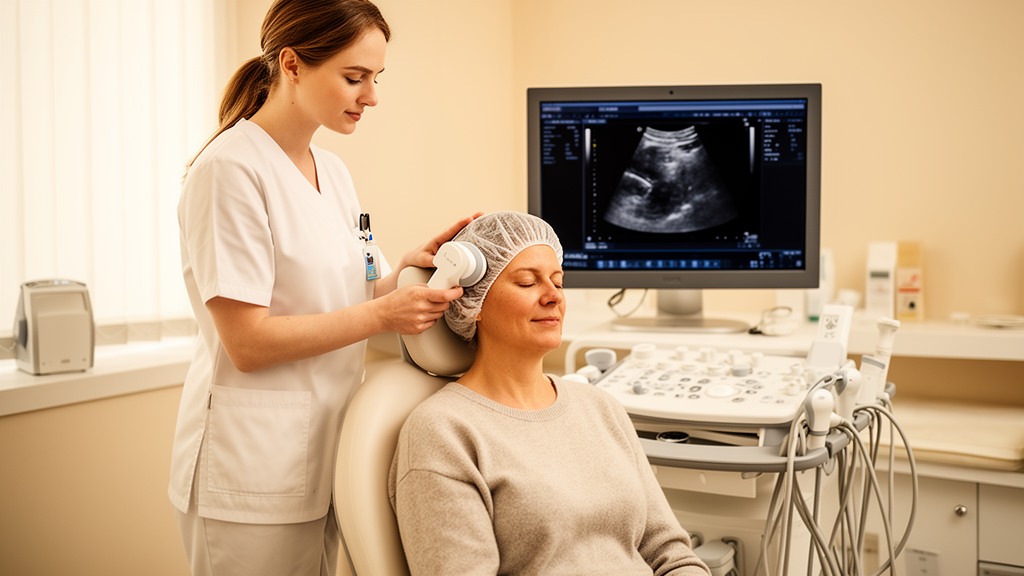
Each participant received one active session and one sham session, allowing investigators to compare responses within the same individuals while limiting differences caused by separate groups. The active procedure and sham condition were administered one week apart in random order. Neither the participants nor the members of the research team who assessed symptoms knew which condition they were receiving. During the sham session, the ultrasound device was positioned on the head and switched on, but a mechanism inside it blocked the sound waves from reaching the brain. This design was intended to preserve the sensory and procedural experience of treatment while isolating the biological effect of stimulation. The study was classified as a randomized controlled clinical trial, although its size and format identify it as a pilot investigation.
MRI scans were used to guide placement of the ultrasound device and identify the right globus pallidus interna. The researchers then applied ultrasound for 10 minutes in alternating 30-second stimulation and 30-second rest cycles. The targeted structure lies deep within the brain and ordinarily would be difficult to reach with non-invasive methods that offer precise spatial targeting. Focused ultrasound can be directed to a small area, giving the team a way to test the function of a defined neural circuit. In this study, the goal was not simply to expose the brain to sound but to determine whether stimulation of the selected region was associated with a change in delusions and whether the procedure could be tolerated under blinded conditions.
Symptoms were evaluated before treatment, during treatment and for up to seven days after each session. The assessment included a series of rating scales covering delusions, hallucinations, thinking, memory and side effects. The principal signal appeared in the delusion ratings: the average score decreased by 1.2 points following the active ultrasound session, whereas it rose by an average of 0.4 points after the sham procedure. The study team characterized the active-treatment change as modest but clear and reported that the difference between the two conditions persisted for as long as a week, which was the end of the observation period. The article did not provide uncertainty estimates such as confidence intervals for the score changes, so the precision and variability of the effect could not be evaluated from the supplied report alone.
The procedure was generally well tolerated. Side effects—including fatigue, headache and brief increases in psychotic symptoms—were described as mild and short-lived. Their frequency did not differ between active and sham sessions, meaning the report did not show a side-effect burden unique to the ultrasound intervention. This safety finding is important in a pilot psychiatric study involving people with serious symptoms despite medication treatment, but it should not be interpreted as evidence that ultrasound is broadly risk-free. Ten participants were too few to detect uncommon adverse events, and the maximum follow-up lasted only seven days after each session. Larger and longer studies would be needed to characterize both tolerability and durability more reliably.
Shy Shoham, the study’s co-senior author and a professor of neuroscience and ophthalmology at NYU Grossman School of Medicine, said the work demonstrates the unusual targeting possibilities offered by focused ultrasound. Other emerging approaches can modulate brain circuits, but ultrasound can be focused on very small regions that influence thinking and behavior. That spatial precision is central to the investigators’ strategy: rather than stimulating a large portion of the brain, they aimed at a structure selected because of evidence connecting it to delusions and medication response. Donald Goff, the study’s senior author, said the results also show that focused ultrasound can be used to examine circuits relevant to psychiatric illness. The experiment therefore combined a potential treatment mechanism with a probe of brain function.
Transcranial ultrasound stimulation has previously been explored for anxiety, depression and obsessive-compulsive disorder, as well as for thinking and memory problems in people with Alzheimer’s and Parkinson’s diseases. Those earlier investigations established the technique as an experimental tool for influencing selected brain areas, but they do not supply evidence for treating delusions in schizophrenia. The present pilot involved a distinct population and target, and it tested only a single active session. The observed reduction cannot yet be separated fully from ordinary symptom fluctuation, expectancy, placebo response or other influences, despite the use of a sham procedure and blinded symptom ratings. A larger trial with more participants, repeated stimulation and follow-up beyond one week would be needed to determine whether the effect is reproducible and clinically meaningful.
Researchers from the psychiatry and biomedical engineering teams plan to enroll more patients and test repeated ultrasound sessions over longer periods. They also intend to use more advanced brain imaging to verify that the ultrasound is reaching the intended globus pallidus interna and to adjust stimulation intensity for individual participants. Those steps address two central challenges in translating the result: confirming that the targeted structure receives the intended dose and determining whether repeated treatment produces more durable effects. The team has said further work is required before targeted ultrasound could supplement—or potentially replace—standard medicines for schizophrenia. That possibility remains speculative; the present evidence comes from a short, small sham-controlled crossover pilot, not from a trial demonstrating replacement of established care.
The work was funded by the Doris Duke Foundation Fund to Retain Clinical Scientists, the Brain & Behavior Research Foundation and the Max G. Schlapp Mental Hygiene Fund. The results were led by Wei Qi, a clinical assistant professor in NYU Langone’s Department of Psychiatry, together with Shoham, Goff and colleagues from the medical school’s psychiatry and engineering programs. The report was slated for publication in npj Acoustics on October 20, 2026, under the title “Transcranial ultrasound stimulation of the right globus pallidus interna in schizophrenia: A randomized, sham-controlled pilot study.” For now, the most defensible conclusion is that a carefully targeted, single ultrasound session was safe in this small group and coincided with a modest improvement in delusions that was not observed after sham stimulation. Whether that signal can become a reliable psychiatric treatment will depend on larger, longer and more technically verified studies.
Subject of Research: A sham-controlled pilot trial of focused ultrasound targeting the right globus pallidus interna in schizophrenia and schizoaffective disorder
Article Title: Gentle brain ultrasound may help ease delusions in schizophrenia
Article References: Gentle brain ultrasound may help ease delusions in schizophrenia. Original publication (Bibliographic details unavailable.)
Image Credits: AI Generated
DOI: Not provided
Keywords: transcranial ultrasound, schizophrenia, delusions, schizoaffective disorder, focused ultrasound, globus pallidus interna, brain stimulation, randomized crossover trial, psychosis, non-invasive neuromodulation, Gentle, brain
Cite Scienmag News
Ophelia Keating. (October 21, 2026). Pilot ultrasound session modestly reduces schizophrenia delusions. Scienmag. https://scienmag.com/pilot-ultrasound-session-modestly-reduces-schizophrenia-delusions/
Ophelia Keating. "Pilot ultrasound session modestly reduces schizophrenia delusions." Scienmag, 21 October 2026, https://scienmag.com/pilot-ultrasound-session-modestly-reduces-schizophrenia-delusions/. Accessed 21 October 2026.
Ophelia Keating. "Pilot ultrasound session modestly reduces schizophrenia delusions." Scienmag. October 21, 2026. https://scienmag.com/pilot-ultrasound-session-modestly-reduces-schizophrenia-delusions/