


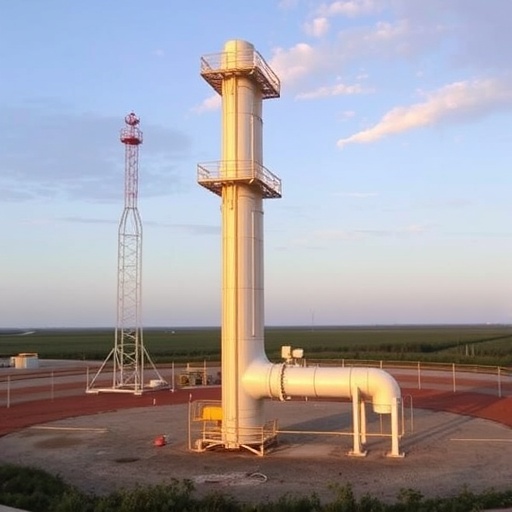
In a groundbreaking advancement in mining safety and environmental management, researchers Zhang, Qin, Li, and colleagues have unveiled a transformative approach to gas extraction in mining and goaf areas. Published in Scientific Reports, their 2026 study introduces an innovative continuous gas extraction method utilizing improved L-shaped wells that promise to enhance efficiency while mitigating hazardous gas accumulation in subterranean mining zones. This cutting-edge technique holds the potential to recalibrate industry standards for occupational safety and environmental stewardship in mining operations worldwide.
The challenge of managing harmful gases such as methane in mining environments is a perennial concern. Methane buildup within goaf areas—the voids left behind after coal extraction—poses risks including hazardous explosions and respiratory dangers to workers. Traditional gas extraction methods have often struggled with inefficiencies, leading to incomplete gas removal and elevated operational hazards. The new study addresses these deficiencies by integrating continuous gas extraction with a novel L-shaped well design, engineered to optimize gas flow and minimize leaks, offering a reliable solution to these age-old problems.
One of the core innovations in this approach is the geometrical configuration of the L-shaped wells. Unlike conventional vertical or horizontal wells, these wells feature a carefully engineered bend that allows for deeper penetration into gas-rich strata while adapting to the complex spatial constraints of mined-out areas. This structural enhancement increases the surface area contact with gas pockets, facilitating more consistent and thorough gas withdrawal. Advanced modeling and field pilot tests detailed by Zhang and his team underscore the efficacy of this design in maintaining steady-state gas extraction over extended periods.
The continuous nature of the extraction system is another critical facet of this pioneering technology. Prior systems often operated intermittently, resulting in cyclical pressure build-up and inefficient gas release. By maintaining unceasing extraction flows, the L-shaped well configuration ensures steadier pressure gradients, reducing the risk of sudden gas surges. This regulation contributes not only to safer mining conditions but also to greater operational predictability, which is essential for effective mine planning and emergency response strategies.
The research team’s pilot tests were conducted in active mining environments where their L-shaped well system was systematically deployed and monitored. Over several months, data was collected on gas flow rates, methane concentration reductions, and overall system stability. Results consistently demonstrated significantly enhanced extraction efficiency compared to conventional wells, with marked decreases in dangerous methane accumulation in multiple goaf zones. These empirical findings validate the theoretical advantages anticipated by the well design and continuous operation model.
Another significant advantage brought forward by the research is the reduction in environmental impact. Methane is a potent greenhouse gas, with a global warming potential many times greater than carbon dioxide. By improving the capture and controlled release of methane before it escapes into the atmosphere, the new extraction technique supports broader climate mitigation efforts within the mining sector. This aligns with growing regulatory and societal demands for cleaner and more responsible industry practices across resource extraction activities.
The engineering behind the improved L-shaped wells also reflects sophisticated material choices and drilling techniques, allowing for increased durability and reduced maintenance costs. By integrating corrosion-resistant alloys and adaptive drilling rigs capable of precise angling, the system not only secures gas extraction efficiency but also lowers operational downtime. These benefits translate into direct economic gains for mining companies, incentivizing adoption alongside the clear safety and environmental merits.
Detailed computational fluid dynamics simulations played an integral role in optimizing the well design. The modeling work enabled researchers to predict and visualize complex gas flow behaviors within the subterranean fractures and voids. These simulations informed decisions on well curvature, spacing, and extraction rates, ensuring maximum capture with minimal structural disruption. The combination of theoretical rigor and practical field validation exemplifies a holistic approach to engineering solutions in mining gas management.
Furthermore, the study explores the scalability of this extraction method, highlighting its adaptability to various mine sizes and geological contexts. Whether applied in thin seam operations or deep underground coal mines, the L-shaped well design can be customized to meet specific site conditions. This flexibility makes it a versatile tool in the global mining industry’s arsenal against gas-related hazards, promising widespread applicability beyond the initial pilot sites.
The collaborative nature of the research reflects cross-disciplinary expertise, bringing together geotechnical engineers, environmental scientists, and mining safety experts. By addressing the multifaceted challenges of gas extraction from technical, environmental, and human factors perspectives, the team presents a comprehensive solution framework. This multidisciplinary model is likely to inspire further innovations in mine safety technologies and environmental controls.
Implications of this study extend beyond immediate gas safety improvements. Capturing methane efficiently prior to its release opens avenues for its utilization as an energy source. Integrating continuous extraction with gas purification systems could enable mining operations to convert waste methane into valuable fuel, contributing to circular economy principles and creating new revenue streams. Such developments would mark a paradigm shift in the perception of mine gases from hazards to resources.
Looking ahead, the researchers advocate for expanded trials across diverse geological settings to fine-tune the technology and optimize deployment strategies. They emphasize the importance of continuous monitoring systems paired with smart sensors to dynamically adjust extraction rates and respond to fluctuating underground gas conditions. Integrating real-time data analytics promises to elevate the safety and productivity of mining operations still further.
Industry stakeholders and regulatory bodies have welcomed these findings, recognizing the potential for a new standard in methane management. Enhanced regulatory frameworks may soon incorporate such innovative extraction methods, incentivizing investments into safer and greener mining technologies. This study could thus catalyze a broader transformation in mining governance and industry best practices globally.
In conclusion, Zhang and colleagues have ushered in a significant leap in mining gas extraction technology with their improved L-shaped well system. By seamlessly blending advanced engineering design, continuous operational protocols, and environmental consciousness, they provide a robust solution to a longstanding challenge in mining safety and climate impact mitigation. This breakthrough not only promises safer workplaces but also aligns the mining sector with pressing sustainability imperatives, marking a pivotal moment in the future of responsible resource extraction.
Cite Scienmag News
Denise Maddox. (May 28, 2026). Pilot Tests Improve Gas Extraction with L-Shaped Wells. Scienmag. https://scienmag.com/pilot-tests-improve-gas-extraction-with-l-shaped-wells/
Denise Maddox. "Pilot Tests Improve Gas Extraction with L-Shaped Wells." Scienmag, 28 May 2026, https://scienmag.com/pilot-tests-improve-gas-extraction-with-l-shaped-wells/. Accessed 4 September 2026.
Denise Maddox. "Pilot Tests Improve Gas Extraction with L-Shaped Wells." Scienmag. May 28, 2026. https://scienmag.com/pilot-tests-improve-gas-extraction-with-l-shaped-wells/


