


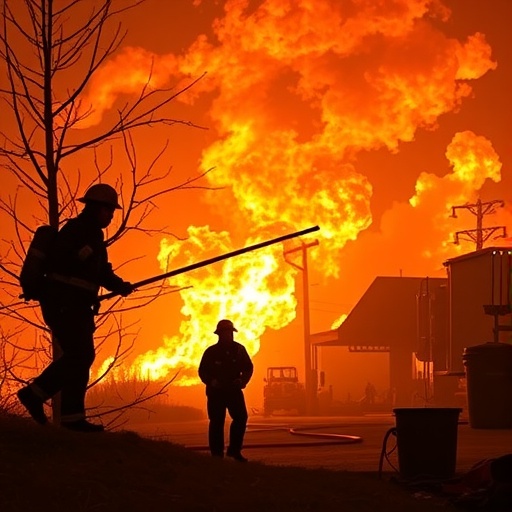
In a groundbreaking study poised to reshape our understanding of occupational hazards among frontline responders, researchers have unveiled a pioneering proteomics approach to identify molecular signatures of pollution exposure in firefighters. This seminal work, soon to appear in the Journal of Exposure Science & Environmental Epidemiology, delves into the complex biological aftermath of environmental toxins encountered during firefighting, shining a light on previously uncharted biochemical pathways and potential long-term health risks.
Firefighters routinely operate in environments laden with diverse chemical pollutants—ranging from combustion byproducts to industrial contaminants—that challenge the resilience of their respiratory and systemic systems. Despite rigorous protective measures, the persistent and cumulative exposure to such toxins has long been suspected to contribute to adverse health outcomes, including chronic respiratory conditions, cardiovascular disease, and cancer. However, capturing a definitive biological fingerprint of this exposure has remained elusive until now.
Leveraging advanced proteomics, the study pioneers the use of high-throughput mass spectrometry to profile thousands of proteins in blood samples collected from active duty firefighters. This comprehensive proteomic survey aims to distill a specific “pollution exposure signature” — a constellation of proteins whose abundance is altered in response to toxic environmental stimuli. By applying sophisticated bioinformatics and machine learning algorithms, the researchers were able to distinguish distinct proteomic patterns correlating with levels and duration of exposure.
What differentiates this study from prior environmental health research is its focus on proteomics as a dynamic readout of the body’s immediate and adaptive biochemical responses. Unlike traditional biomarkers, which often capture static or indirect effects, proteomic data illuminate alterations in cellular pathways, immune responses, and metabolic processes. This multidimensional data holds promise for not only diagnosing exposure but potentially predicting individual susceptibility to disease sequelae.
The team identified several proteins indicative of oxidative stress, inflammatory response, and xenobiotic metabolism that were consistently upregulated in firefighters relative to unexposed controls. These proteins include enzymes involved in detoxification processes, acute phase reactants, and signaling molecules related to cellular repair mechanisms. Their abundance patterns formed a robust composite signature, reflecting the complex milieu of airborne toxins encountered in firefighting environments.
Moreover, the study emphasizes temporal dynamics, tracking proteomic shifts in relation to recent fire events and cumulative years of service. Acute exposure to smoke and chemicals elicited immediate perturbations in proteins linked to immune activation and tissue remodeling. Conversely, chronic exposure was associated with sustained elevations in proteins implicated in fibrotic processes and metabolic dysregulation, potentially underlying longer-term pathologies documented in this population.
This proteomic signature offers a powerful new tool for occupational health surveillance, allowing for minimally invasive monitoring of firefighters’ biological burden from hazardous exposures. It could enable early identification of individuals at heightened risk for developing chronic illnesses, facilitating timely interventions or alterations in work protocols to mitigate harm. Such precision monitoring aligns with emerging priorities in occupational medicine advocating personalized health management strategies.
Intriguingly, the research also hints at the possibility that proteomic markers may reveal differential vulnerabilities based on demographic factors such as age, sex, and genetic predispositions. Parsing these interaction effects could inform targeted preventive measures, resource allocation, and policy decisions to protect subpopulations within the firefighting community more effectively.
Beyond immediate occupational health applications, the insights gained extend to environmental epidemiology at large. Firefighters serve as sentinel populations offering a window into the biological consequences of urban pollution and industrial emissions, which affect wider public health. Methods developed in this study may be adapted to monitor other exposed groups, including residents near industrial sites or traffic corridors.
From a technical standpoint, the integration of proteomics with exposure science represents a formidable advance. The researchers navigated immense analytical challenges, including controlling for individual variability, circadian influences on protein expression, and technical noise inherent in mass spectrometry. Rigorous validation with independent cohorts and cross-comparisons with existing exposure biomarkers bolstered confidence in their findings.
The research further underscores the transformative potential of combining omics technologies with traditional epidemiological frameworks. By layering molecular-level data atop meticulous exposure histories and clinical assessments, scientists can unravel the mechanistic underpinnings of environmental health risks, paving the way for novel therapeutic targets and prevention strategies.
While this investigation serves as a pilot, its implications are vast. Future studies expanding sample sizes and incorporating longitudinal designs will be critical to confirming causality and delineating cause-effect timelines. Integration with genomics, transcriptomics, and metabolomics could yield an even richer understanding of the biological imprint of toxic exposures.
In practical terms, equipping fire departments with tools to measure and interpret proteomic exposure signatures could revolutionize occupational health protocols. Routine blood monitoring might inform real-time risk assessments, guide personalized protective equipment usage, or prompt medical interventions. Such capabilities stand to materially improve health outcomes and reduce absenteeism and disability among firefighters.
As urbanization and industrial activities accelerate globally, the burden of environmental pollutants on essential workers intensifies. This study exemplary demonstrates how cutting-edge science can meet urgent societal needs, translating molecular discoveries into actionable health insights. The firefighters who safeguard our communities deserve nothing less than such unwavering scientific commitment to understanding and alleviating their invisible biological hazards.
Ultimately, this landmark proteomics study not only advances the frontier of environmental health research but also exemplifies the power of interdisciplinary collaboration spanning proteomics, bioinformatics, exposure science, and clinical epidemiology. Its findings chart a promising course toward precision occupational health surveillance and underscore the imperative of protecting those who risk their lives in hazardous environments.
Cite Scienmag News
Ophelia Keating. (April 14, 2026). Pilot Study Uncovers Pollution Signature in Firefighters. Scienmag. https://scienmag.com/pilot-study-uncovers-pollution-signature-in-firefighters/
Ophelia Keating. "Pilot Study Uncovers Pollution Signature in Firefighters." Scienmag, 14 April 2026, https://scienmag.com/pilot-study-uncovers-pollution-signature-in-firefighters/. Accessed 4 September 2026.
Ophelia Keating. "Pilot Study Uncovers Pollution Signature in Firefighters." Scienmag. April 14, 2026. https://scienmag.com/pilot-study-uncovers-pollution-signature-in-firefighters/


