

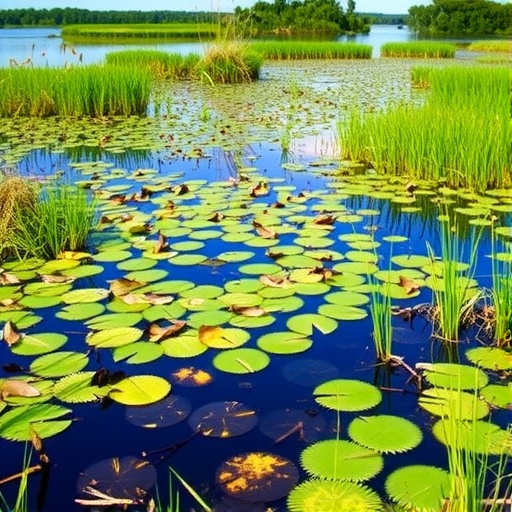
The ongoing discourse surrounding climate change and its multifaceted impacts has led researchers to investigate various ecosystems that could play a pivotal role in carbon management. Among the promising solutions are constructed wetlands, which have garnered attention as potential players in the global carbon cycle. Through a meticulous analysis, Wang, Qin, Liu, and colleagues shed light on whether different configurations of pilot-scale constructed wetlands act as carbon sources or carbon sinks. This critical research contributes to our understanding of how engineered ecosystems can mitigate environmental challenges.
In the realm of environmental science, constructed wetlands stand out as innovative solutions for wastewater treatment and ecological restoration. These systems utilize natural processes involving wetland vegetation, soil, and microbial activity to treat pollutants effectively. Yet, beyond their primary function, the role of these wetlands in carbon dynamics oscillates between sequestering carbon dioxide from the atmosphere and, potentially, releasing it back into the environment. The nuanced interplay between these dynamics is at the heart of the investigation by Wang and colleagues.
The researchers implemented a series of pilot-scale constructed wetlands employing different configurations to analyze their carbon dynamics. The study was meticulously designed, aiming to assess various factors that influence carbon storage and release. For instance, the design of the wetland, the types of substrates used, and the specific flora planted were systematically altered to understand their effects on carbon sequestration. The findings indicate that these factors significantly influence whether a wetland configuration acts as a carbon source or sink.
Initial observations revealed striking variations in carbon dynamics among the different wetland configurations. Certain designs demonstrated remarkable efficiency in capturing atmospheric CO2, effectively transforming these emissions into biomass through photosynthesis. This process enhances carbon storage within the wetland structure, illustrating the potential of such ecosystems in combating climate change. Conversely, some configurations unexpectedly emitted greenhouse gases, raising critical questions regarding their long-term viability as climate solutions.
The implications of these findings are significant for the future of constructed wetlands in carbon management. The ability of a wetland to sequester carbon is not solely dependent on the plants and soil; it also hinges on hydrology, nutrient availability, and microbial communities. Therefore, understanding the intricate web of interactions within these ecosystems is essential to optimizing their performance as carbon sinks. Wang and his team’s research underscores the importance of tailoring constructed wetlands to specific environmental contexts to maximize their carbon sequestration potential.
Moreover, the research highlights the urgency of investing in the right configurations for constructed wetlands. As climate change exacerbates environmental challenges, enhancing the carbon storage capacity of these systems can serve as a vital strategy to mitigate greenhouse gas emissions. The study advocates for a comprehensive approach, combining scientific rigor with on-ground applications, to align constructed wetland designs with climate action goals.
The environmental benefits extend beyond carbon storage. Constructed wetlands provide habitats for numerous organisms, contributing to biodiversity and improving overall ecosystem health. The biological processes within these systems facilitate the breakdown of organic pollutants, improving water quality while simultaneously providing crucial ecosystem services. The dual benefits of carbon management and ecological restoration represent a powerful case for the expansion of constructed wetlands as a design feature in urban and rural landscapes alike.
Wang and colleagues also drew attention to the socio-economic dimensions of constructed wetlands. Beyond their environmental role, these systems can offer cost-effective solutions for wastewater treatment, particularly in regions where traditional infrastructure is lacking. By utilizing local resources and engaging communities, the implementation of constructed wetlands can foster sustainable development, creating jobs and promoting environmental stewardship.
Further studies suggested that public awareness and policy support are critical for fostering the adoption of constructed wetlands. Policymakers must recognize the multifaceted benefits of these systems and create frameworks that encourage their integration into urban planning and water management strategies. Awareness campaigns can also educate communities about the importance of wetlands, promoting conservation efforts and enhancing participation in climate action initiatives.
Wang et al.’s research is also poised to inspire innovative technological advancements in the field. The ongoing exploration of constructed wetlands as carbon sinks could lead to the development of hybrid systems that combine natural processes with artificial enhancements, maximizing their efficiency and adaptability. Such research endeavors pave the way for future breakthroughs that can redefine how we approach carbon management and ecosystem restoration.
As awareness of the climate crisis continues to grow, the role of constructed wetlands in the global carbon cycle will become increasingly critical. The findings from Wang and his team illuminate the path forward, emphasizing the necessity of tailored approaches to maximize their potential as carbon sinks. The ongoing research promises to spur a broader movement towards embracing natural solutions in environmental management.
In conclusion, constructed wetlands embody a powerful intersection of science, engineering, and environmental stewardship. As we grapple with the pressing challenges posed by climate change, this research underscores the importance of innovative, nature-based solutions in our collective fight against global warming. The question of whether constructed wetlands serve as carbon sources or sinks is not just an academic inquiry; it is a vital consideration for the future of sustainable development and environmental resilience.
Ultimately, the work of Wang and colleagues will serve as a foundational reference for future studies in this area. By providing valuable insights into the carbon dynamics of constructed wetlands, this research reinforces the idea that effective environmental solutions must be grounded in scientific inquiry and contextual understanding. As we move forward, embracing the lessons learned from these findings will be essential in our quest for a sustainable and resilient future.
Subject of Research: The functionality of constructed wetlands as carbon sources or sinks.
Article Title: Are different configurations of pilot-scale constructed wetlands carbon sources or carbon sinks?
Article References: Wang, Y., Qin, H., Liu, T. et al. Are different configurations of pilot-scale constructed wetlands carbon sources or carbon sinks? ENG. Environ. 20, 58 (2026). https://doi.org/10.1007/s11783-026-2158-0
Image Credits: AI Generated
DOI: 20 January 2026
Keywords: Constructed wetlands, carbon sinks, climate change, ecological restoration, carbon dynamics.


