


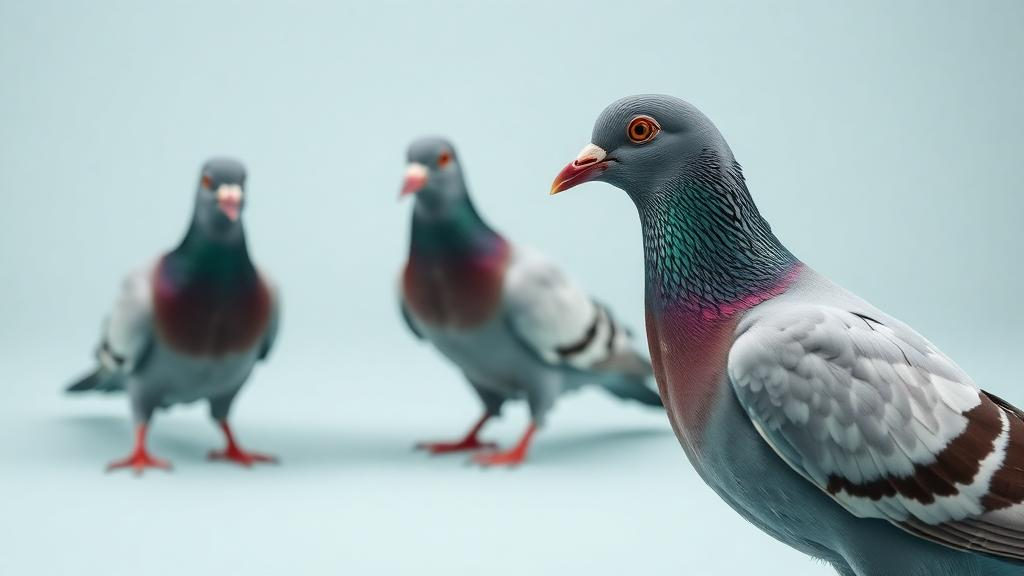
Pigeons have long been celebrated for their astonishing visual prowess, from memorizing hundreds of photographs to distinguishing paintings by different artists. But when an object offers several clues at once — its color, its shape, its texture — which feature does a pigeon’s brain actually listen to? A new study published in the journal Animal Cognition offers a striking answer: when color and shape are both available, pigeons lean overwhelmingly on color, and their visual system appears to reorganize itself accordingly. The research, conducted by a team at Zhengzhou University working with a colleague at Tsinghua University, combined careful behavioral training with direct neural recordings to reveal a processing bias that may say as much about efficient brain design as it does about bird cognition.
The question the researchers set out to answer is deceptively simple, yet it touches one of the deepest issues in visual neuroscience. In the natural world, objects rarely advertise a single identifying feature. A ripe berry is both red and round; a predator’s silhouette is both dark and shaped in a particular way. When multiple cues redundantly point to the same answer, an animal could in principle combine them all, weight them equally, or shortcut the whole computation by relying on whichever cue is easiest to extract. Humans and other mammals show complex, context-dependent weighting of such redundant cues. Whether birds — whose visual system is built along an entirely different anatomical plan — follow a similar logic, or adopt a simpler dominance rule, has remained unclear.
Earlier work had already hinted that pigeons prefer color over shape when classifying visual targets. What remained unknown was whether color merely takes the lead while shape still contributes meaningful discriminative information in the background, or whether shape is effectively sidelined once color is on the scene. Disentangling these possibilities required an experimental design in which the two types of information could be separated, combined, and compared across the same animals — and, crucially, a way to watch the brain respond as each kind of cue arrived.
The team’s approach was a transfer paradigm built around single-cue and multi-cue discriminations. Pigeons were first trained on tasks in which only one type of information was useful: some birds learned to classify images using color alone, while others had to rely on shape alone. Once these single-cue habits were firmly established, the birds were shifted to multi-cue tasks in which color and shape appeared together as redundant signals, both pointing toward the same classification response. This transition is the heart of the experiment. If a pigeon trained on color alone suddenly performs even better when shape is added, that suggests shape is being recruited as extra evidence. If performance stays flat, color was already doing the heavy lifting. Conversely, a shape-trained bird that improves when color joins the display would reveal that color carries information the bird can exploit immediately.
The behavioral results were asymmetric in a way that speaks volumes. Moving pigeons from the single-color task to the combined color-plus-shape task produced no measurable change in recognition accuracy — the birds were already performing at a level that the additional shape information could not improve. Moving them from the single-shape task to the multi-cue task, however, produced a significant boost in accuracy. The pattern indicates that color served as the primary behavioral driver of object recognition in these tasks, while shape contributed little detectable benefit once color was present. In other words, the pigeons did not behave like statisticians averaging two independent sources of evidence; they behaved like animals that had found one sufficient answer and saw little reason to look further.
What makes the study more than a behavioral curiosity is its second, neurophysiological layer. While the birds performed the tasks, the researchers recorded local field potentials — the summed electrical activity of populations of neurons — from the entopallium, the bird brain’s principal station for processing visual object information. The entopallium is the avian counterpart of structures in the mammalian visual pathway that support object recognition, making it the natural place to look for a neural signature of cue preference. If pigeons genuinely privilege color, that bias should leave traces in the strength and coordination of the entopallial response.
It did. At most of the recording sites, the local field potential responses were stronger for color cues than for shape cues, a neural asymmetry that mirrors the behavioral hierarchy. Even more intriguing was what happened to functional connectivity — the degree to which activity at different sites rises and falls together. When pigeons viewed multi-cue images, the local functional connectivity within the entopallium was less dense than when they viewed single-cue images. This counterintuitive finding suggests that when one dominant cue is sufficient, the brain may actually relax the coordinated communication that a harder, multi-feature computation would demand. Rather than integrating two streams of information and paying the neural cost of doing so, the color-dominant system appears to streamline its activity — an economy of processing that fits the idea that redundancy invites efficiency rather than elaboration.
The authors interpret this color preference as a potentially efficient strategy: when one cue is enough to classify an object accurately, relying primarily on that cue saves computational effort without sacrificing performance. There is an appealing ecological logic to this. Color in nature is often a fast, high-contrast signal — ripe versus unripe fruit, warning coloration, the flush of blood in a threat display — and a foraging or predator-avoiding bird may benefit from a visual system that locks onto such signals quickly. The new data add a mechanistic dimension to that intuition, showing that the preference is not just a habit of responding but is reflected in the raw amplitude of the brain’s visual response and in the architecture of its local communication.
The study also carries broader implications for how scientists think about avian intelligence. Birds achieve object recognition with a forebrain organization radically different from the mammalian cortex, yet they solve visual classification problems with a flexibility that sometimes rivals primates. Findings like these show that the strategies birds bring to such problems are not simply scaled-down versions of mammalian ones; they can exhibit their own characteristic biases, shaped by the statistics of natural scenes and the economics of neural processing. Understanding when and why a brain chooses to ignore redundant information — rather than exploit it — is a question that reaches beyond pigeons, informing models of attention, cue integration, and efficient coding in any visual system, including our own and those of artificial agents designed to mimic them.
Funded by the National Natural Science Funds of China, the China Postdoctoral Science Foundation, and the Science and Technology Research Project of Henan Province, the work is published open access, allowing researchers anywhere to examine the full behavioral and electrophysiological evidence. For now, the takeaway is vivid and a little humbling: the pigeon pecking at a screen in a laboratory is not weighing every scrap of information available to it. It has made up its mind about what matters — and in the world of these birds, at least under these conditions, color rules.
Subject of Research: Color-dominant visual object recognition and cue redundancy processing in pigeons
Article Title: Color-dominant processing in pigeon object recognition: behavioral and entopallial evidence from redundant-cue transfer tasks
Article References: Niu, X., Liu, R., Zhu, M., Peng, Y., Wang, Q., & Zhang, X. (2026). Color-dominant processing in pigeon object recognition: behavioral and entopallial evidence from redundant-cue transfer tasks. Animal Cognition. https://doi.org/10.1007/s10071-026-02113-w
Image Credits: AI Generated
DOI: 10.1007/s10071-026-02113-w
Keywords: pigeons, object recognition, color perception, shape perception, redundant visual cues, entopallium, local field potentials, animal cognition, visual neuroscience, cue transfer tasks, bird vision, functional connectivity
Cite Scienmag News
Cassandra Pierce. (October 12, 2026). Pigeons Trust Color Over Shape When Recognizing Objects, Brain Recordings Reveal. Scienmag. https://scienmag.com/pigeons-trust-color-over-shape-when-recognizing-objects-brain-recordings-reveal/
Cassandra Pierce. "Pigeons Trust Color Over Shape When Recognizing Objects, Brain Recordings Reveal." Scienmag, 12 October 2026, https://scienmag.com/pigeons-trust-color-over-shape-when-recognizing-objects-brain-recordings-reveal/. Accessed 12 October 2026.
Cassandra Pierce. "Pigeons Trust Color Over Shape When Recognizing Objects, Brain Recordings Reveal." Scienmag. October 12, 2026. https://scienmag.com/pigeons-trust-color-over-shape-when-recognizing-objects-brain-recordings-reveal/


