


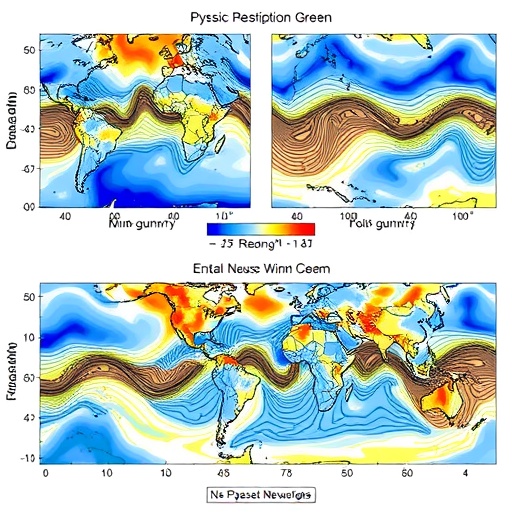
A new study published in Communications Earth & Environment reports a physics-guided deep learning system designed to forecast wind speed across space and time with quantified uncertainty. The work, led by Wang, Zhang, and colleagues, tackles a long-standing challenge in atmospheric prediction: models that fit historical data often fail to communicate how confident they are when conditions shift.
The researchers introduce a physics-guided neural network that does more than learn patterns from wind observations. It embeds physical constraints into the training process, encouraging the model’s predictions to remain consistent with governing principles relevant to wind dynamics. This strategy aims to reduce the “black-box” behavior typical of purely data-driven networks.
At the core of the approach is an uncertainty evolution mechanism. Instead of providing a single deterministic estimate, the system tracks how prediction uncertainty changes as forecasts extend forward in time and spread across spatial grids. This allows the model to express not only what it expects, but also how its expectations degrade—or sharpen—under evolving conditions.
For spatiotemporal wind forecasting, the method integrates uncertainty modeling directly into the neural architecture. The authors describe how uncertainty is propagated and updated across sequences, producing uncertainty maps that can be compared with real-world variability. Such representations are especially valuable for operations that require risk-aware decisions, from energy dispatch to wind farm maintenance planning.
The study emphasizes that physics guidance and uncertainty evolution work synergistically. Physics constraints help stabilize learning, while uncertainty dynamics provide a diagnostic lens for reliability. Together, they help address scenarios where environmental signals are noisy, sparse, or partially observed.
In practical terms, the model is evaluated on spatiotemporal wind speed prediction tasks, demonstrating improved predictive behavior relative to conventional baselines. While performance depends on data availability and atmospheric regimes, the key advance is the ability to forecast with calibrated uncertainty rather than outputting confidence-free predictions.
The authors argue that uncertainty-aware forecasts can improve downstream workflows by enabling threshold-based alerts and probabilistic assessment. For example, operators could weigh the likelihood of low wind speed outcomes differently than high wind events, guided by model-derived uncertainty rather than arbitrary error assumptions.
Beyond wind, the framework could be adapted to other geophysical variables that evolve in time and space, including temperature, precipitation-related proxies, or pollutant dispersion. By uniting physical realism with explicit uncertainty trajectories, the approach points toward more trustworthy weather-adjacent machine learning.
Overall, this “viral science news” breakthrough spotlights a shift from accuracy-only forecasting toward decision-ready prediction, where confidence is generated by the model itself—evolving alongside the atmosphere it attempts to emulate.
Cite Scienmag News
Blake Davidson. (July 28, 2026). Physics-Guided Neural Network Tracks Uncertainty Evolution for Spatiotemporal Wind Forecasts. Scienmag. https://scienmag.com/physics-guided-neural-network-tracks-uncertainty-evolution-for-spatiotemporal-wind-forecasts/
Blake Davidson. "Physics-Guided Neural Network Tracks Uncertainty Evolution for Spatiotemporal Wind Forecasts." Scienmag, 28 July 2026, https://scienmag.com/physics-guided-neural-network-tracks-uncertainty-evolution-for-spatiotemporal-wind-forecasts/. Accessed 4 September 2026.
Blake Davidson. "Physics-Guided Neural Network Tracks Uncertainty Evolution for Spatiotemporal Wind Forecasts." Scienmag. July 28, 2026. https://scienmag.com/physics-guided-neural-network-tracks-uncertainty-evolution-for-spatiotemporal-wind-forecasts/


